On 29 May 1912 two boys from the village of Mala Pereshchepyna, near Poltava in central Ukraine, were playing on a sandy hill when one of them felt something hard underfoot. Scraping away the sand, they found the wide neck of a large vessel and pulled out a gilded jar and several gold cups. The next day the local constable arrived with diggers. As they opened the hill, villagers crowded round, snatching pieces as souvenirs and tearing thin gold foil. A museum official who saw the aftermath described people trampling fragments underfoot. Searches recovered what they could, and the treasure went to the Imperial Hermitage in Saint Petersburg, where it remains.
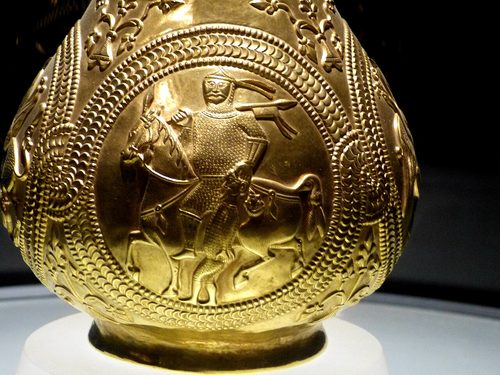
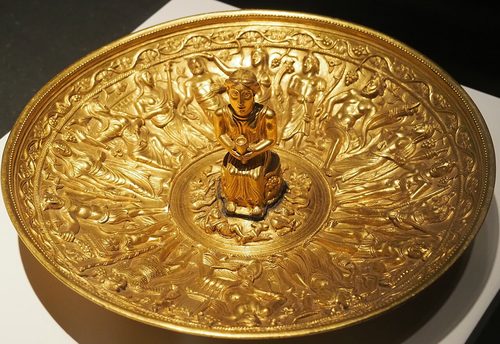
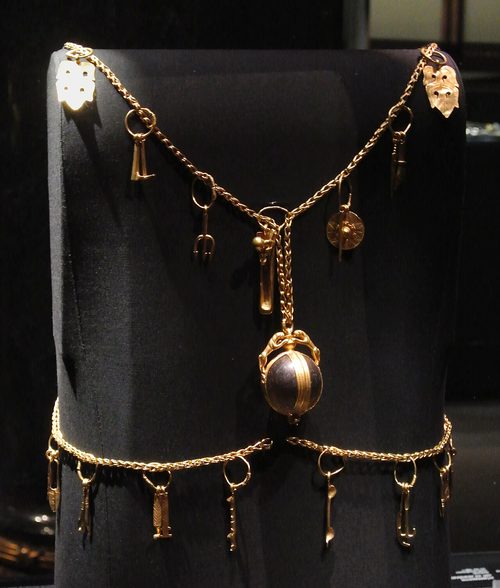
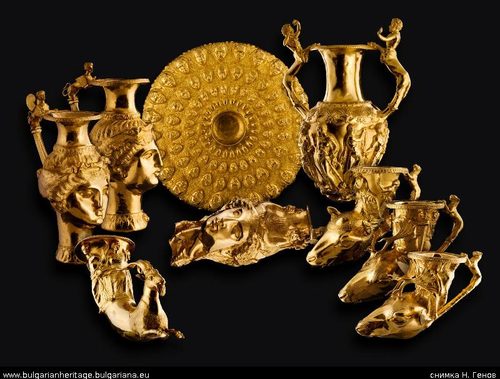
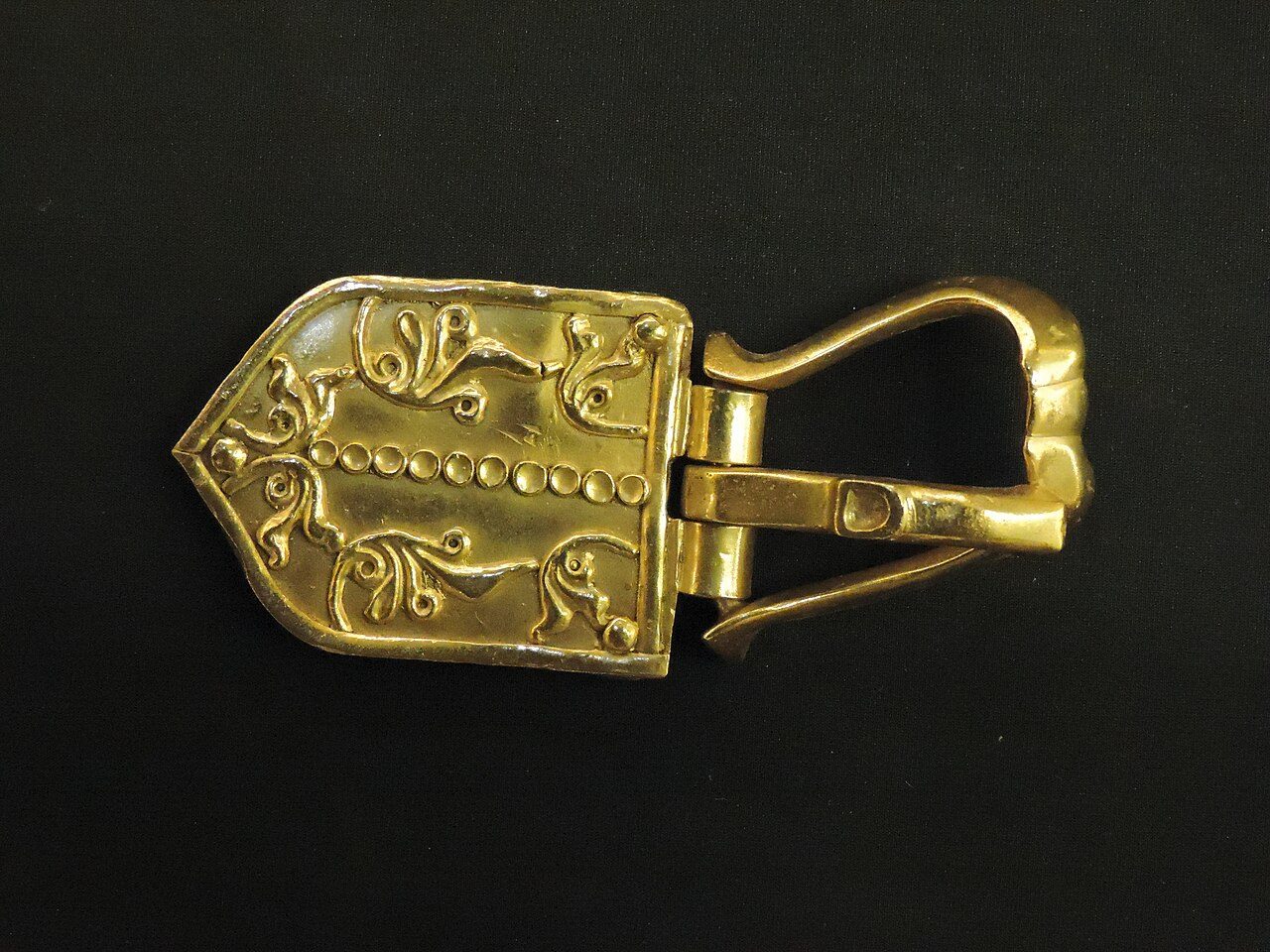
It is the richest find of its age in eastern Europe. More than 800 objects were recovered, with over 20 kilograms of gold and around 50 kilograms of silver. There are 35 gold and silver vessels, among them a Sasanian silver dish showing the 4th-century Persian king Shapur II and a Byzantine dish inscribed for Paternus, a bishop of Tomis on the Black Sea in the early 6th century. There is a gold rhyton and the fittings of a second, a staff with a gold casing, an iron sword with gold-covered hilt and scabbard, belt sets, a torc, bracelets and rings set with amethysts, sapphires, garnets and emeralds, and square gold plaques that once covered a wooden structure. Sixty-nine Byzantine gold coins run from the emperor Maurice to Constans II.
Gold signet rings in the hoard bear Greek monograms. One has often been read as naming Kubrat, with the Byzantine rank of patrikios. Kubrat was the ruler of Old Great Bulgaria, a steppe state north of the Black Sea, in the first half of the 7th century. Byzantine writers record that he was baptised in Constantinople and honoured by the emperor Heraclius, and the Hermitage suggests the sword may have been part of a diplomatic gift from Heraclius in the 630s.
From soon after the find, many scholars have treated the site as Kubrat's grave. Fragments of oak beams, gold-woven silk and possibly bone suggested a burial. Others note that some objects seem too late for a ruler who probably died in the middle decades of the 7th century, and prefer to see the deposit as a memorial offering or treasure laid down by his successors, or attribute it to the Khazars who took over the region. In 2019 the gold-covered sword travelled outside Russia for the first time, to an exhibition in Sofia, a sign of how much the treasure means to Bulgaria.
Because it was dug out in a scramble rather than excavated, much context was lost, and it is not certain that every piece was recovered. The treasure is a key reference for the art of the steppe elites who sat between Byzantium, Persia and the nomad world, and it has given its name to the Pereshchepina culture of the region.
Highlights
An iron sword with ring pommel, its grip and scabbard sheathed in gold, possibly a Byzantine diplomatic gift to Kubrat; the Hermitage counts it among its chief treasures.
Gold signet rings with Greek monograms, one widely read as 'Kubrat, patrikios'.
A Byzantine silver dish inscribed for an early 6th-century bishop of Tomis (modern Constanța).
A silver plate with a portrait of the Persian king Shapur II, already old when it was buried.
Byzantine gold solidi from Maurice to Constans II, strung together as a necklace.
What is in it
Gold and silver vessels including Byzantine and Sasanian plate, a gold-covered sword and other weapons, belt fittings, jewellery set with stones, gold coins of Byzantine emperors, and gold plaques from a wooden structure.
Size: more than 800 objects. Weight: over 21 kg of gold (some sources say 25 kg) and about 50 kg of silver (gold and silver).
| Item | Number | Notes |
|---|---|---|
| Vessels | 35 | 16 of gold and 19 of silver, including a rhyton, a Sasanian dish with Shapur II and a Byzantine dish of a bishop of Tomis |
| Byzantine gold coins | 69 | Maurice (582-602) to Constans II (641-668), some strung as a necklace |
| Weapons | several | An iron sword with gold-covered hilt and scabbard, fragments of other swords and daggers |
| Jewellery and rings | dozens | A torc, earring, seven bracelets, seven rings with gems, signet rings with Greek monograms |
| Belt fittings, plaques and appliqués | hundreds | Gold belt sets, dress appliqués and square plaques from a wooden funeral structure |
Photographs
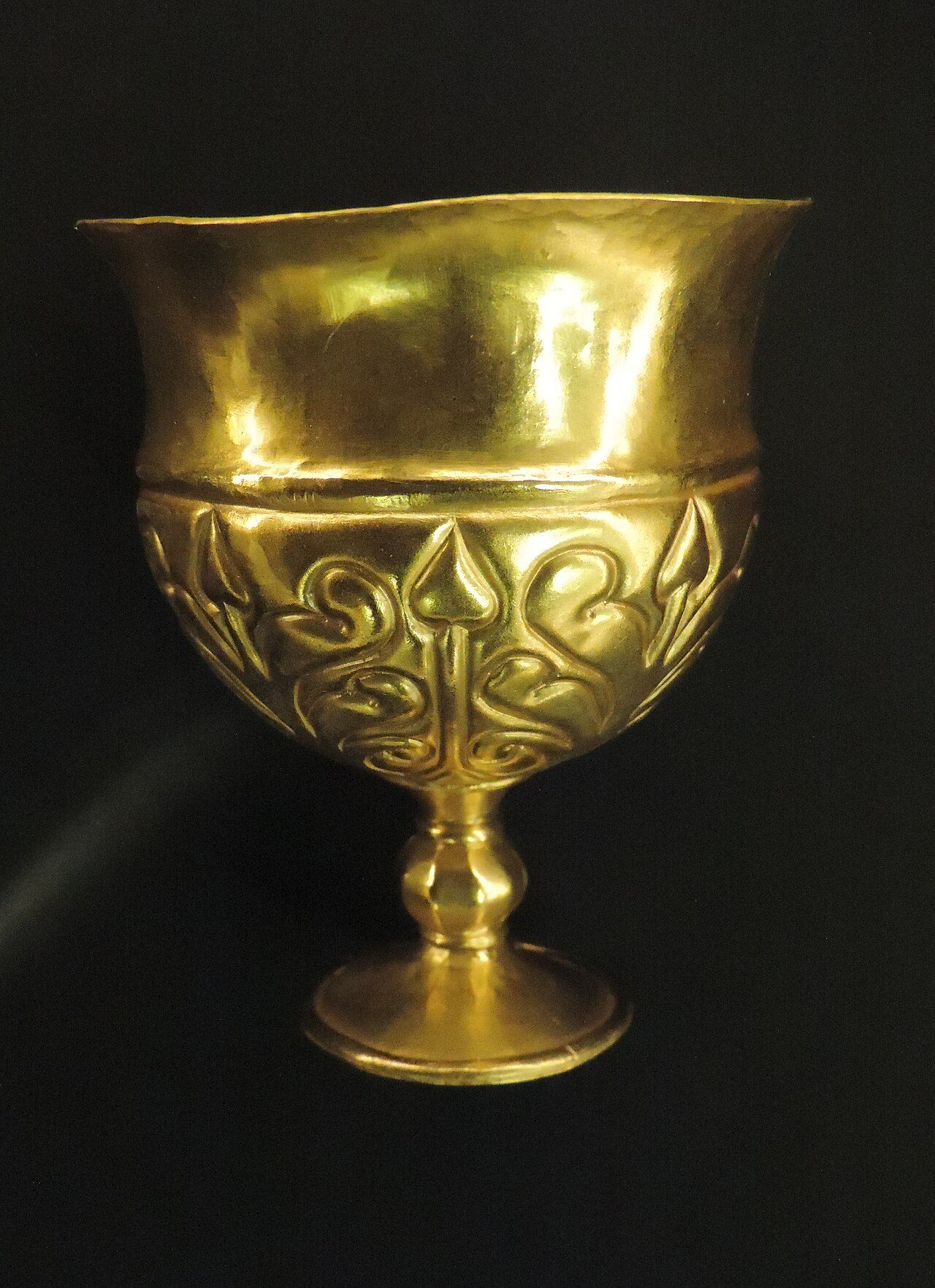
Photo: Vassia Atanassova - Spiritia, CC BY-SA 4.0, via Wikimedia Commons
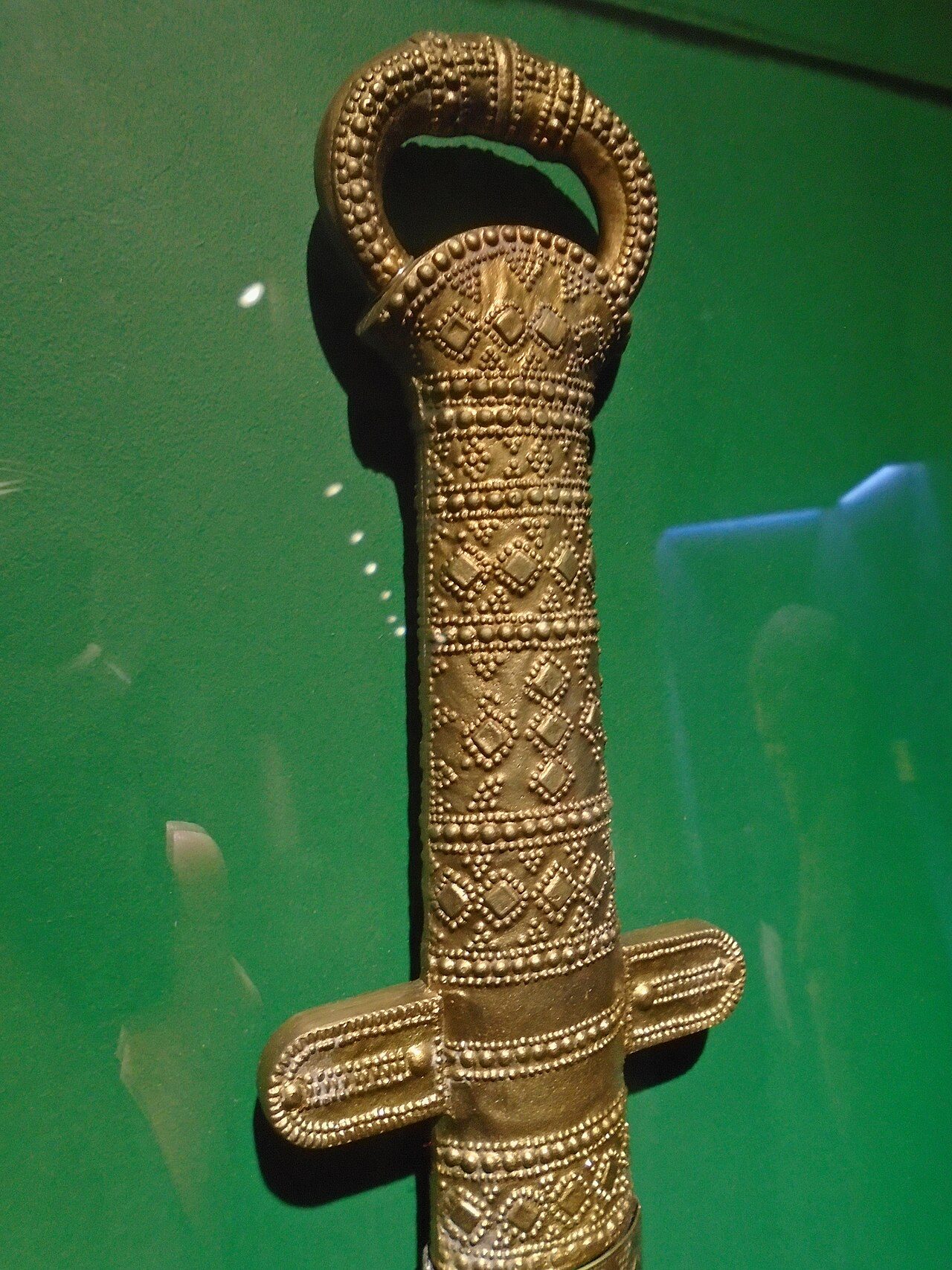
Photo: Vyacheslav Kirillin, CC BY-SA 4.0, via Wikimedia Commons
How it is dated
The coins give a terminus post quem: the latest are of Constans II, struck from the 640s, which puts the deposit after about 646. Some objects are dated by style to the 670s, so the deposit is usually placed between about 650 and 680.
What happened after the find
The find was seized by the local authorities in 1912, with searches to recover pieces taken by villagers, and handed to the Hermitage. Ukraine has no current arrangement for its return.
Where sources differ
- Gold weight: English Wikipedia says over 21 kg; Russian and Ukrainian Wikipedia say over 25 kg (including electrum).
- Object count: 'more than 800' in most sources; a Ukrainian account says about a thousand were dug out.
- Discovery story: English Wikipedia says a shepherd boy fell into the pit; Ukrainian Wikipedia says two boys found a vessel in the sand while walking.
- Whether the site is Kubrat's grave, a memorial deposit or a treasure is disputed; the monogram reading 'Kubrat patrikios' is widely but not universally accepted.
- Current display: I could not reach the Hermitage site to confirm which gallery shows the treasure.
- Number of monogram rings: Commons shows three ('The rings of Kubrat'); the text sources speak of 'the ring' or 'rings' without a number.
Questions
Where is the Pereshchepina Treasure now?
Almost all of it is in the State Hermitage Museum in Saint Petersburg, which received it in 1912. Replicas of key pieces are shown in Bulgarian museums.
Is the Pereshchepina Treasure the grave of Khan Kubrat?
Possibly. A ring monogram has been read as Kubrat's name and title, and remains of timber and silk suggest a burial. But some objects may postdate his death, so many scholars call it Kubrat's treasure rather than his grave.
How much gold is in the Pereshchepina Treasure?
Sources give more than 21 kg, some 25 kg, of gold, plus about 50 kg of silver, in over 800 objects.