In October 1963 a builder in Villena, in the province of Alicante, noticed a heavy metal ring in a load of gravel and assumed it was a part from a lorry. It passed through several hands before reaching a local jeweller, who recognised a solid gold bracelet and called the town's archaeologist, José María Soler. When a second bracelet with the same earthy crust appeared in November, Soler traced the gravel to a dry riverbed a few kilometres from town.
On 1 December 1963 his small team dug there all day without result. At five in the afternoon, as they were packing up, one of them struck two more bracelets and the rim of a pottery jar. Rather than cover the find and risk leaving it overnight, Soler sent for a photographer, recorded the jar in place by lamplight and carried it back to town in a taxi. Inside, packed together, were the bowls, bottles and bracelets of the Treasure of Villena.
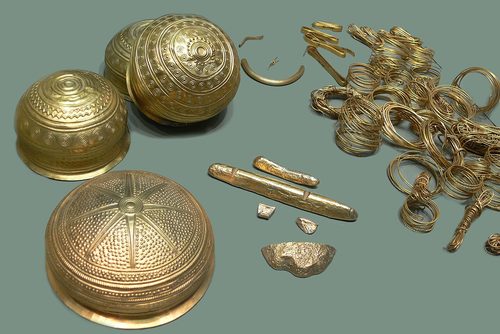
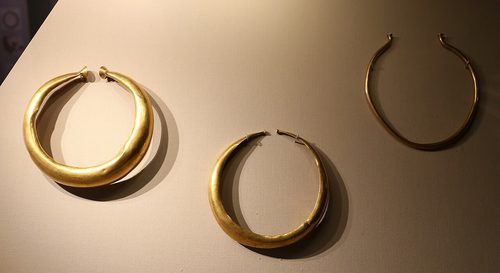
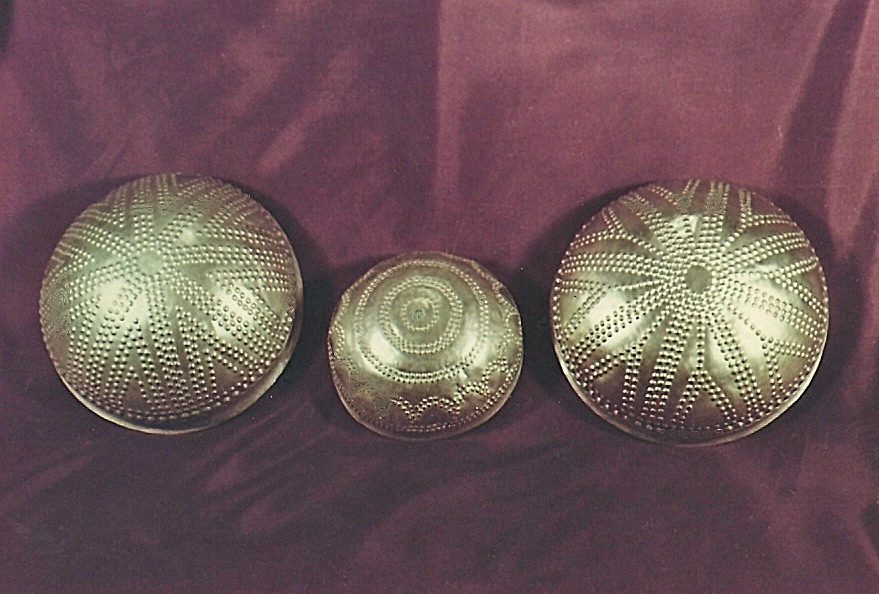
The hoard holds 59 objects weighing 9.75 kg, about 9.1 kg of it gold. Eleven gold bowls, beaten from sheet and covered with rows of raised dots punched from inside, make up the finest set of Bronze Age gold tableware in Spain. With them are five bottles of the same shape, two in gold and three in silver, and 28 heavy gold bracelets, most of them cast and then moulded and pierced into crenellated bands. Smaller pieces include a button of gold set with amber and fragments that may have come from a sceptre.
Two small objects are of iron: a bracelet and a gold-covered fitting. They are among the oldest iron objects found in the Iberian Peninsula, from a time when iron was rare enough to be treated as a precious metal, and analysis has found nickel levels consistent with meteoritic iron. Their presence alongside gold helps place the hoard late in the Bronze Age, roughly 1300 to 1000 BC.
The jar itself is a local type like pottery from the nearby hilltop settlement of Cabezo Redondo, where a smaller gold hoard and evidence for a goldsmith have also been found. Soler argued that the treasure was made in the area, the product of a wealthy regional centre rather than imported. Who buried it and why is unknown; the quantity of gold suggests the wealth of a ruling group, kept in a single container. Its gold bowls have parallels as far away as the Eberswalde hoard in Germany.
For six decades the treasure was the pride of Villena's museum, declared a Bien de Interés Cultural in 2005 and lent to exhibitions in Madrid, Alicante, Tokyo and Kyoto. Early on 27 August 2026, thieves broke into the Museo de Villena and in about four minutes took most of the gold. The silver bottles, one bracelet and some fragments were left behind. Police are investigating, and the case has raised fears that the pieces could be melted down for their metal.
Highlights
Eleven hemispherical bowls of beaten gold, together about 3.5 kg, decorated with raised dots in geometric bands.
Five small bottles of identical form, two of gold and three of silver, decorated with vertical and horizontal ribs.
One of the most elaborate of the 28 heavy gold bracelets, moulded and pierced into a band of crenellated ridges.
A bracelet and a gold-covered fitting of iron, among the earliest iron objects in Iberia, made when iron counted as a precious metal.
What is in it
Eleven gold bowls, two gold and three silver bottles, 28 gold bracelets and one of iron, buttons or fittings of gold with iron and amber, and small pieces perhaps from a sceptre, packed inside a pottery jar.
Size: 59 objects (66 pieces). Weight: 9,754 g in all, about 9.1 kg of it gold.
| Item | Number | Notes |
|---|---|---|
| Gold bracelets | 28 | 5,170 g; most moulded and pierced, average about 184 g each |
| Gold bowls | 11 | 3,508 g; beaten sheet decorated with repoussé dots |
| Bottles | 5 | 2 gold (381 g), 3 silver (557 g) |
| Iron pieces | 2 | an iron bracelet and a gold-covered iron fitting, among the oldest iron objects from Iberia; analysis suggests meteoritic iron |
| Other | 13 | a gold and amber button and small fragments, perhaps from a sceptre |
Photographs
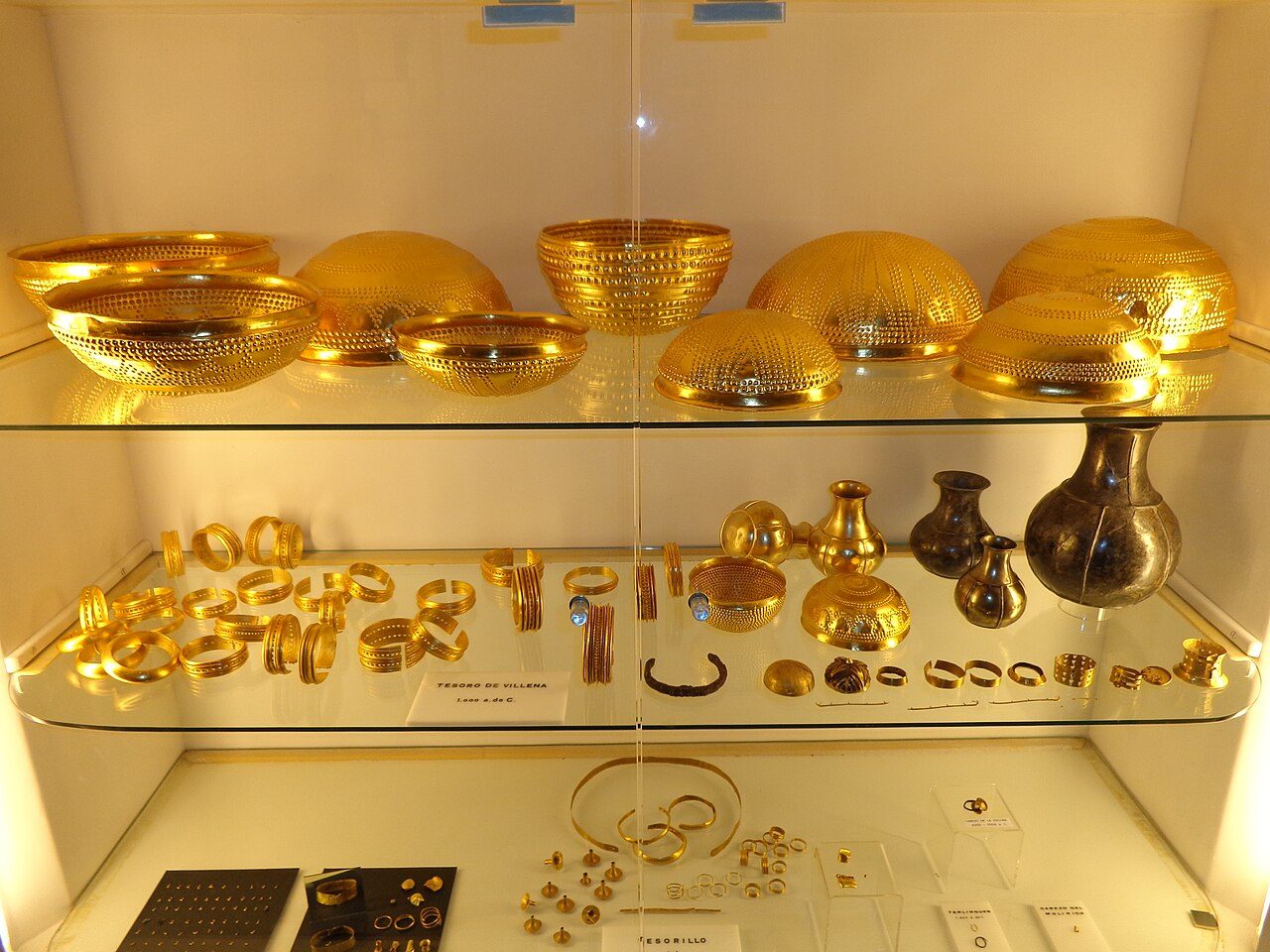
Photo: Superchilum, CC BY-SA 4.0, via Wikimedia Commons
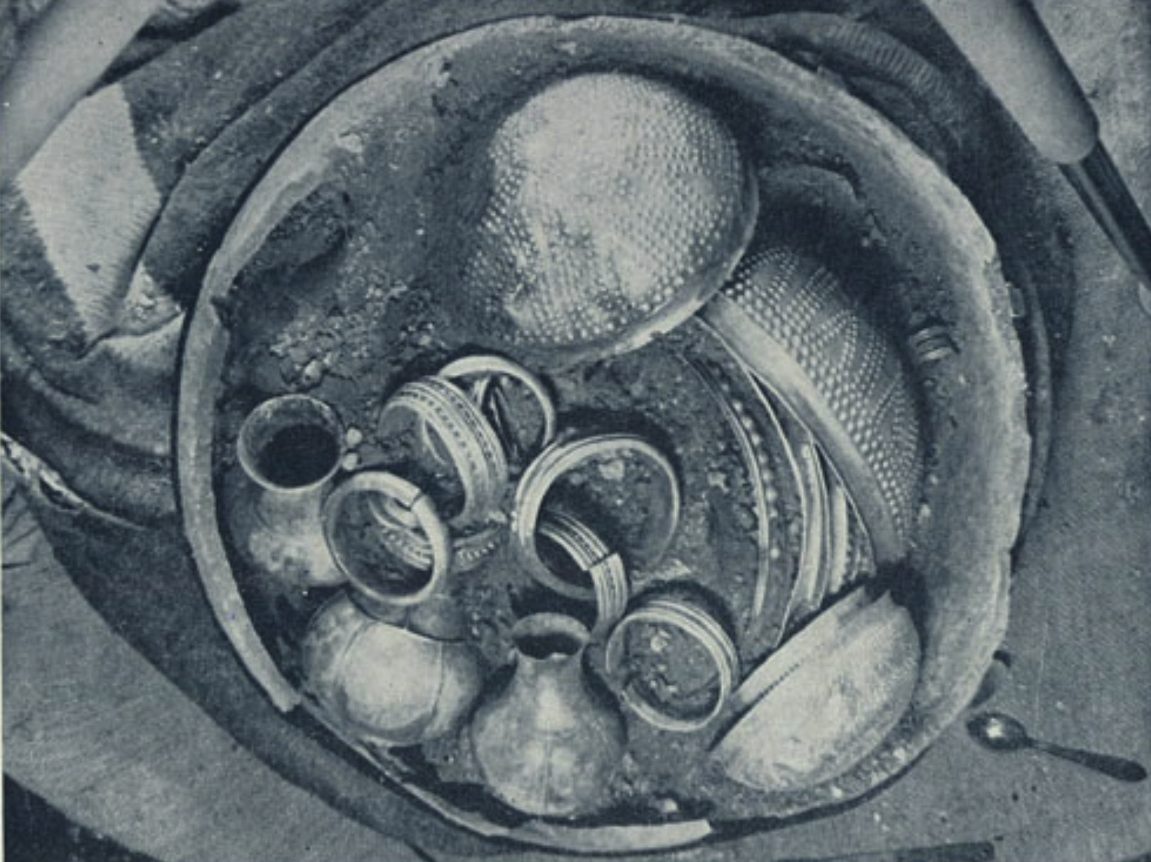
Photo: Enrique Íñiguez Medina, CC BY-SA 3.0, via Wikimedia Commons
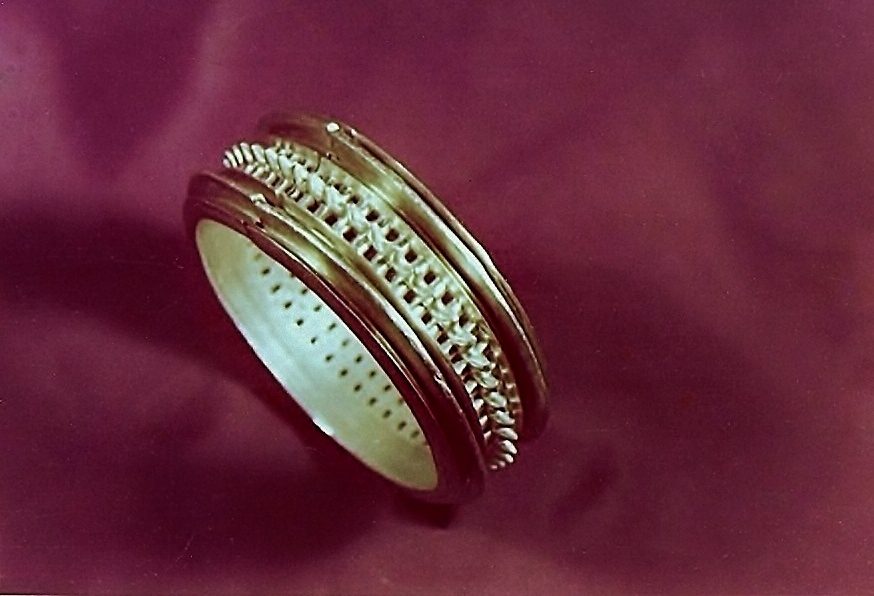
Photo: Enrique Íñiguez Medina, CC BY-SA 3.0, via Wikimedia Commons
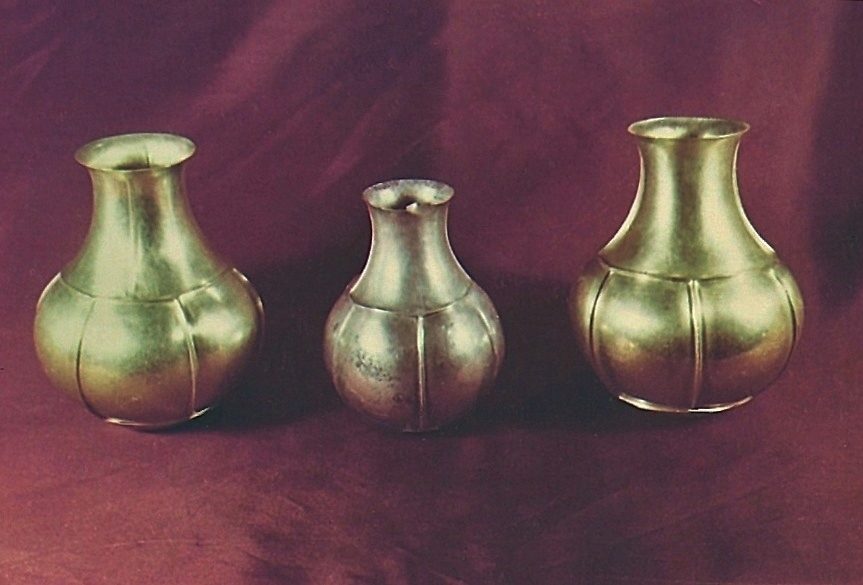
Photo: Enrique Íñiguez Medina, CC BY-SA 3.0 es, via Wikimedia Commons
How it is dated
There is no radiocarbon date for the hoard. It is dated by comparing its objects with other Bronze Age finds in Iberia and Europe and by the early iron pieces. Soler placed it around 1000 BC; most accounts give about 1300-1000 BC.
What happened after the find
The treasure was recovered by the town's archaeologist following a judicial inquiry into the stray bracelets and has belonged to the town museum since 1963. It was declared a Bien de Interés Cultural on 1 April 2005. After the 2026 theft, Spanish courts opened inquiries into whether the museum's security was adequate.
Where sources differ
- Date: English Wikipedia gives c. 1300-1000 BC; Soler and Spanish Wikipedia give around 1000 BC (10th century BC).
- Distance from Villena: about 5 km (Spanish Wikipedia) versus about 12 km (English Wikipedia).
- Piece count: 59 objects (Spanish and English Wikipedia) or 66 pieces (France 24, Spanish Wikipedia's piece table).
- Exactly which pieces were stolen and whether any have been recovered could not be confirmed after late September 2026.
- Spanish Wikipedia's infobox gives the discovery year as 1964, but its text and all other sources give 1963.
Questions
Was the Treasure of Villena stolen?
Yes. Early on 27 August 2026 thieves broke into the Museo de Villena and in about four minutes took most of the gold pieces. The silver bottles, a bracelet and some fragments remained. The Guardia Civil is investigating.
How much gold is in the Treasure of Villena?
The 59 objects weigh 9,754 g in total, of which about 9.1 kg is gold; the rest is silver, iron and amber.
How old is the Treasure of Villena?
It is Late Bronze Age, usually dated about 1300-1000 BC. The inclusion of iron, then a rare and precious metal, helps place it near the end of the Bronze Age.
Sources
- Tesoro de Villena (Spanish Wikipedia)
- Treasure of Villena (Wikipedia)
- Robo a museo de España: parte del Tesoro de Villena fue extraído en tan solo cuatro minutos (France 24, 29 August 2026)
- La Justicia abre diligencias por el robo del Tesoro de Villena (Euronews, 29 September 2026)
- Wikidata Q1488571 (CC0)