In the late 1970s the gravedigger at the church of St Mary Magdalene in Pentney, a village in the Nar valley of west Norfolk, struck a disc of metal while opening a new grave. Five more came out beside it. He passed them to the rector, who, not recognising what they were, put them in the parish chest. There they stayed until a new rector came across them a few years later and took them to Norwich Castle Museum. The British Museum identified them as Anglo-Saxon silver disc brooches of the 9th century and of national importance.
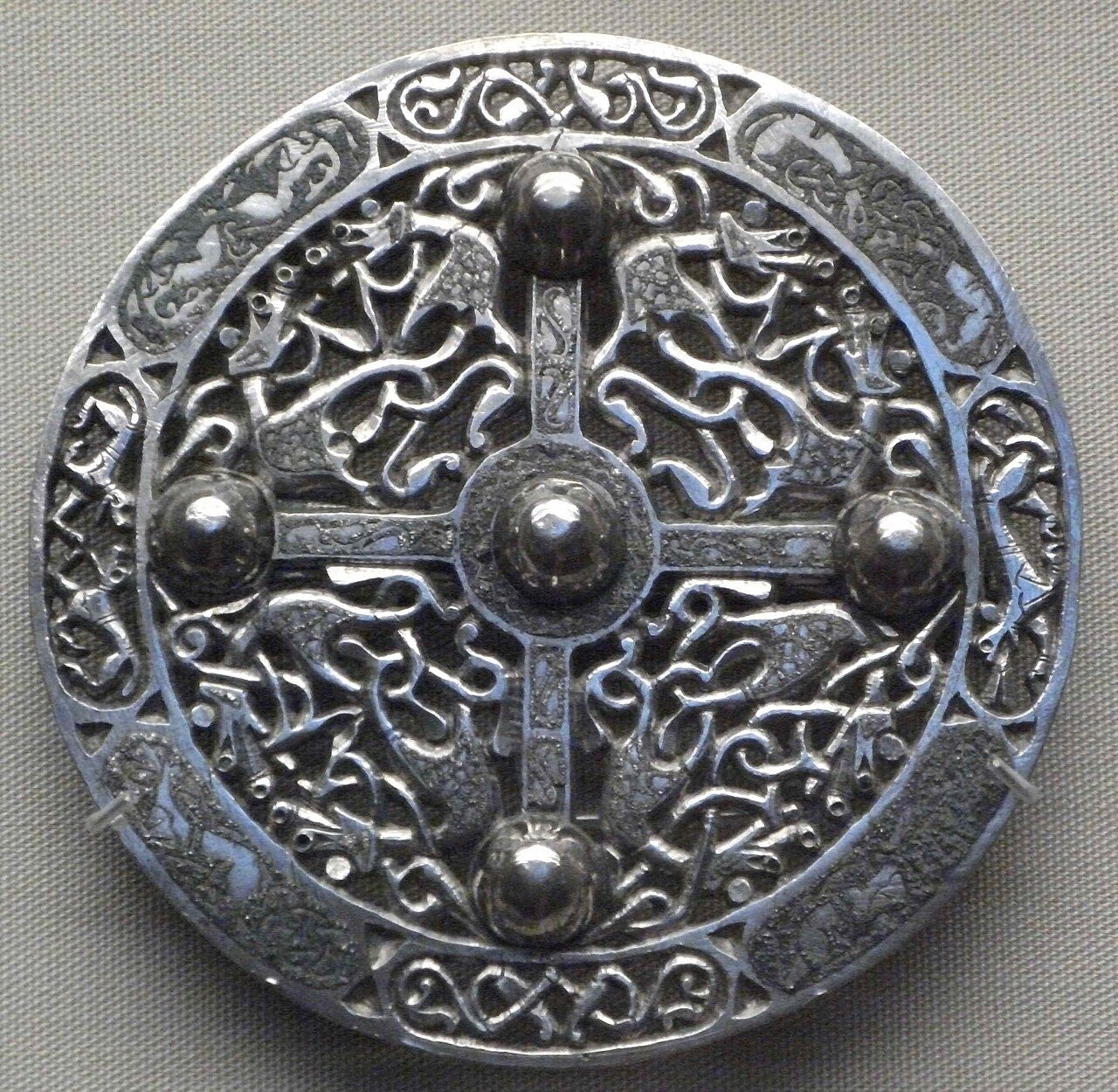
There are six brooches, all round, all openwork and all built around a cross-shaped arrangement of bosses. The largest, 10.2 centimetres across, is a superb piece: a ring of eight panels filled with intertwined creatures surrounds a centre of stylised animals and plants, with the background cut away and the silver picked out with black niello. Four others form two pairs that are similar in layout but differ in detail, one pair with scalloped, beaded edges and the other with bolder panels of niello beasts. The sixth, only 6.1 centimetres across, is made differently, with a silver openwork face riveted over a gilded copper-alloy plate, and is decorated mostly with plant scrolls.
All six belong to the family of ornament called the Trewhiddle style, after the Cornish hoard of 1774, with its small engraved animals, foliage and niello. The five larger brooches are dated on style to about 800-840 and appear to come from one workshop; the smallest is a little earlier, from the late 8th century. It is also the only one with signs of wear, and its pin is damaged. The others still have intact pins, springs and hinges, and look almost unused. When the hoard was found it doubled the number of late Anglo-Saxon silver disc brooches known.
Why six fine brooches ended up in a churchyard is unclear. The most common suggestion is that they were hidden in the middle of the 9th century, when Viking armies were active in East Anglia; the Danish Great Army wintered at Thetford in 869-870 and killed King Edmund. Others prefer to leave the question open, since there are no coins to fix the date and nothing about the find spot shows whether the burial was hurried, deliberate or connected with an earlier church.
In 1980 archaeologists returned to the grave site, reopened it and searched it with metal detectors. They recovered a single silver boss, probably one of those missing from the paired brooches, and established that the hoard had lain less than about 1.5 metres down. The brooches were declared treasure trove at an inquest and acquired by the British Museum, with a reward paid to the finder, who gave part of it to the church.
Highlights
A 10.2 cm silver disc with eight outer panels of interlaced creatures and a niello-filled centre of animals and plants. It is among the best surviving examples of the Trewhiddle style.
Two 8.5 cm brooches with a simple cross layout, five riveted bosses and four panels of entangled beasts inlaid with niello.
The odd one out: 6.1 cm, silver over gilded copper alloy, late 8th century, and the only one that seems to have been worn.
What is in it
Six circular openwork disc brooches, five entirely of silver and one of silver over a gilded copper-alloy backing, all decorated in the Trewhiddle style with animals, plants and niello.
Size: 6 disc brooches.
| Item | Number | Notes |
|---|---|---|
| Large single brooch | 1 | 10.2 cm across, silver with niello, eight outer panels of interlaced creatures |
| Pair with scalloped edges | 2 | About 8.3 cm, openwork with beading and four-lobed centres |
| Pair with niello panels | 2 | About 8.5 cm, cross-shaped layout with five bossed rivets |
| Small single brooch | 1 | 6.1 cm, silver openwork over a gilded copper-alloy plate; the oldest and the only one showing wear |
Photographs
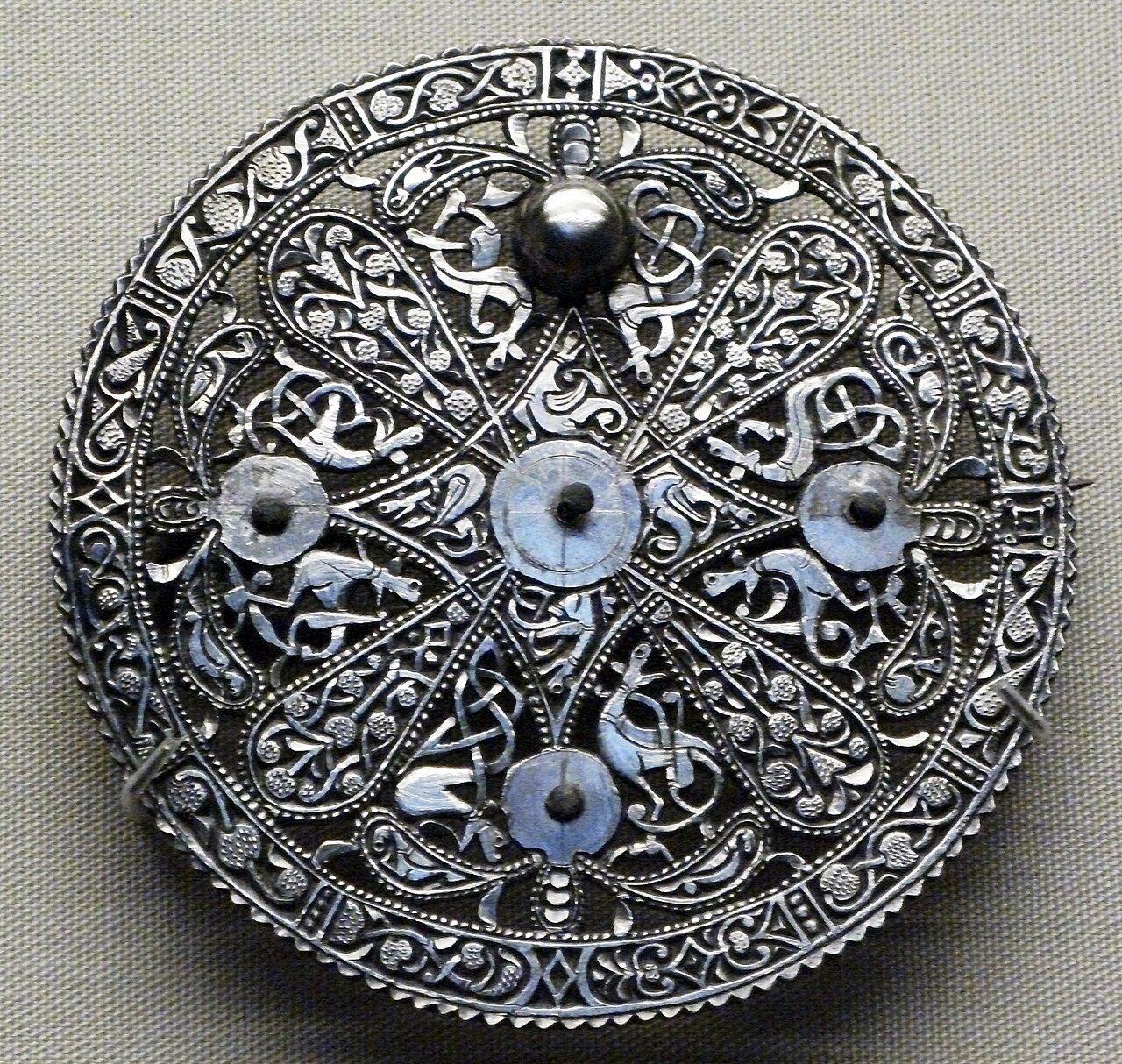
Photo: Johnbod, CC BY-SA 3.0, via Wikimedia Commons
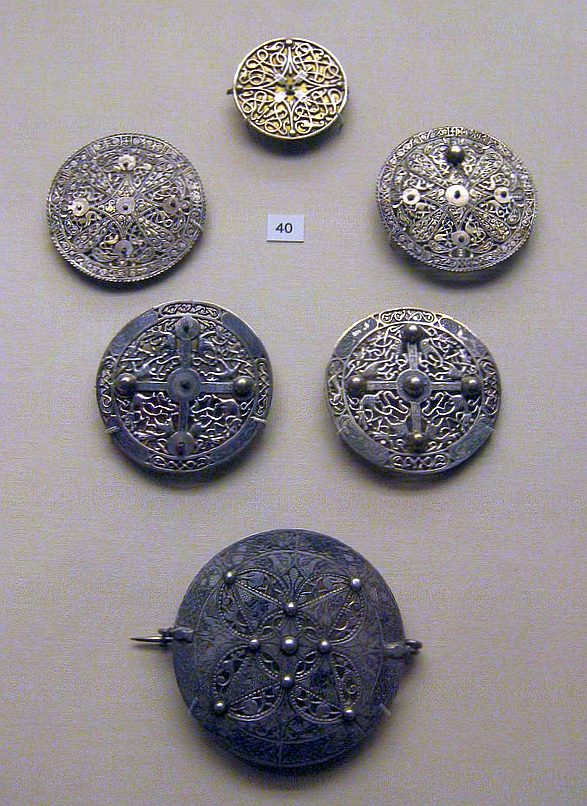
Photo: Claire H. from New York City, USA, CC BY-SA 2.0, via Wikimedia Commons
How it is dated
With no coins, the date rests on style. Comparison with other Trewhiddle-style metalwork places the five larger brooches around 800-840 and the smallest in the late 8th century. A burial in the mid-9th century, during the Viking attacks on East Anglia, is often suggested but cannot be proved.
What happened after the find
An inquest declared the brooches treasure trove and therefore Crown property; the British Museum acquired them and the finder received a reward reported as £135,000 in 1980, of which he gave £25,000 to Pentney church.
Where sources differ
- Find year: Wikipedia gives 1978; the Norfolk Historic Environment Record says 1977. The Wikipedia account (rector kept them three years before passing them on) also sits awkwardly with a 1980 inquest and acquisition, which fits 1977 better.
- Reward: £135,000 (The Times, 17 October 1980, cited on the Pentney village article; also Norfolk HER) versus £137,000 in the Pentney Hoard article.
- Viking-raid explanation is conjecture.
- Current display location in the British Museum not confirmed.
Questions
Where is the Pentney Hoard?
All six brooches are in the British Museum in London, which acquired them after they were declared treasure trove around 1980.
What is in the Pentney Hoard?
Six Anglo-Saxon openwork disc brooches, five of silver and one of silver on a gilded copper-alloy plate, decorated in the 9th-century Trewhiddle style.
Who found the Pentney Hoard?
The village gravedigger found the brooches while digging a grave in the churchyard of St Mary Magdalene, Pentney, in the late 1970s.