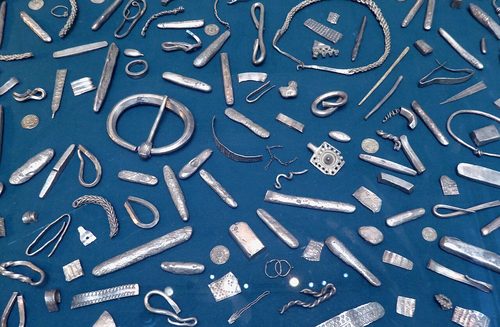
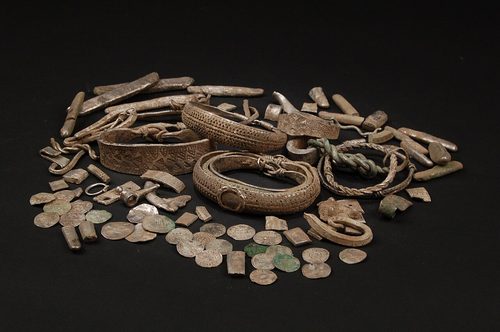
In June 2015 two metal detectorists dug up a Viking hoard on farmland at Eye, just north of Leominster. They had no permission from the landowner, and instead of reporting the find within fourteen days, as the Treasure Act requires, they took it away and began selling it through dealers. Photographs later recovered by police from a deleted mobile phone album showed the hoard intact in a freshly dug hole: a mass of coins, several ingots and gold jewellery.
What survives is a fraction. Investigators recovered three gold ornaments, a silver ingot and about thirty silver pennies; the rest, including around 270 coins, has never been found and is thought to be hidden or sold. The court heard that the whole hoard might have been worth about £3 million. In 2019 four men were convicted at Worcester Crown Court of offences including theft and concealment, and later proceeds-of-crime orders required the two finders to pay back more than £600,000 each.
Even in its damaged state the hoard is one of the most important Viking finds from western Britain. The oldest piece is a small rock crystal sphere held in a cage of four gold strips, decorated with beaded wire and granules: a pendant made perhaps three centuries before the hoard was buried, possibly in the Frankish world. A gold ring of the 9th century and a gold arm-ring with dragon-head terminals sit alongside a silver ingot of the kind used as Viking bullion.
The coins carry the historical weight. Like those in the Watlington Hoard, found a few months later and properly reported, they include 'Two Emperors' pennies struck for Alfred the Great of Wessex and Ceolwulf II of Mercia, showing two rulers seated side by side, and many of the shared Cross-and-Lozenge type. Before these finds each king's Two Emperors penny was known from a single coin. Together the two hoards show a substantial joint coinage and an alliance between the kingdoms that the Anglo-Saxon Chronicle, written for Alfred, plays down. One Alfred penny in the Herefordshire group is of a quatrefoil design by a previously unknown moneyer.
The coins point to burial around 879, probably connected with the Viking Great Army's movements in south-west Mercia after its defeat by Alfred. A later survey of about 50 acres of fields the detectorists were known to have visited explored the landscape around Leominster, where a Mercian monastery had been founded in 660.
The case is a lesson in what is lost when a find is not reported. Had the finders followed the law, they could have shared a reward of up to half the hoard's value with the landowner, and the hoard could have been excavated and studied whole.
Highlights
A crystal sphere, 26-28 mm across, caged in four gold strips with beaded wire and granules; 5th to 7th century and perhaps Frankish, so centuries old when buried.
Coins of Alfred and Ceolwulf II showing two seated rulers, evidence of an alliance between Wessex and Mercia that the written sources downplay.
A gold arm-ring whose terminals end in dragon heads, recovered after the hoard was dispersed.
A unique Alfred issue with a quatrefoil design, struck by a moneyer not previously recorded.
What is in it
The coins included Anglo-Saxon, Frankish and Islamic issues. As recovered: a gold ring, a gold arm-ring with dragon-head ends, a rock crystal pendant in a gold frame, a silver ingot and about 30 silver pennies. Police photographs suggest the complete hoard held around 300 coins and several more ingots.
Size: about 300 coins originally, plus jewellery and ingots; about 35 pieces recovered.
| Item | Number | Notes |
|---|---|---|
| Coins (recovered) | 30-31 | Anglo-Saxon pennies of Alfred and Ceolwulf II, including Two Emperors and Cross-and-Lozenge types and a unique Alfred quatrefoil type |
| Coins (missing) | about 270 | believed sold or hidden |
| Gold ornaments (recovered) | 3 | a 9th-century ring, an arm-ring with dragon heads, and a rock crystal pendant of the 5th-7th century |
| Silver ingot (recovered) | 1 | photographs show several more |
How it is dated
Specialists date the burial to c. 879 from the coins, which belong to the same Two Emperors and Cross-and-Lozenge issues as the Watlington Hoard (buried c. 879-80). The crystal pendant is much older, of the 5th to 7th century.
What happened after the find
The find was not reported as the Treasure Act 1996 requires. In 2019 four men were convicted of offences including theft and concealment and jailed; proceeds-of-crime orders followed in 2022. The recovered objects went through the Treasure process, with Herefordshire Museum Service seeking to acquire them.
Where sources differ
- Recovered coins: Wikipedia says 31, the BBC (2022) and Current Archaeology say 30.
- Rock crystal pendant date: Current Archaeology says 5th-7th century; Wikipedia says 5th or 6th; the BBC says around AD 600.
- Current ownership and display: Herefordshire Museum Service was acquiring the recovered items as of 2020; the outcome was not confirmed.
- The hoard's original size is estimated from police photographs and court evidence, not counted.
Questions
What happened to the Herefordshire Hoard?
The detectorists who found it in 2015 did not report it and sold parts to dealers. Only about a tenth has been recovered; around 270 coins are still missing.
Why is the Herefordshire Hoard important?
Its coins of Alfred the Great and Ceolwulf II of Mercia, including the rare Two Emperors type, are evidence for an alliance between Wessex and Mercia in the 870s that the written chronicles downplay.
Where can I see the Herefordshire Hoard?
Recovered pieces were shown at the British Museum while Herefordshire Museum Service worked to acquire them for display in Hereford. Check the museum service for the current position.