Lambousa, on the north coast of Cyprus a few miles west of Kyrenia, was a prosperous Byzantine town and bishopric. At the end of the nineteenth century its ruins near the monastery of the Acheiropoietos produced two hoards of early Byzantine silver within a few years of each other. The second, found in 1902, includes the famous David Plates now in New York and Nicosia. The first, smaller and less celebrated, went to the British Museum.
For a long time almost nothing was known about how the first treasure came to light. A letter in the state archive in Nicosia, written on 28 December 1898 by the British district commissioner of Kyrenia and discussed by Robert Merrillees in 2009, settled the question: a farmer had found it in 1897 while working a field near the monastery. The silver then passed to the French aristocrat Maurice de Talleyrand-Périgord, Duc de Dino, who sold it to the British Museum in 1899.
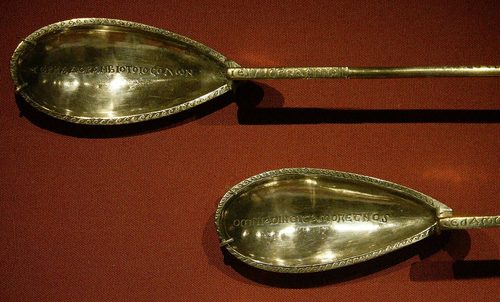
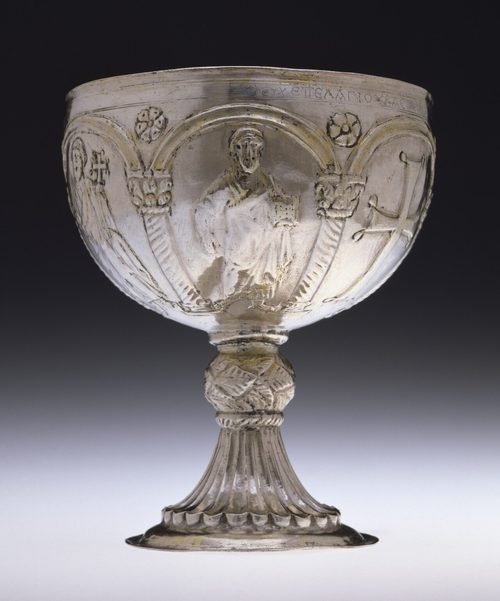
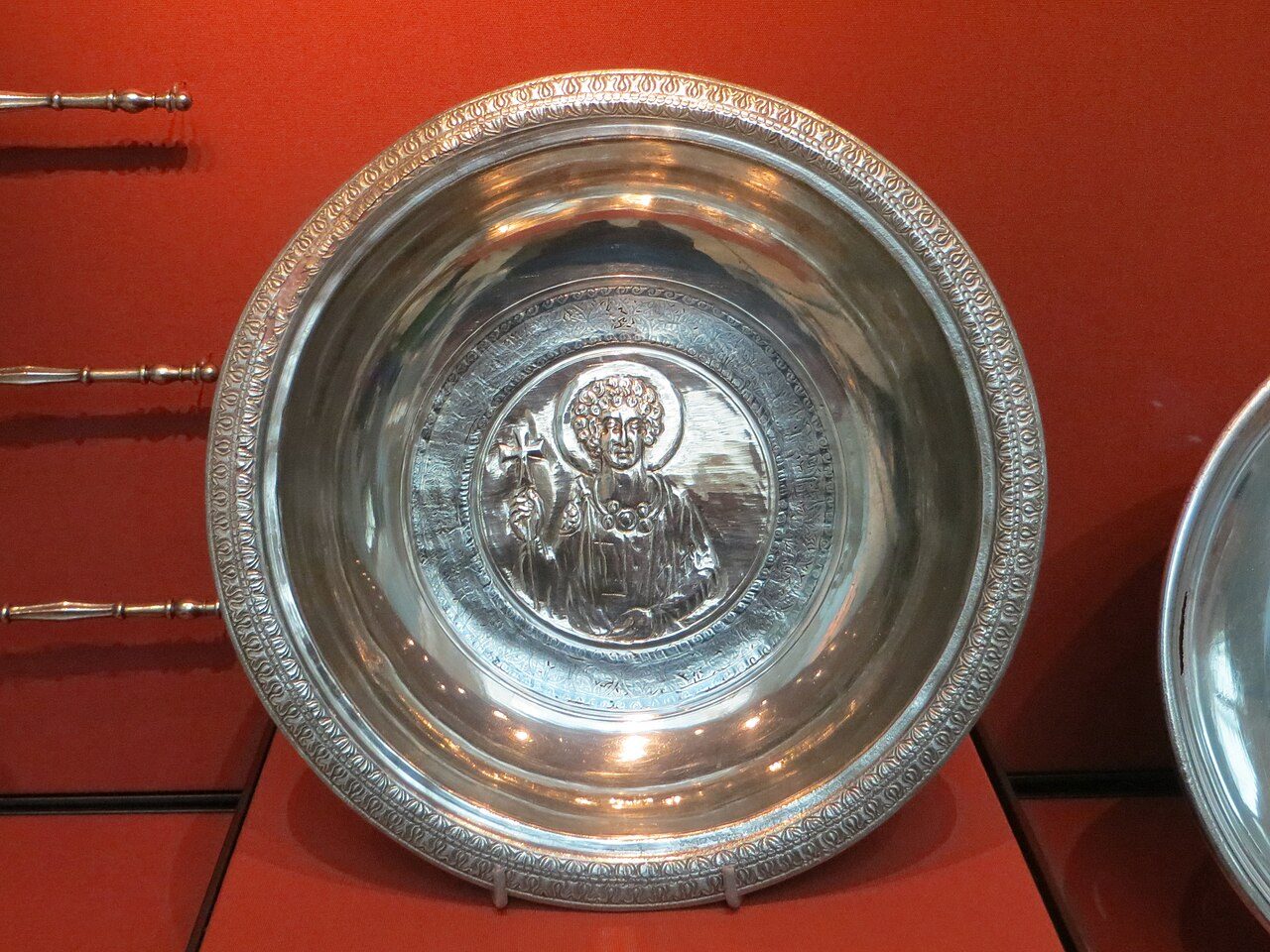
The museum's 28 pieces are all silver. The finest is a bowl with a medallion of a young, beardless saint in a courtier's cloak with a cross-staff, probably Saint Sergius. A dish has a Latin cross inlaid in black niello at its centre. A small hexagonal vessel with three suspension rings, probably a censer for incense though perhaps a lamp, carries six medallion busts: Christ between Peter and Paul on one side, the Virgin between two saints on the other. Twenty-five pear-shaped spoons complete the group, eleven of them engraved with animals running along the bowl.
The pieces are datable to the reign because each larger item carries the control stamps used by Byzantine officials to certify silver. The dish was stamped under Tiberius II (578-582), the censer under Phocas (602-610) and the saint's bowl under Constans II, between 641 and 651. The group was therefore assembled over about seventy years, consistent with the plate of a church or monastery acquired gift by gift.
Why it was hidden is not recorded. The obvious context is the Arab raids on Cyprus of 649 and the 650s. The scholar O. M. Dalton, who first published the find, already suspected that it was incomplete: eleven spoons of a set of 36 seem to be missing, and Marlia Mundell Mango has suggested that three further silver plates from it were sold to the United States in the 1950s.
Small beside its famous sibling, the First Cyprus Treasure is still an important document of how silver was made, stamped and given in the early Byzantine world, and of the wealth of the Church in Cyprus on the eve of the Arab raids.
Highlights
A bowl about 24 cm across with a medallion of a young saint, probably Sergius, in niello-framed relief; stamped under Constans II, 641-651.
A small six-sided silver vessel with busts of Christ, the Virgin, Peter, Paul and two other saints; stamped under Phocas, 602-610.
A silver paten or plate about 27 cm across, with a niello cross and gilded borders; stamped under Tiberius II, 578-582.
Eleven of the 25 spoons are engraved with leaping animals.
What is in it
Byzantine silver probably from a church or monastery: a bowl with a bust of a saint, a dish with a niello cross, a hexagonal censer and 25 spoons.
Size: 28 objects.
| Item | Number | Notes |
|---|---|---|
| Spoons | 25 | Pear-shaped; eleven engraved with running animals |
| Bowl | 1 | With a bust of a saint, probably Sergius; stamps of Constans II (641-651) |
| Dish (paten) | 1 | With a niello cross; stamps of Tiberius II (578-582) |
| Censer | 1 | Hexagonal, with busts of Christ, the Virgin and saints; stamps of Phocas (602-610) |
Photographs
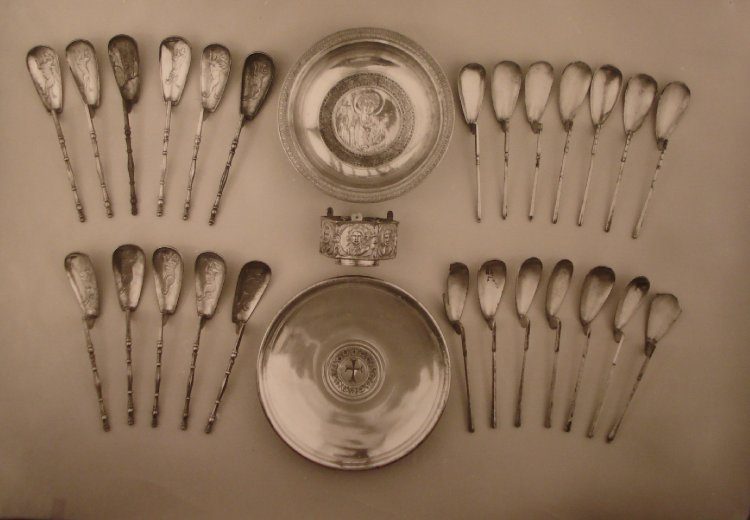
Photo: O. M. Dalton, Public domain, via Wikimedia Commons
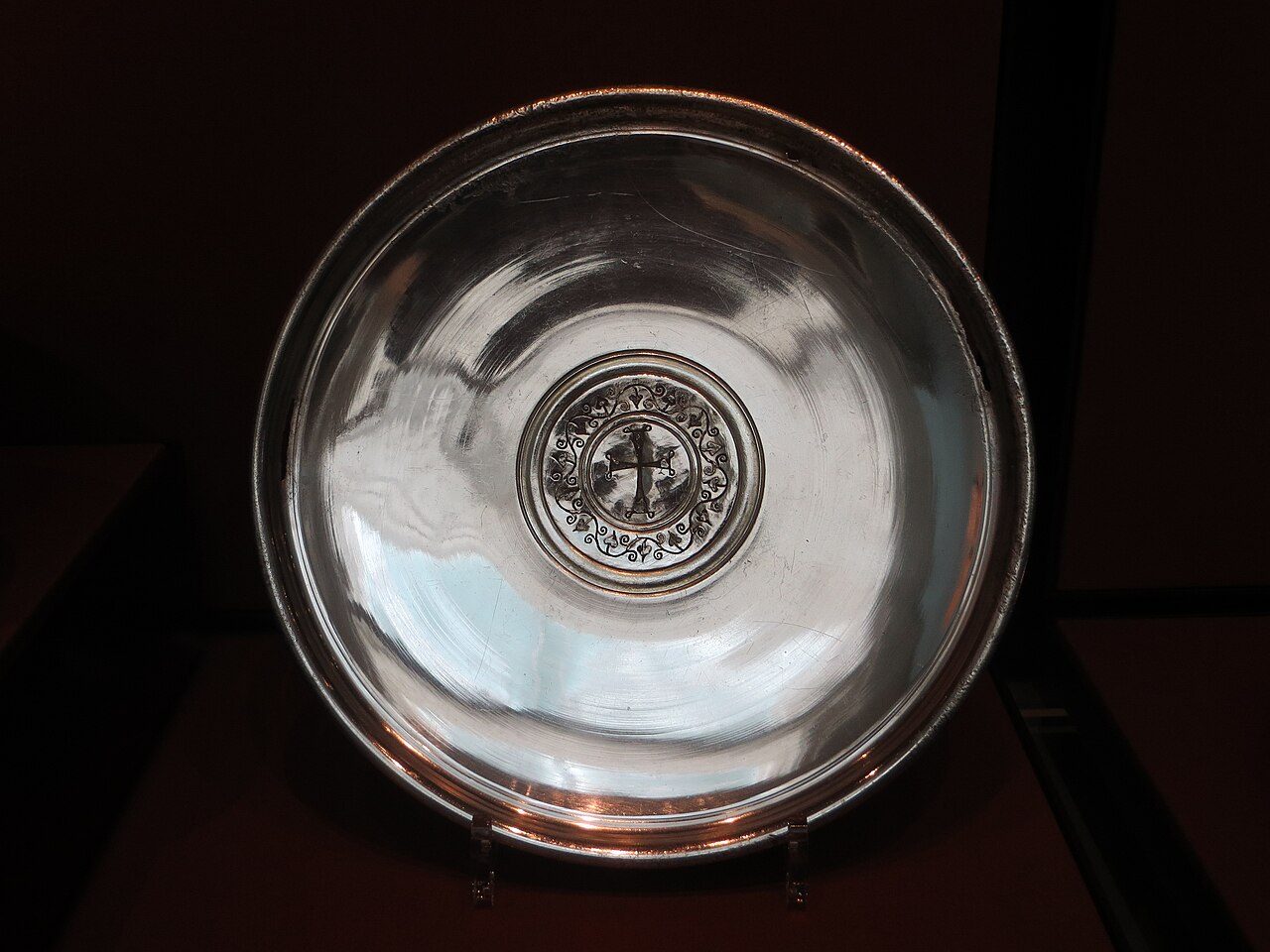
Photo: Jononmac46, CC BY-SA 3.0, via Wikimedia Commons
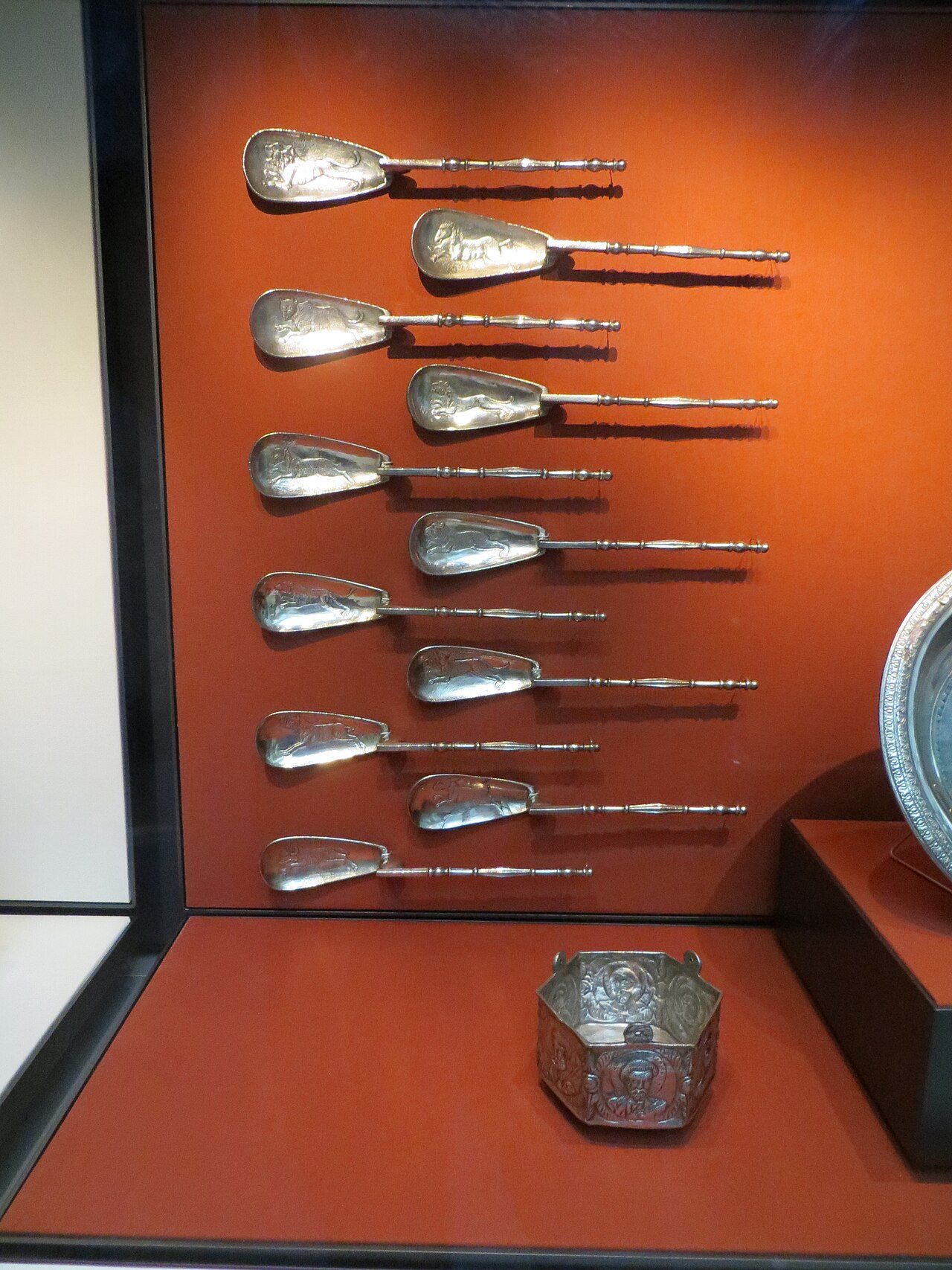
Photo: Jononmac46, CC BY-SA 3.0, via Wikimedia Commons
How it is dated
Byzantine control stamps date three pieces to the reigns of Tiberius II (578-582), Phocas (602-610) and Constans II (641-651). The burial must postdate the latest of these and is usually linked to the Arab raids on Cyprus from 649 onward.
What happened after the find
Found in 1897 in British-administered Cyprus and passed to the Duc de Dino; bought by the British Museum in 1899.
Where sources differ
- Find year: English Wikipedia says only 'end of the nineteenth century'; 1897 comes from Merrillees (2009) as reported by German Wikipedia.
- Whether the treasure is complete: Dalton thought spoons were missing, and Mango suggests three plates were sold to the USA in the 1950s.
- The identity of the saint on the bowl (probably Sergius, after Dalton).
- The censer may instead have been a lamp.
- The British Museum website could not be reached, so display location and object numbers are unconfirmed.
Questions
What is the difference between the First and Second Cyprus Treasures?
Both were found near Lambousa on the north coast of Cyprus. The First, found in 1897, is mainly church silver and is in the British Museum. The Second, found in 1902, contains the David Plates and is divided between the Metropolitan Museum in New York and the Cyprus Museum in Nicosia.
Where is the First Cyprus Treasure?
In the British Museum in London, which bought the 28 pieces from the Duc de Dino in 1899.
Why was the Lambousa treasure buried?
No one knows for certain. The latest piece dates from 641-651, and the Arab raids on Cyprus that began in 649 are the most likely reason.