The Hiddensee gold came out of the sea, piece by piece. On 13 November 1872 a storm surge battered the Baltic coast of Pomerania, and in the months that followed fishermen and their families at Neuendorf, on the narrow island of Hiddensee west of Rügen, began to find small gold ornaments on the beach. A sailmaker reported seven pieces to the island authorities in June 1873; others were sold quietly to goldsmiths in Stralsund. More turned up after another flood in February 1874.
Rudolf Baier, founder of the provincial museum in Stralsund, set about gathering the set together. He bought the first group for 500 marks, persuaded the Hiddensee fishermen to bring him anything else they found at a fixed price per gram, and retrieved pieces that had gone to local goldsmiths. Sixteen pieces survive, weighing just under 600 grams of very pure gold. Because the spacer beads do not quite fit the pendants, the set was probably once larger.
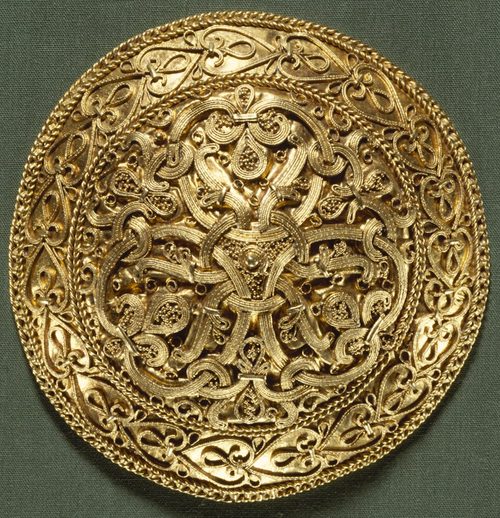
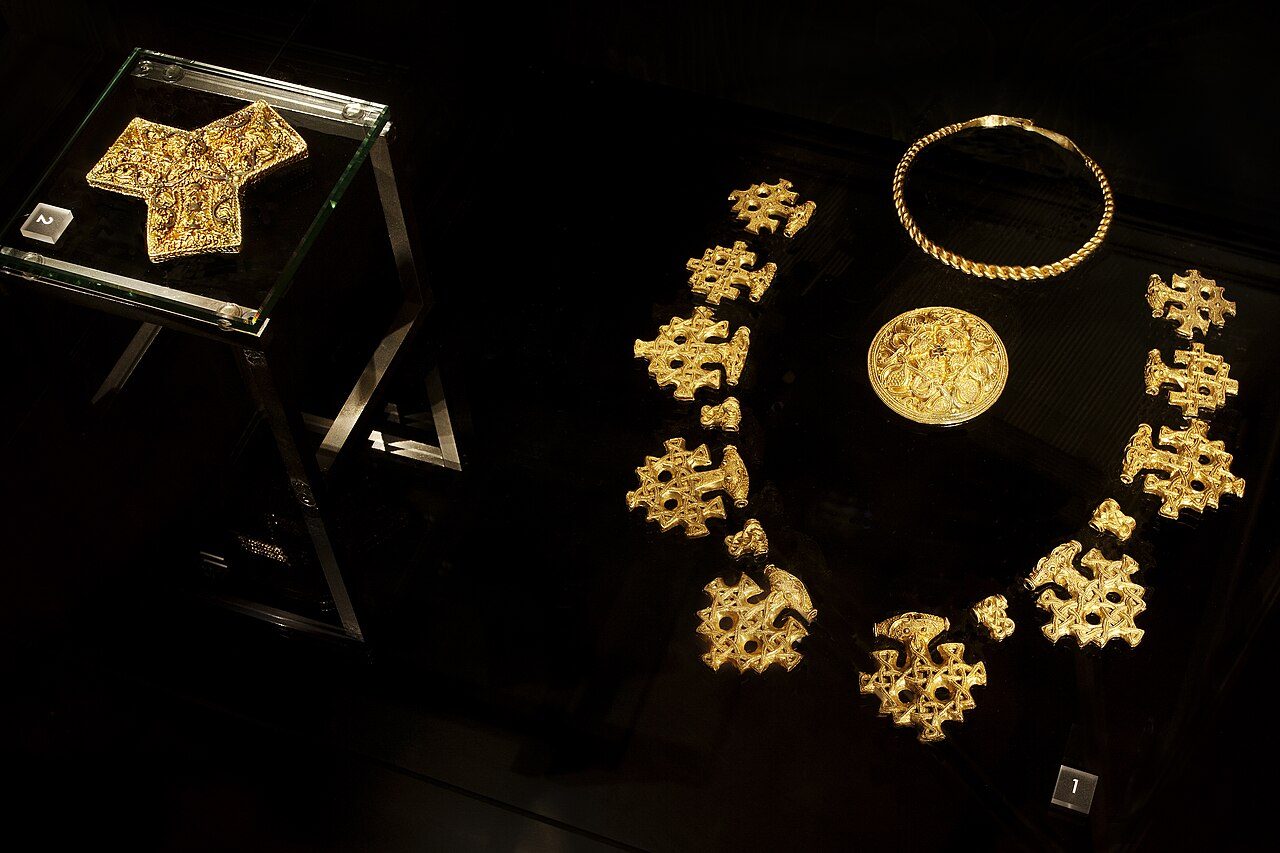
What survives is a single coherent suite of jewellery rather than a mixed hoard. There is a slender neck-ring of four twisted gold wires; a round brooch covered with interlaced beasts whose beaks touch a cross at its centre; ten openwork pendants, six large and four small; and four hollow beads. Each pendant is an interlaced cross crowned by a bird's head, built up from stamped sheet with filigree wire and fine granulation. A bent neck-ring suggested to the first curator that everything had been packed into a small pot.
Nearly a hundred other pieces of jewellery in this 'Hiddensee style' are known, mostly smaller and mostly of silver, and close parallels come from Hedeby and even York. The Hiddensee crosses, almost 7 cm tall and in gold, outclass them all. The quality and the near-identical gold of the Hiddensee pieces point to one workshop of the highest rank in the second half of the tenth century. That is the reign of Harald Bluetooth, the Danish king who accepted baptism around 960, and the crosses that sit inside the pagan-looking hammer-and-bird forms fit that moment of change. The link to Harald's court is a plausible reading of the style, not a documented fact; there is no inscription or record of ownership.
How the gold reached Hiddensee is also unclear. Baier thought the 1872 flood had washed it out of the dunes; his successor argued that it came from a boat wrecked near the find spot, an idea that did not win support. The island lay on the sea lanes between Denmark and the Slav lands of the southern Baltic coast.
The set has had an eventful modern life. It was evacuated to Szczecin in 1945, brought back and buried, dug up and confiscated by the Soviet authorities in 1947, and later returned to Stralsund. For decades visitors saw a replica while the original stayed in store. It travelled to Copenhagen, London and Berlin in 2013-15 for the major Viking exhibition, and has been displayed permanently in Stralsund since late 2015.
Highlights
Ten openwork pendants in which a cross is woven into a pattern often read as Thor's hammer, each topped by a bird's head. They are the signature pieces of the Hiddensee style.
A domed gold brooch covered with four intertwined beasts in Nordic style, their beaks meeting at a cross-shaped cell in the centre.
Four gold wires twisted together into a ring only about 12.5 cm across, with flattened, punched ends forming a hook-and-eye clasp.
What is in it
A matched set of gold jewellery: a twisted neck-ring, a round brooch, ten cross-shaped pendants and four small spacer beads, probably once a single necklace and cloak ornament.
Size: 16 pieces. Weight: about 600 g of gold.
| Item | Number | Notes |
|---|---|---|
| Neck-ring | 1 | Four twisted gold wires, about 12.5 cm across, with a hook-and-eye clasp; small enough for a woman or a child |
| Disc brooch | 1 | Gripping-beast ornament around a cross-shaped central cell, framed by beaded filigree |
| Cross-shaped pendants | 10 | Six large and four small, each topped by a stylised bird's head; filigree and granulation |
| Spacer beads | 4 | Hollow granulated beads that probably sat between the pendants |
Photographs
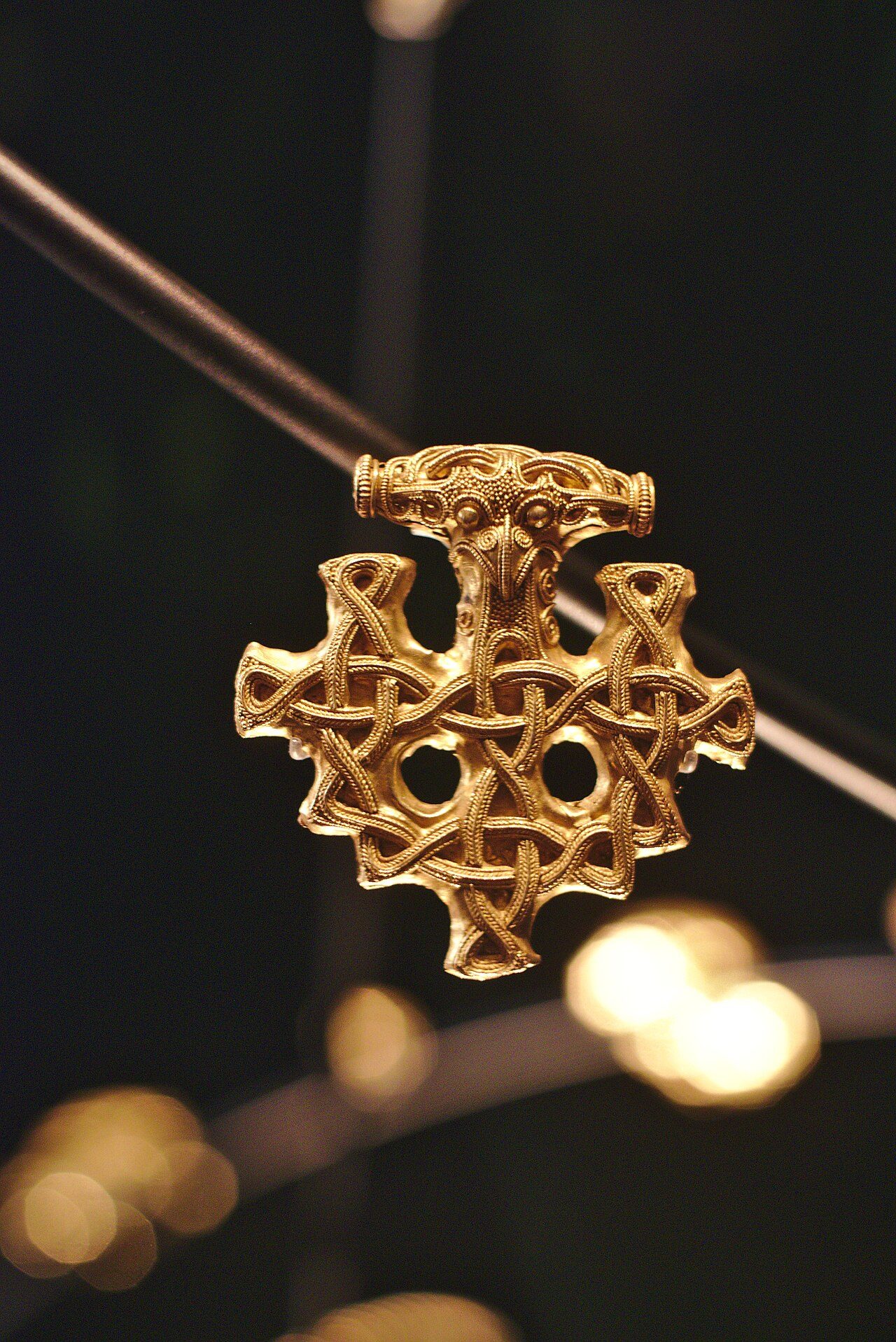
Photo: Thomas Vogt from Paderborn, Deutschland, CC BY-SA 2.0, via Wikimedia Commons
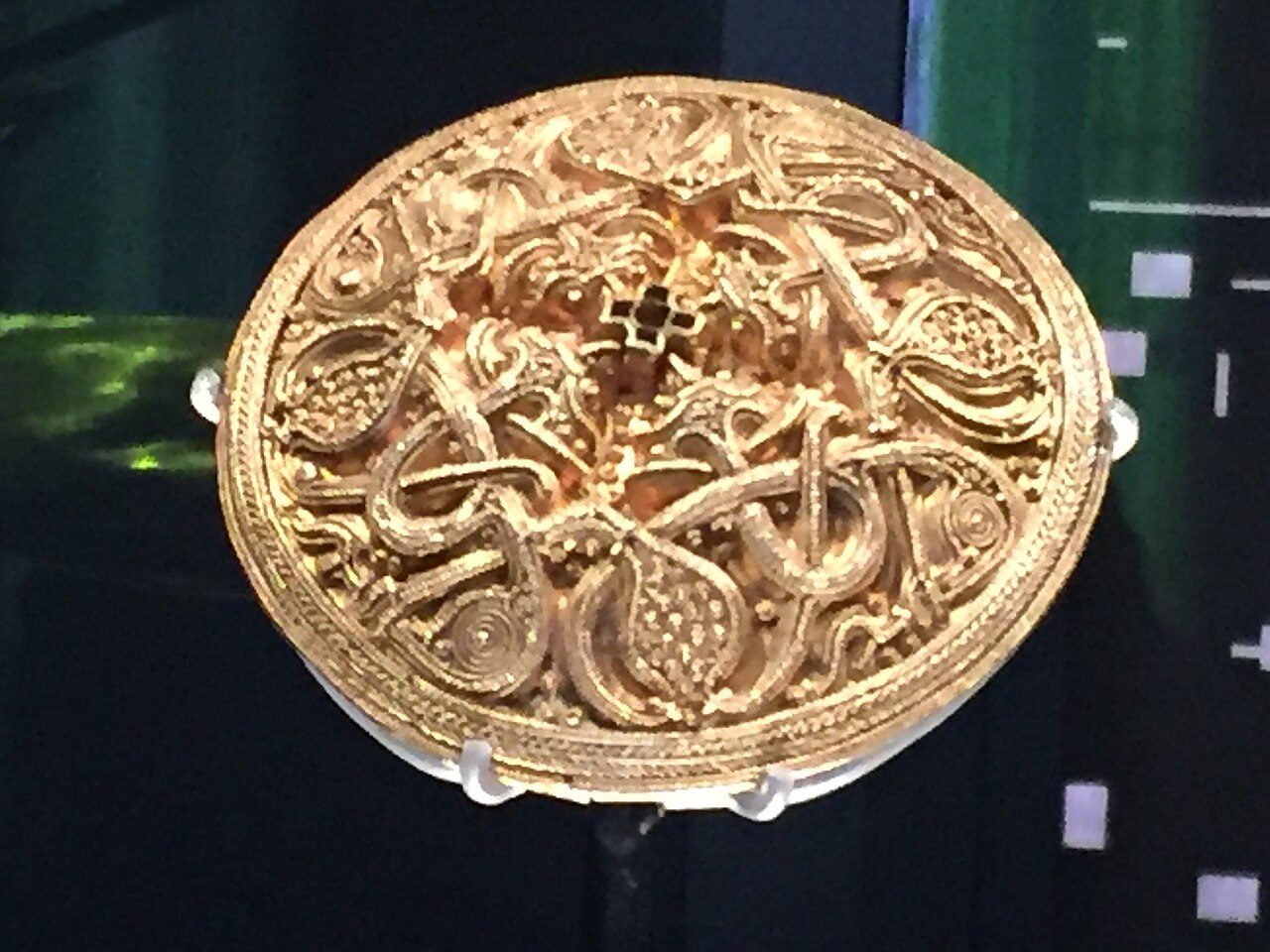
Photo: Sebastian Wallroth, CC BY 4.0, via Wikimedia Commons
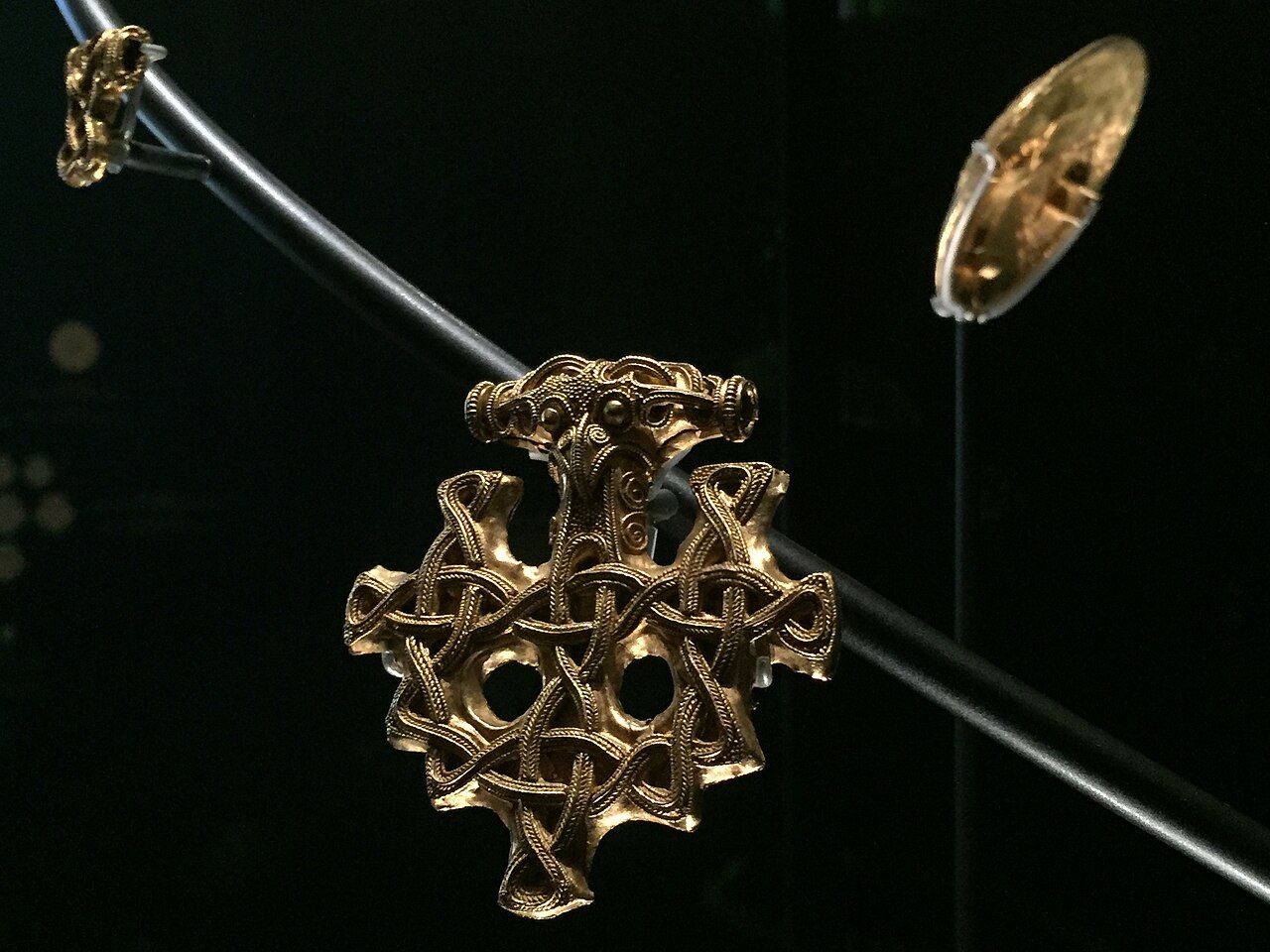
Photo: Sebastian Wallroth, CC BY 4.0, via Wikimedia Commons
How it is dated
There are no coins, so the date rests on craftsmanship. The forms and the filigree-and-granulation technique match a small group of Danish goldwork of the second half of the tenth century, and the set is usually placed around 970-980. When it was hidden or lost is not known.
What happened after the find
There was no modern treasure law in 1870s Prussian Pomerania. The Stralsund museum bought the pieces from finders and goldsmiths, paying a fixed rate per gram, for a total of over 2,000 marks; one large pendant was donated by the regional governor after he acquired it.
Where sources differ
- Number of pieces: German Wikipedia and the Viking Gold exhibition give 16 items in total; English Wikipedia says 16 pendants plus a brooch and a neck-ring (18), apparently counting the spacers as pendants.
- Find date: English Wikipedia says 1873; the pieces actually surfaced between late 1872 and 1874 according to German Wikipedia and the Viking Gold exhibition.
- Weight: 598.2 g (German Wikipedia) versus 600 g (English Wikipedia, rounded).
- The connection to Harald Bluetooth's family is an inference from style, not documented.
Questions
Where is the Hiddensee gold today?
The original is on permanent display at the Stralsund Museum in Stralsund, Germany. A replica can be seen in the local history museum on Hiddensee.
Did the Hiddensee treasure belong to Harald Bluetooth?
Possibly to his circle. The jewellery is of a rare, high-status Danish style of the late tenth century, and its Christian crosses fit the period after Harald's baptism, but nothing names the owner.
Is the Hiddensee treasure real gold?
Yes. The 16 pieces weigh about 600 grams in total and the gold is very pure, around 93-97 per cent.