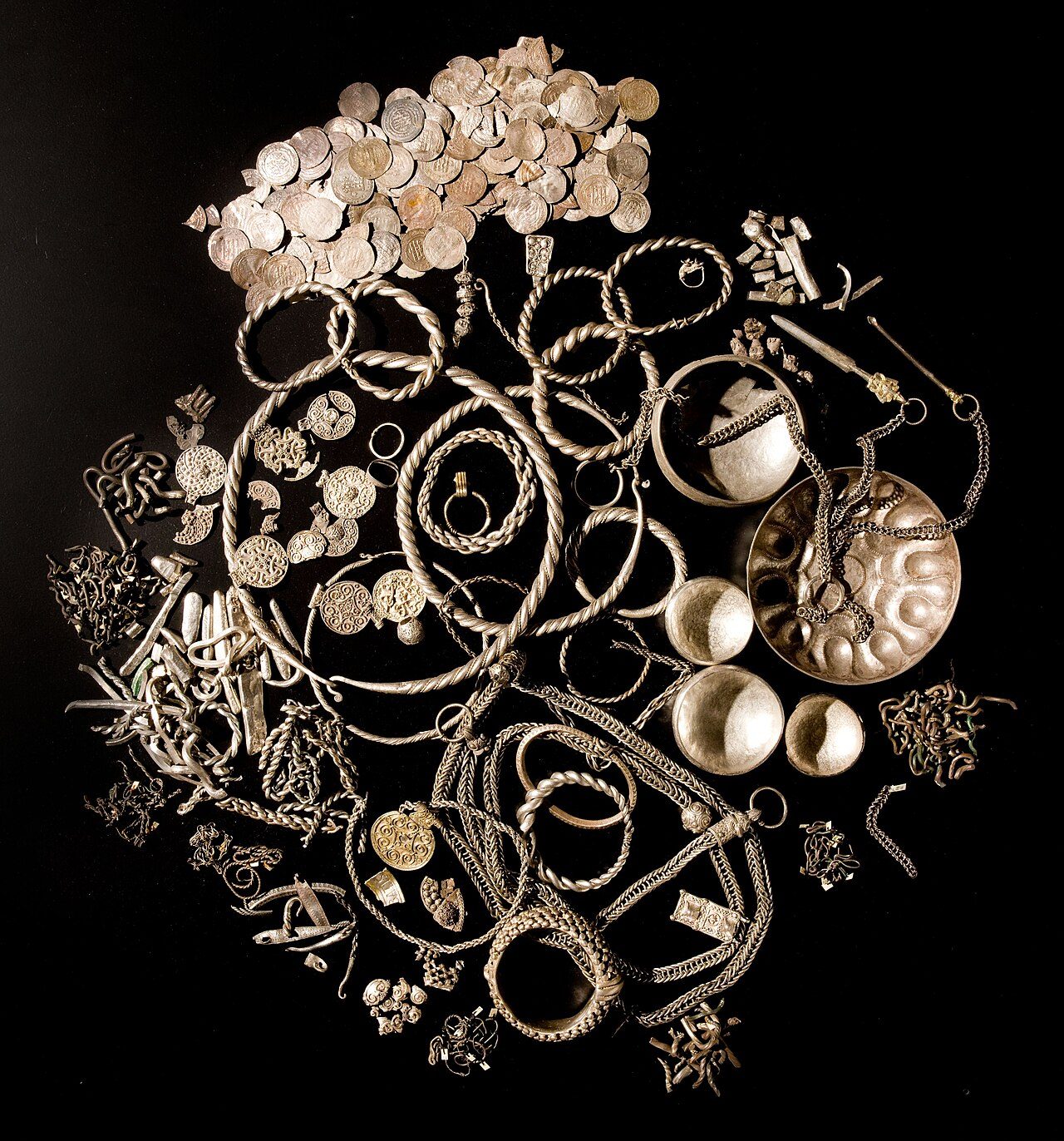
In September 1911 two small boys were given the job of digging holes in a garden in the village of Terslev, on Zealand a few kilometres north of Haslev. Through about a metre of dark topsoil their spade struck something black on the clay beneath. Out came a large, flat silver bowl, and with the help of grown-ups who were called over, a heap of bowls, chains, rings and coins soon followed. Word reached the local court office in Haslev, which told the National Museum, and a curator arrived to find most of the silver already out of the ground.
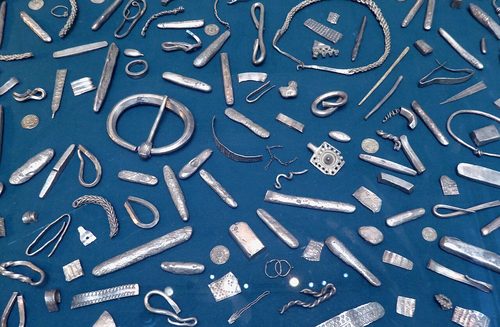
No archaeologist ever saw the hoard in place. The finders described everything lying close together in one pile, with the bowls on top and upside down, judging by how their outsides had corroded. There was no trace of a container, so it was probably wrapped in cloth or leather, or packed in a wooden box that rotted. Sieving the spoil turned up more small fragments but nothing new. The museum weighed the whole find at 6,576 grams, of which the coins made up about 1.9 kg and the cut silver about 1.5 kg. At the time only one earlier Danish silver hoard was of comparable size.
The coins are overwhelmingly Arab. Of 1,751, the National Museum counts 1,708 as dirhams, most of them cut into pieces; the rest include English, German, French and Italian coins and a small group of early Danish issues, eight of them struck at Hedeby. Many dirhams had been stabbed through with a knife so they could be threaded on a cord, and others were drilled to hang or be sewn onto clothing. One is scratched with a tiny four-spoked wheel.
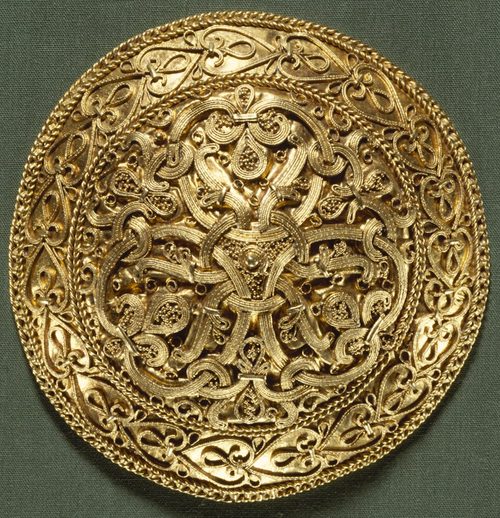
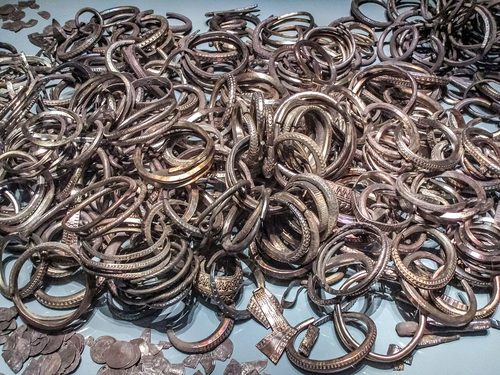
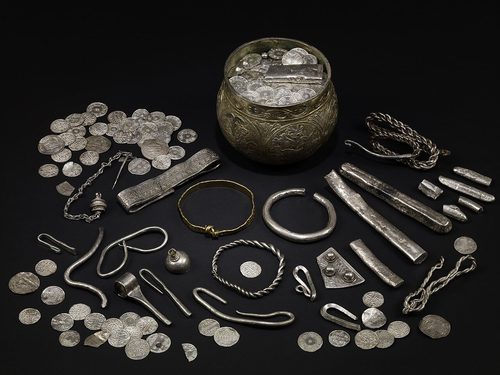
What sets Terslev apart is the quality of its finished silver. There is a drinking set: a large, thin bowl embossed with a wreath of bosses, which may have come from Persia, and four small hammered cups, one with a Thor's hammer roughly scratched under its base and another with a triquetra engraved beneath. A heavy chain almost one and a half metres long ends in two filigree animal heads with rings through their snouts. A toilet set hangs from smaller chains: an ear-spoon whose top is a gaping beast, and a nail-cleaner shaped like a tiny dagger, inlaid with niello and touched with gilding. There are twisted neck- and arm-rings, filigree pendants and brooch fragments, eleven silver bars and a scrap of a church paten inscribed '..BATIS..'.
The scrap of paten is a reminder that some of this silver may have come from Christian Europe by force, while the Arab coins point east along the trade routes through Russia. The filigree pendants gave their name to the 'Terslev style', a type of Viking-age ornament built from bands of granular wire, now recognised from finds across Scandinavia.
Who buried the hoard, and why it was left, is unknown. Its size and the refinement of its jewellery mark it as the wealth of a prosperous household on Zealand in the tenth century, at the time when the Danish kingdom was being drawn together under the Jelling dynasty.
Highlights
A silver chain 1.48 m long made of interlocking links, joined by filigree beads and ending in two hollow animal heads with rings through their snouts.
An ear-spoon topped by a gaping animal head and a dagger-shaped nail-cleaner decorated with paired bird heads in niello, both hanging from fine chains.
A large embossed bowl, possibly Persian, with four small hammered cups; one carries a scratched Thor's hammer, another an engraved triquetra under its base.
A cut piece of a church paten with part of a Latin inscription, hacked up and kept as bullion.
What is in it
Coins, mostly Arab dirhams and fragments of them, with neck- and arm-rings, a long chain with animal-head ends, toilet implements, filigree jewellery, bars and cut silver, and a drinking set of silver bowls.
Size: 1,751 coins plus about 80 numbered groups of objects. Weight: 6.6 kg of silver.
| Item | Number | Notes |
|---|---|---|
| Arab dirhams | 1,708 | Whole and cut; many pierced with a knife-point to string on a cord |
| European coins | 43 (28 whole, 15 fragments) | From England, Germany, France and Italy |
| Danish coins | 18 | Early Scandinavian issues, eight of them Hedeby coins |
| Vessels | 5 bowls and cups | A large embossed bowl, perhaps from Persia, and four small Nordic cups |
| Jewellery and rings | dozens | Twisted neck- and arm-rings, a 1.48 m chain, toilet set, filigree pendants and brooch parts |
| Bars and cut silver | 11 whole bars and many fragments | About 1.5 kg of hacksilver; several bars carry test nicks |
How it is dated
The National Museum gives the latest dated coin as 944 and places the burial in the second half of the tenth century. The 1912 publication, using a provisional coin list, reported the youngest coins as issues of Æthelstan (924-939) and of Otto I struck before he became emperor in 962, and dated the burial to about the middle of the century. The jewellery fits a tenth-century date.
What happened after the find
The hoard was declared danefæ (treasure belonging to the Crown) and passed whole to the National Museum in Copenhagen; the coins went to the museum's coin collection.
Where sources differ
- Burial date: 'around the middle of the tenth century' in the 1912 publication versus 'second half of the tenth century' on the National Museum's page.
- Coin count: the 1912 report gave only a provisional count (413 whole Kufic coins and nearly 1,300 fragments, 12 whole and 10 fragmentary western coins, 10 whole and 9 fragmentary Nordic coins). The 1,751 / 1,708 figures are from the National Museum and Danish Wikipedia.
- The Persian origin of the large bowl is a 'may' in the National Museum's text.
- The exact find spot is a private garden in the village; it was recorded by property number in 1912 and is deliberately not given here.
Questions
Where can I see the Terslev Hoard?
In the Danish Prehistory galleries of the National Museum of Denmark in Copenhagen, alongside other Viking-age silver hoards.
What is the Terslev style?
A type of Viking-age filigree ornament, named after pendants and brooch parts in this hoard, in which designs are built up from granulated silver or gold wire, often around a cross or trefoil layout.
Why are there so many Arab coins in a Danish hoard?
In the ninth and tenth centuries huge quantities of silver dirhams reached Scandinavia from the Islamic world via the Russian rivers. In Denmark, as elsewhere, they were valued by weight and cut up as needed.