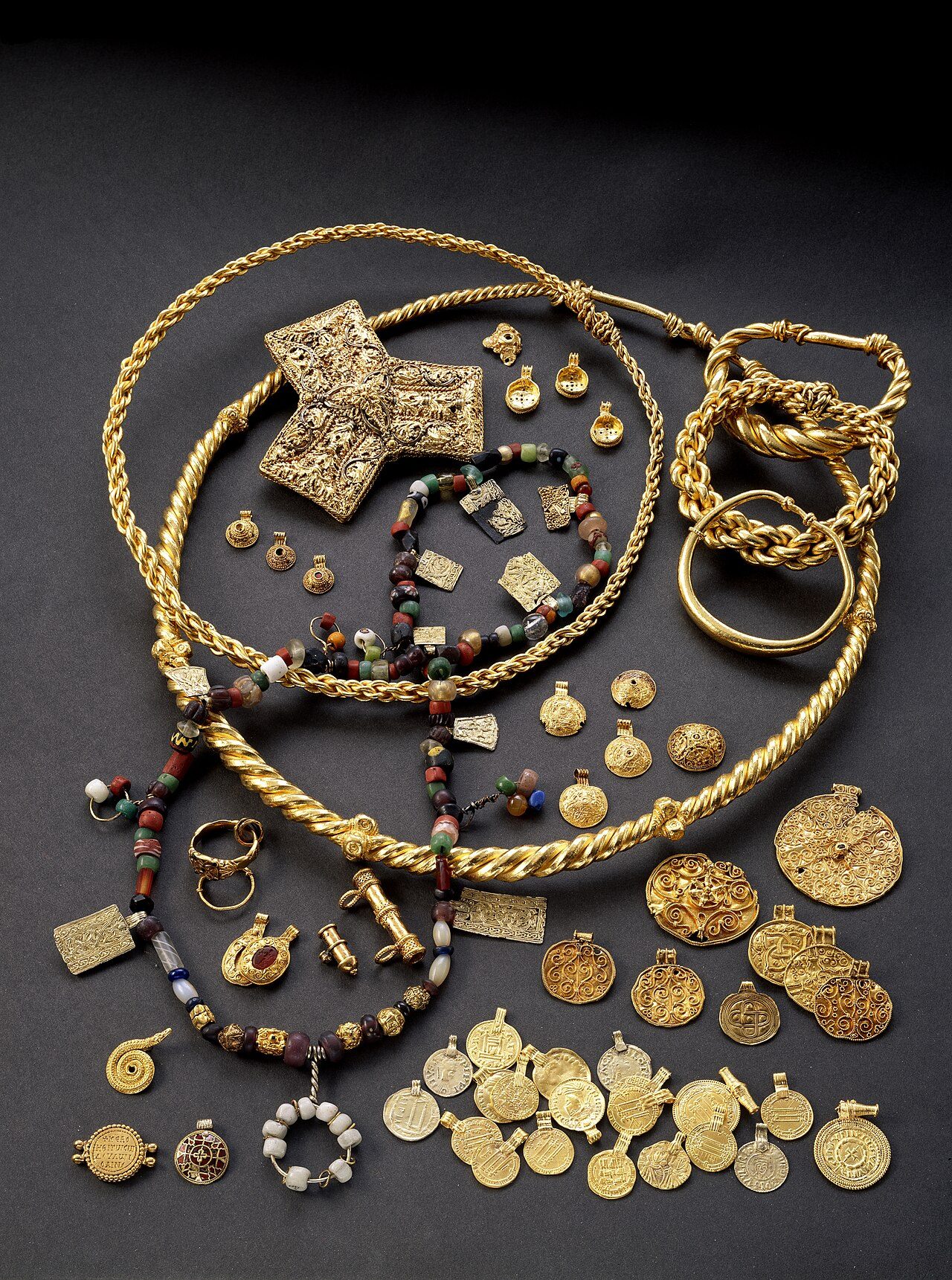
On 12 August 1834 Halvor Torstensen Kvernmoen, a smallholder hired to drain a wet hollow on the farm of Nedre Hoen at Hokksund, west of Oslo near Drammen, was tidying the last stretch of ditch when he found a heavy gold neck-ring hanging on his spade. Digging carefully into a low mound in the trench, he uncovered a second neck-ring, arm-rings, gold coins, finger-rings, brooches and pendants, held together in what looked like a whitish film, perhaps the remains of a cloth bag. It came to about 2.5 kilograms, and it remains the largest Viking-age gold hoard from Norway.
There was no duty to hand in finds then, and the farmer was reportedly offered a small sum for the gold. Instead, a week later he and Kvernmoen drove it to Christiania (Oslo) and gave it to the Ministry of Finance. The reward, set at the value of the gold, was 2,060 speciedaler. The farmer split it equally with Kvernmoen, who used his share to buy a farm of his own; it was said to equal nearly fifty years' wages for a labourer.
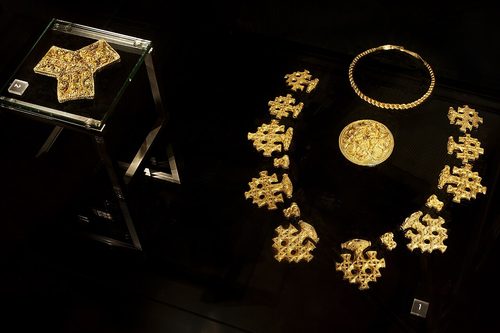
Most Viking hoards are silver with a little gold. Hoen is the reverse. Its core is a set of massive Scandinavian ornaments: two twisted gold neck-rings, the larger weighing almost a kilogram, and plaited arm-rings, one of about 400 grams. Around these is jewellery from far away. The best-known piece is a gold Frankish mount with three short arms, covered in leaf ornament, made in the Carolingian empire to join the straps of a sword harness and later fitted with a pin to wear as a brooch. There is an Anglo-Saxon finger-ring, Byzantine pendants, and twenty coins, Roman, Byzantine, Arab and Frankish, each given a loop in a Scandinavian workshop so that it could hang from a necklace among the beads.
The beads and pendants probably made up one long, heavy necklace, and specialists think the whole group reads as a woman's jewellery. The mixture is the hoard's great value to historians: in one deposit there are objects that left Baghdad, Constantinople, the Frankish lands and England, gathered by people living on a fjord in eastern Norway. In the Viking age the sea came several metres higher up the Drammen river, so Hokksund was a landing place with access to inland valleys.
How that wealth arrived is guesswork. Earlier writers saw it as plunder; one local historian has floated a link with a chieftain named in saga tradition and with the huge ransom the Franks paid to Viking raiders in 858, but he called this speculation himself. The hoard may have been an offering in the bog or valuables hidden in a dangerous moment and never recovered. Analyses since the find show that much of the jewellery and the beads were made in Scandinavia, so this was not simply loot.
The hoard went to the university collection in Christiania in 1836 and was the centrepiece of the new Viking hall of the Historical Museum from 1904. It was hidden in a rural bank vault during the Second World War, has toured to Paris, London, New York and Berlin, and since 2019 has opened the museum's Víkingr exhibition.
Highlights
A three-armed gold strap-distributor from a Carolingian sword harness, densely decorated with leaf scrolls, reused as a brooch. Copies of the type became a fashion in Scandinavia.
A twisted ring of solid gold weighing almost a kilogram, the heavier of the hoard's two neck-rings.
Twenty coins from Rome, Byzantium, the Islamic world and the Frankish kingdom, each fitted with a ribbed loop to hang on a necklace.
A gold ring with an openwork bezel and inset stones, one of the English pieces in the hoard.
What is in it
Gold neck-rings and arm-rings, a Frankish gold mount reworked as a brooch, finger-rings, pendants, about twenty coins turned into pendants, and a long string of glass and stone beads.
Size: about 207 pieces (published counts differ). Weight: about 2.5 kg, mostly gold.
| Item | Number | Notes |
|---|---|---|
| Neck-rings | 2 | Twisted gold; the heavier weighs almost 1 kg |
| Arm-rings | 3 | Plaited and twisted gold; one weighs about 400 g |
| Other jewellery | about 50 gold and silver-gilt pieces | Including a Frankish trefoil mount made into a brooch, an Anglo-Saxon finger-ring and Byzantine pendants |
| Coins | 20 | Roman, Byzantine, Arab and Frankish, all fitted with loops to hang as pendants |
| Beads | about 130-200 | Glass and semi-precious stone; counts differ between sources |
Photographs
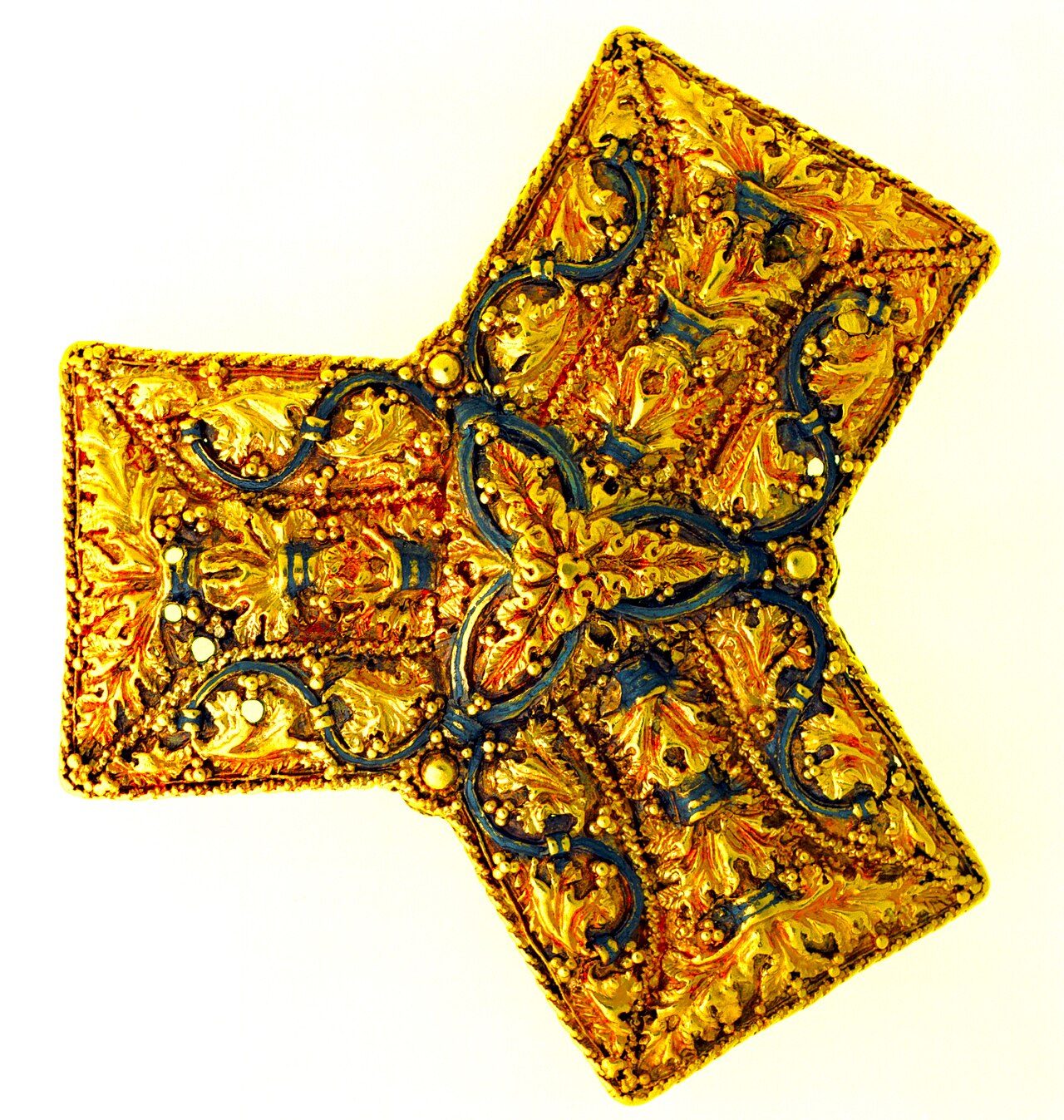
Photo: Mona Knudsen, Kulturhistorisk Museum, CC BY-SA 4.0, via Wikimedia Commons
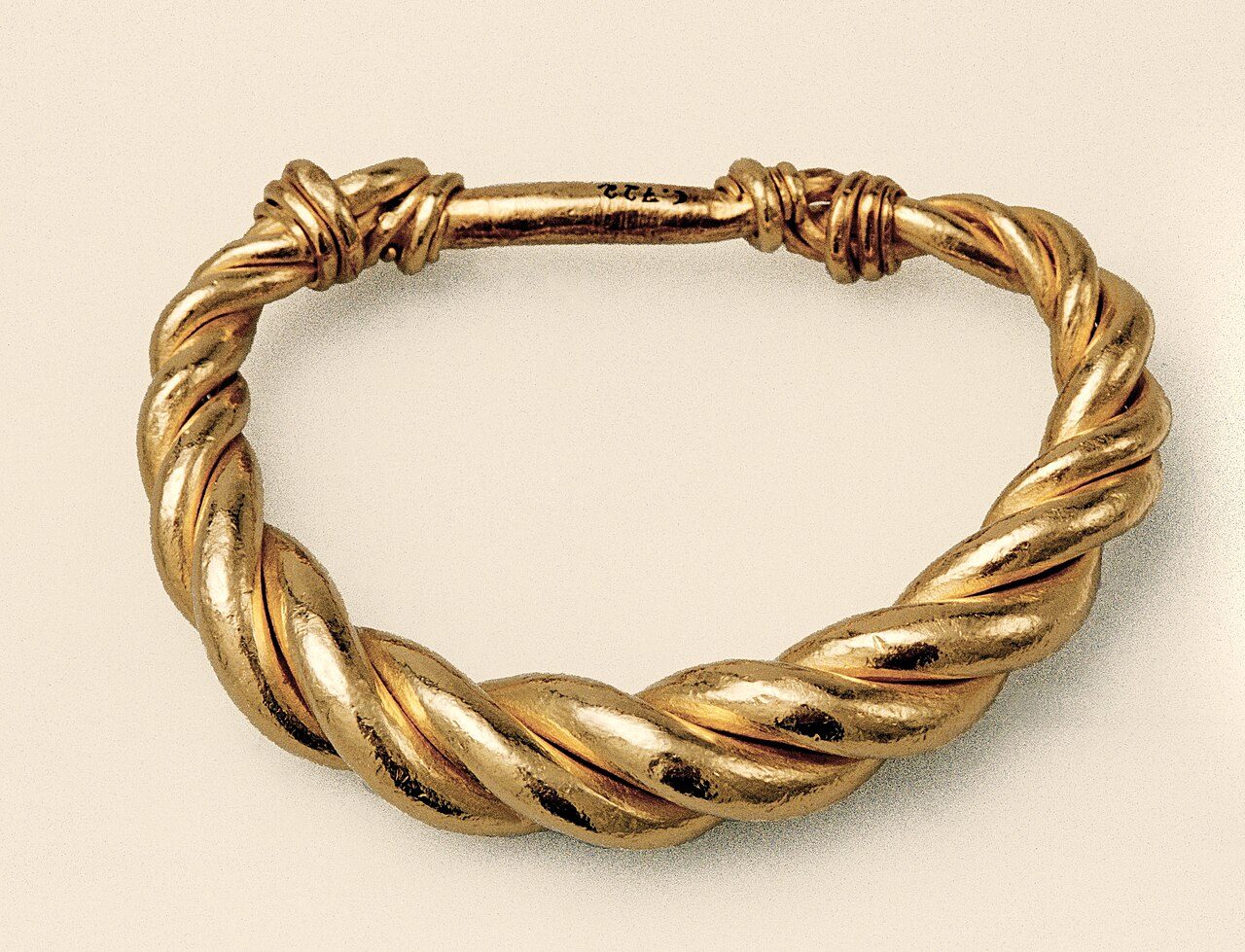
Photo: Eirik Irgens Johnsen, Kulturhistorisk Museum, CC BY-SA 4.0, via Wikimedia Commons
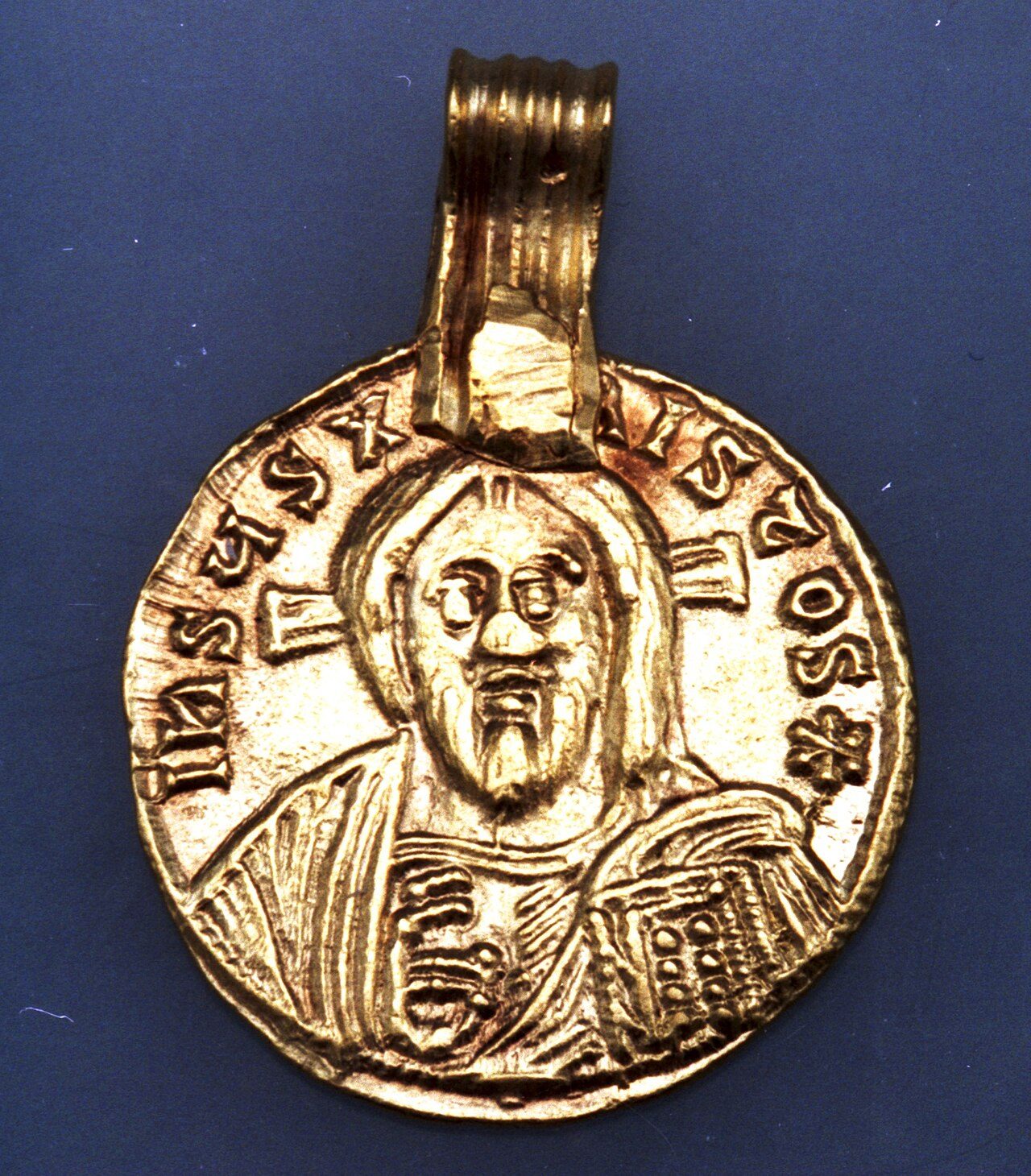
Photo: Eirik Irgens Johnsen, Kulturhistorisk Museum, CC BY-SA 4.0, via Wikimedia Commons
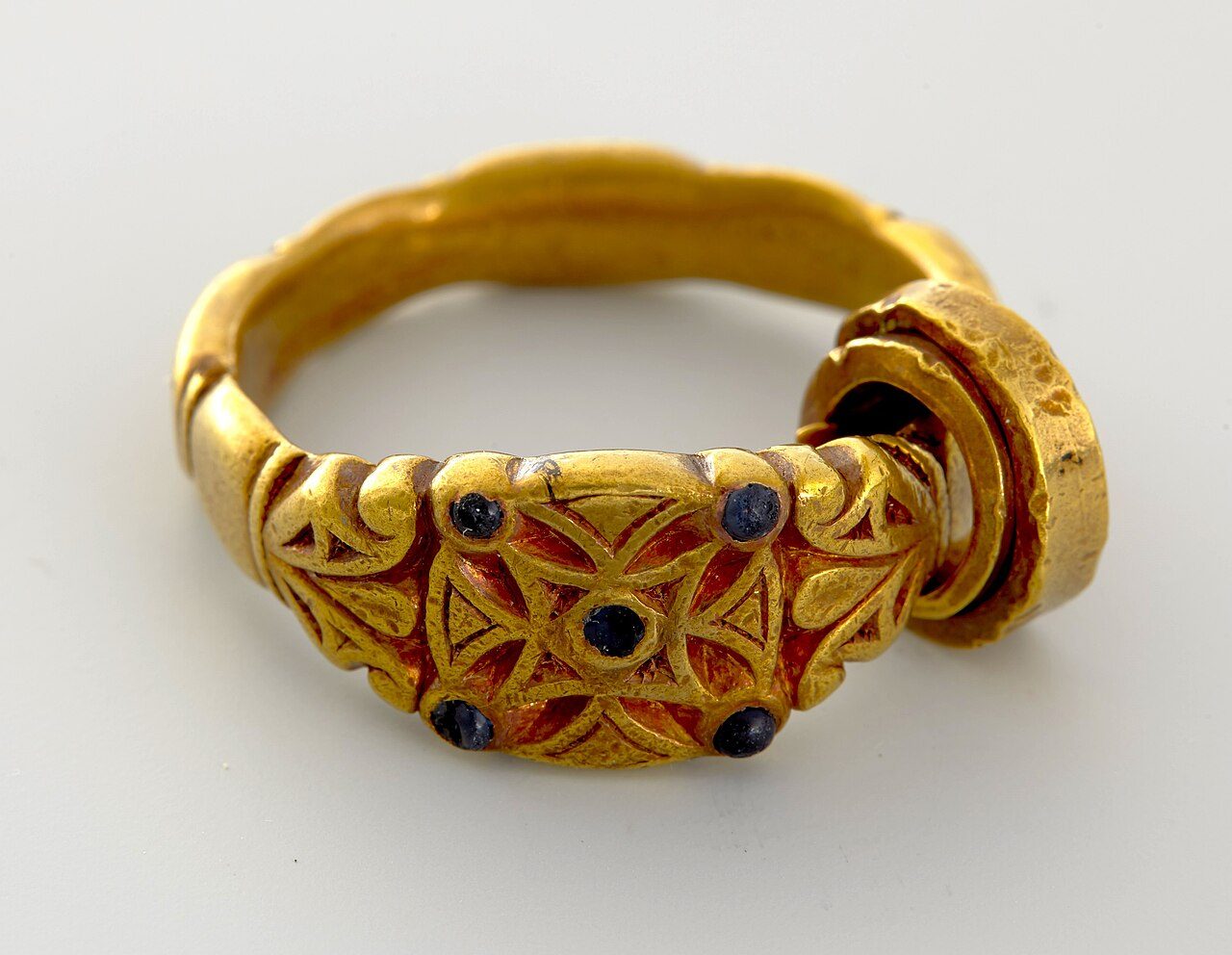
Photo: Kirsten Helgeland, Kulturhistorisk Museum, CC BY-SA 4.0, via Wikimedia Commons
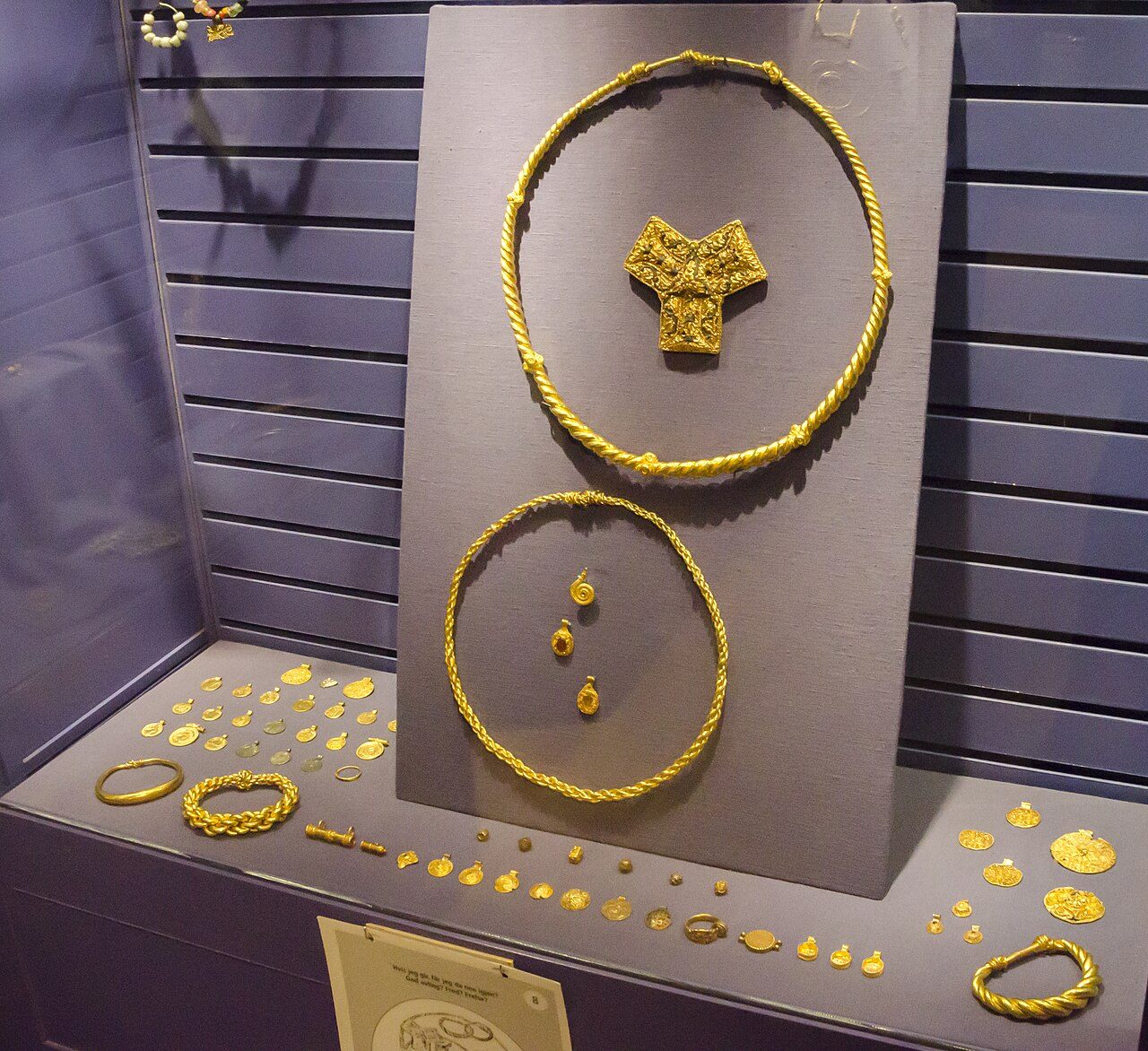
Photo: Petter Ulleland, CC0, via Wikimedia Commons
How it is dated
Dating rests on the coins and the jewellery. Most coins were struck in the middle of the ninth century, and the youngest put the burial after about 875. Most writers place it between 875 and 900; the 2006 monograph calls it a ninth-century treasure, while broader ranges (875-1000) also appear in popular accounts.
What happened after the find
In 1834 Norway had no compulsory reporting of finds. The farmer delivered the hoard to the Ministry of Finance, and the state paid a reward equal to its gold value, 2,060 speciedaler, which he shared with the finder. It passed to the university collection in 1836.
Where sources differ
- Piece count varies: 207 (Viking Gold exhibition; English Wikipedia, which lists 54 metal objects, 20 coins and 132 beads); 50 ornaments, 20 coins and about 200 beads (Norwegian and German Wikipedia); 20 coins, 51 ornaments and 125 beads (Danish Wikipedia).
- Burial date: 875-890 (German Wikipedia), 875-900 (Norwegian Wikipedia, museum label quoted on Commons), between 875 and 1000 (NRK, 2019); one popular article says late eighth or early ninth century, which conflicts with the coins.
- The reward figure: NRK gives 2,060 speciedaler shared equally; Norwegian Wikipedia says each man received 1,015 speciedaler.
- The Commons coin pendant shown appears to be Byzantine (Christ on the obverse); I did not verify which ruler struck it.
Questions
Where is the Hoen Hoard displayed?
At the Historical Museum in central Oslo, part of the University of Oslo's Museum of Cultural History. It is the first thing visitors see in the Víkingr gallery, opened in 2019.
How much gold is in the Hoen Hoard?
The whole find weighs about 2.5 kg, almost all of it gold. The largest neck-ring alone weighs close to a kilogram.
Who owned the Hoen treasure?
Nobody knows. The jewellery set suggests a wealthy woman's ornaments, and the foreign pieces show contacts reaching from England to the Islamic world, but no grave or inscription names an owner.