In January 2018 two volunteer heritage wardens from Rügen, one of them a 13-year-old school pupil, were checking farmland near the village of Schaprode, on the west side of the island, close to a Bronze Age burial mound. The pupil's detector picked up a small piece of silver that they at first took for aluminium. It was a coin, and the pair reported it to the state archaeology service of Mecklenburg-Vorpommern rather than digging further.
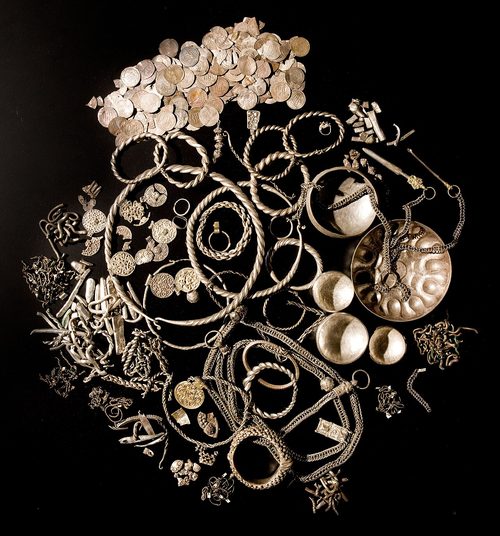
The archaeologists waited until April, then excavated about 400 square metres of the field in one weekend, recording each find as it came up. The soil was kind to silver, and they lifted more than 600 objects in good condition. Once the material had been cleaned and sorted, the count of individual pieces, many of them small fragments, rose to over 1,900. Altogether the silver weighs about 1.5 kg.
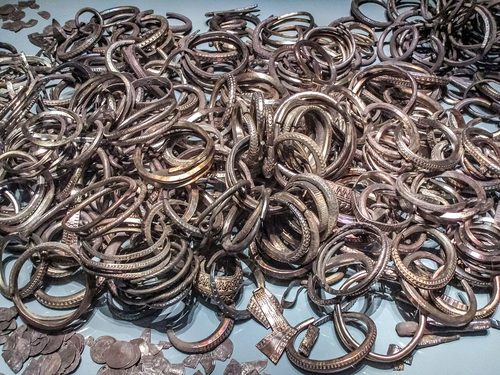
Most of it is hacksilver: coins and jewellery chopped into pieces so they could be weighed out as payment. There are neck-rings, brooches, beads, fragments of arm-rings and a small Thor's hammer pendant. The coins came from a wide world. The oldest is a dirham struck in Damascus in 714 and later reworked; others are Arab coins from further east, German and English pennies and a few Byzantine pieces. The latest are Otto-Adelheid pennies, a German type first struck in 983, which puts the burial in the 980s.
About a hundred coins are what made headlines. They are tiny 'cross coins' of Harald Gormsson, called Bluetooth, the Danish king who claimed on the Jelling stone to have made the Danes Christian. Each weighs only about 0.3 grams and carries a cross, among the first Christian images on Danish money. They were struck in modest numbers and seem to have been handed out to the king's followers. The state archaeologists called this the largest single find of Bluetooth coins in the southern Baltic; comparable groups were previously known only from within the old Danish realm.
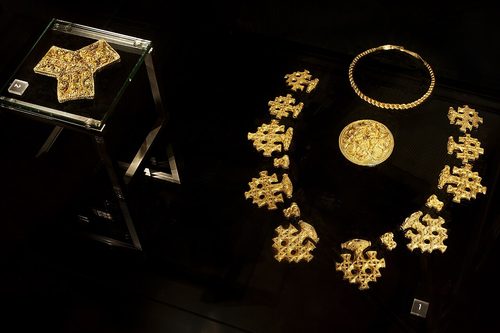
The timing invites a story. Medieval writers say Harald was overthrown in the mid-980s by his son Svein Forkbeard and fled across the Baltic to the Slav lands of Pomerania, where he died around 986 or 987. A hoard of his coins buried on Rügen in exactly those years fits that flight neatly, and the excavators raised the possibility. Historians quoted at the time were careful: the dates match, but there is no proof the silver belonged to Harald or his men. The Hiddensee gold, also linked to Harald's court, was found only about 5 km away.
Rügen was then home to the Slavic Rani, and the hoard was buried away from any settlement, beside a prehistoric mound that would have served as a landmark for recovering it. It never was recovered. Its careful excavation, rather than piecemeal detecting, is what allows the find to be studied as a closed group.
Highlights
About a hundred light silver coins of about 0.3 g bearing a cross, issued under the first Christian Danish king. No larger group has been found in the southern Baltic.
The oldest coin in the hoard, already more than 250 years old and reworked when it was buried.
A small silver hammer amulet buried alongside Christian cross coins, a reminder that the two faiths overlapped.
What is in it
Mostly hacksilver: whole and cut coins from the Islamic world, Denmark, Germany, England and Byzantium, with neck-rings, brooches, beads, ring fragments and a small Thor's hammer.
Size: over 600 silver items reported in 2018; over 1,920 pieces after full processing. Weight: about 1.5 kg of silver.
| Item | Number | Notes |
|---|---|---|
| Coins of Harald Bluetooth | about 100 | Light 'cross coins' of about 0.3 g, among the first Danish coins to carry a Christian cross |
| Other coins | several hundred, many cut | Dirhams (oldest a Damascus coin of 714), German pennies including Otto-Adelheid types, English and a few Byzantine coins |
| Jewellery and hacksilver | many fragments | Neck-rings, arm-ring pieces, brooches, beads, rings and a Thor's hammer pendant |
How it is dated
The youngest coins are Otto-Adelheid pennies, minted from 983, and the numismatist who studied the hoard placed its burial in the late 980s. That is the time of Harald Bluetooth's defeat and flight, which is why the hoard is linked with him, though the connection is circumstantial.
What happened after the find
Under Mecklenburg-Vorpommern's heritage law, archaeological finds belong to the state (Schatzregal). The finders reported the first coin and the state archaeology service carried out a planned excavation. The volunteer group was offered the state's heritage prize in 2018 but declined it, saying the coverage had overlooked the wider team and their routine conservation work.
Where sources differ
- Find date: 28 January 2018 (German Wikipedia) versus 29 January 2018 (Bergen town museum).
- Count: 'more than 600 silver objects' (German Wikipedia, AP), 'close to 600 coins' (Smithsonian, 2018), 'more than 1,920 individual pieces' (Bergen town museum, later). Total coin count not confirmed.
- Whether the originals are on public display anywhere: debate in 2018-19 about Schwerin, Stralsund, Greifswald or Groß Raden; I could not confirm the outcome.
- The link to Harald Bluetooth's flight is a hypothesis.
- The Schatzregal statement is general knowledge of the state's heritage law, not from a source specific to this find.
Questions
Did the Rügen hoard belong to Harald Bluetooth?
Possibly, but it cannot be proved. It contains about 100 of his coins and was buried in the 980s, when Harald fled to Pomerania after losing power to his son, but nothing in the hoard names its owner.
Who found the Harald Bluetooth hoard?
Two volunteer heritage wardens, an adult and a 13-year-old pupil, found the first coin in January 2018 and reported it. Archaeologists from the state heritage service excavated the rest in April 2018.
Where can I see the Schaprode hoard?
Replicas of a selection of objects are on show at the town museum in Bergen auf Rügen until the end of 2026. The originals are held by the state heritage service of Mecklenburg-Vorpommern.