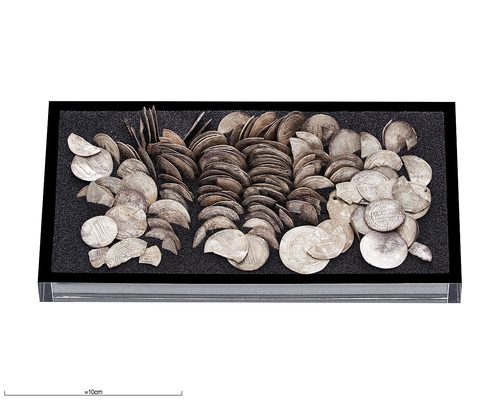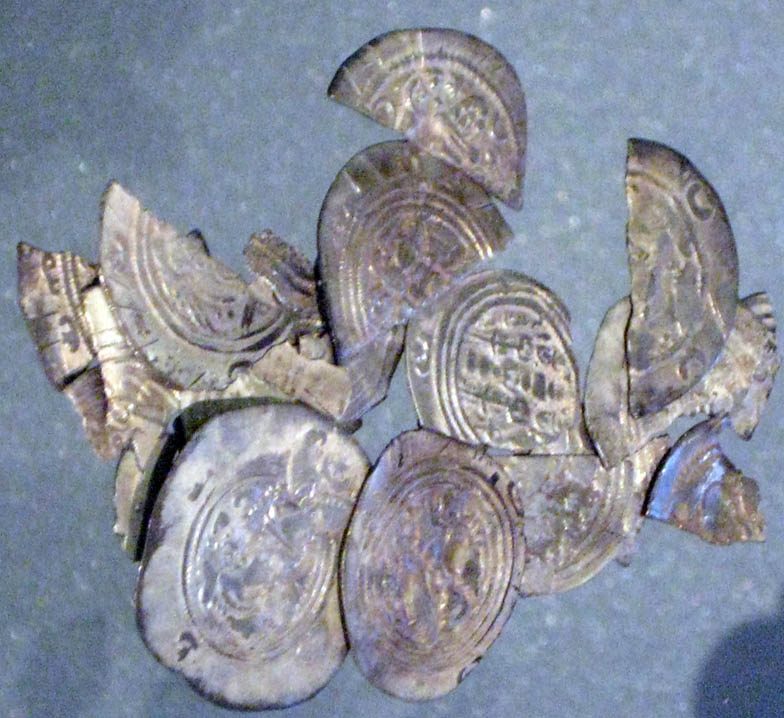
In spring 2008 archaeologists from the Swedish National Heritage Board were excavating a low stone setting at Sundveda, on a ridge between Märsta and Sigtuna north of Stockholm, before the land was built over for housing. They expected an ordinary Iron Age grave. On 1 April they began finding silver coins among the stones, and by the end of the dig they had recovered 482, the largest silver hoard found in the Mälaren region since 1827.
The grave itself proved to have a long and odd history. Radiocarbon dates suggested the stone setting was first built around the first or second century AD, apparently without a burial; the cremated bones in its burial pit belonged to someone who died in the seventh century; and the silver was pushed into the same monument some two hundred years later still. The coins had been put into a hole picked out of the top layer of stones, which were then simply put back; over the centuries some slipped down between the blocks to almost half a metre deep. No container survived, but the excavators thought a cloth or leather bag was likely. A hoard in a grave is unusual, since large Viking-age hoards are more often found on settlement sites.
All but one coin came from the east. Most are Islamic dirhams, from mints spread from Spain and Morocco to Afghanistan and Uzbekistan, Baghdad and Damascus among them. An unusually large share, about one in nine, are older Persian drachms. Among them is a fragment struck for the Sasanian king Peroz I in the 470s or early 480s, the oldest Sasanian coin yet recorded in Scandinavia. There are imitation dirhams made in North Africa and by the Khazars on the lower Volga, and a single western coin, a Carolingian penny of Louis the Pious.
The youngest coin that can be read was struck in 843/44, and the cataloguer estimates the hoard went into the ground around 850-860. That makes Sundveda one of the earliest Viking-age hoards from mainland Sweden, from a time when hoards in the Mälaren valley are rare and small. Most of the coins were struck in the eighth century, so the silver had been circulating for a long time before it was buried. Nearly four in five coins are cut or broken, showing that they were handled as bullion and weighed rather than counted.
Why someone chose an old grave mound for their silver is unknown. The excavators suggested the money might have come from trade across the Baltic towards Russia, or as payment for service abroad, and that the visible monument served as a marker. The site lies a few kilometres from where Sigtuna would be founded around 980, in a district already busy with farms and cemeteries in the ninth century.
Because the hoard was excavated by archaeologists, not ploughed up, its position, the grave and its dating evidence were recorded in detail, which is rare for a hoard of this size.
Highlights
A fragment of a silver drachm of the Sasanian king Peroz I (459-484), the oldest Sasanian coin found in Scandinavia, already more than 350 years old when buried.
The only western coin, a 'Christiana Religio' penny of Louis the Pious (814-840), a type rarely found in Swedish hoards.
Copies of Islamic dirhams made by the Khazars, probably at a centre on the lower Volga, showing how silver passed through intermediaries on its way north.
What is in it
Silver coins only: Islamic dirhams, a notable share of Persian (Sasanian-type) drachms, a few North African and Khazar imitations and one Carolingian penny. Most are cut or broken.
Size: 482 coins (108 whole, 374 fragments). Weight: about 646 g after conservation.
| Item | Number | Notes |
|---|---|---|
| Islamic dirhams | the large majority | From mints between Spain and Morocco in the west and Afghanistan and Uzbekistan in the east |
| Pahlavi-type drachms | about 11 per cent | Sasanian and early Islamic coins from Iran, including a drachm of the Sasanian king Peroz I (459-484) |
| Imitations | a few | North African imitation dirhams and Khazar imitations from the lower Volga |
| Carolingian penny | 1 | 'Christiana Religio' type of Louis the Pious (814-840) |
Photographs
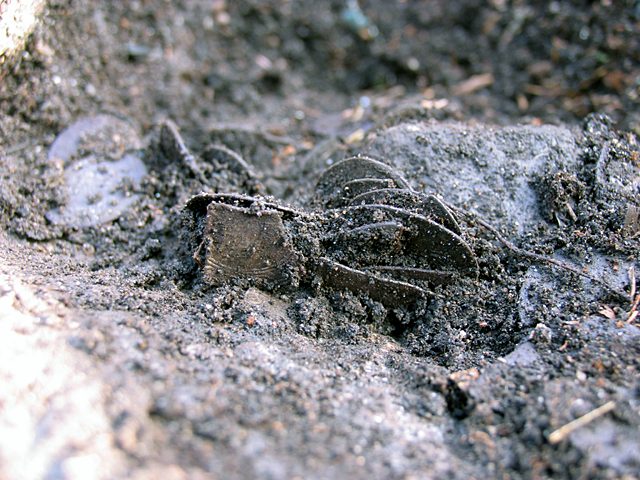
Photo: Juicylucy, CC BY-SA 3.0, via Wikimedia Commons
How it is dated
The latest legible coin is a dirham dated AH 229 (AD 843/44), with a Carolingian penny of 814-840 and Khazar imitations of about 837/38 also near the end of the range. Allowing time for the coins to travel north, the excavation report places the burial around 850 or somewhat later, and the full coin study at about 850-860 or slightly later.
What happened after the find
Excavated by the Swedish National Heritage Board as part of a planned investigation required before development. The finds were held by the Board pending a decision on which museum would receive them.
Where sources differ
- Weight: 646.44 g after conservation (Sigtuna Museum yearbook, 2012) versus about 660 g (English Wikipedia).
- Whole coins: 108 (Sigtuna yearbook) versus 109 (excavation report, which notes the count could change as fragile coins broke).
- Early press reports gave about 450 or 452 coins; the catalogued count is 482.
- The bag is an interpretation: the excavation report found no remains of a container but suggests a cloth or leather bag.
- Current holding museum not confirmed.
Questions
Where was the Sundveda Hoard found?
In an old stone-setting grave at Sundveda, between Märsta and Sigtuna north of Stockholm, during an excavation before housing was built in 2008.
How old is the Sundveda Hoard?
It was buried around 850-860 or slightly later, making it one of the earliest Viking-age silver hoards from mainland Sweden, though many of its coins are much older.