In July 1999 a Swedish television crew came to a field at Spillings, a farm in Othem parish on the north-east coast of Gotland, to film a short piece about the looting of archaeological sites. The farmer had reported coins from the field the previous autumn, and an archaeologist and a numismatist were on hand. The filming turned up a few lumps of melted bronze. About twenty minutes after the crew drove away, the detector gave a strong signal, and by the end of the day two silver deposits lay exposed about three metres apart. On the larger one, by the archaeologist's own account, the machine simply showed 'overload' and switched itself off.
Gotlands Museum chose to announce the find at once rather than keep it quiet, and posted guards while the deposits were excavated. The silver was too fragile to pick out by hand, so the lower parts were cased in plaster and lifted as blocks. They proved to weigh about 27 kg and 40 kg. A third cache, of bronze, was traced a few days later and lifted the following year. One deposit had been clipped by the plough, and a former owner of the land remembered throwing away 'steel wire' from the same spot years before, so the original total was larger still.
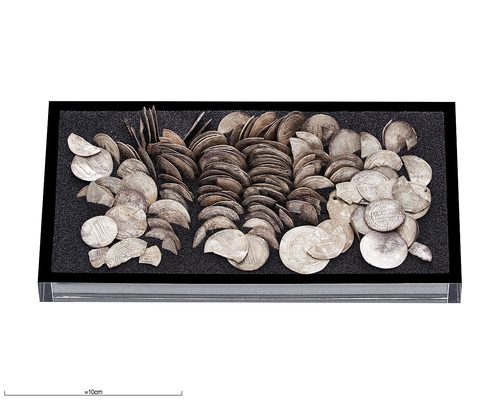
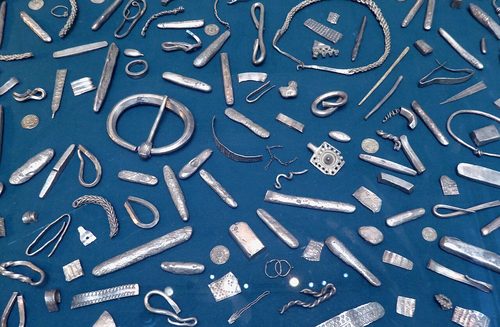
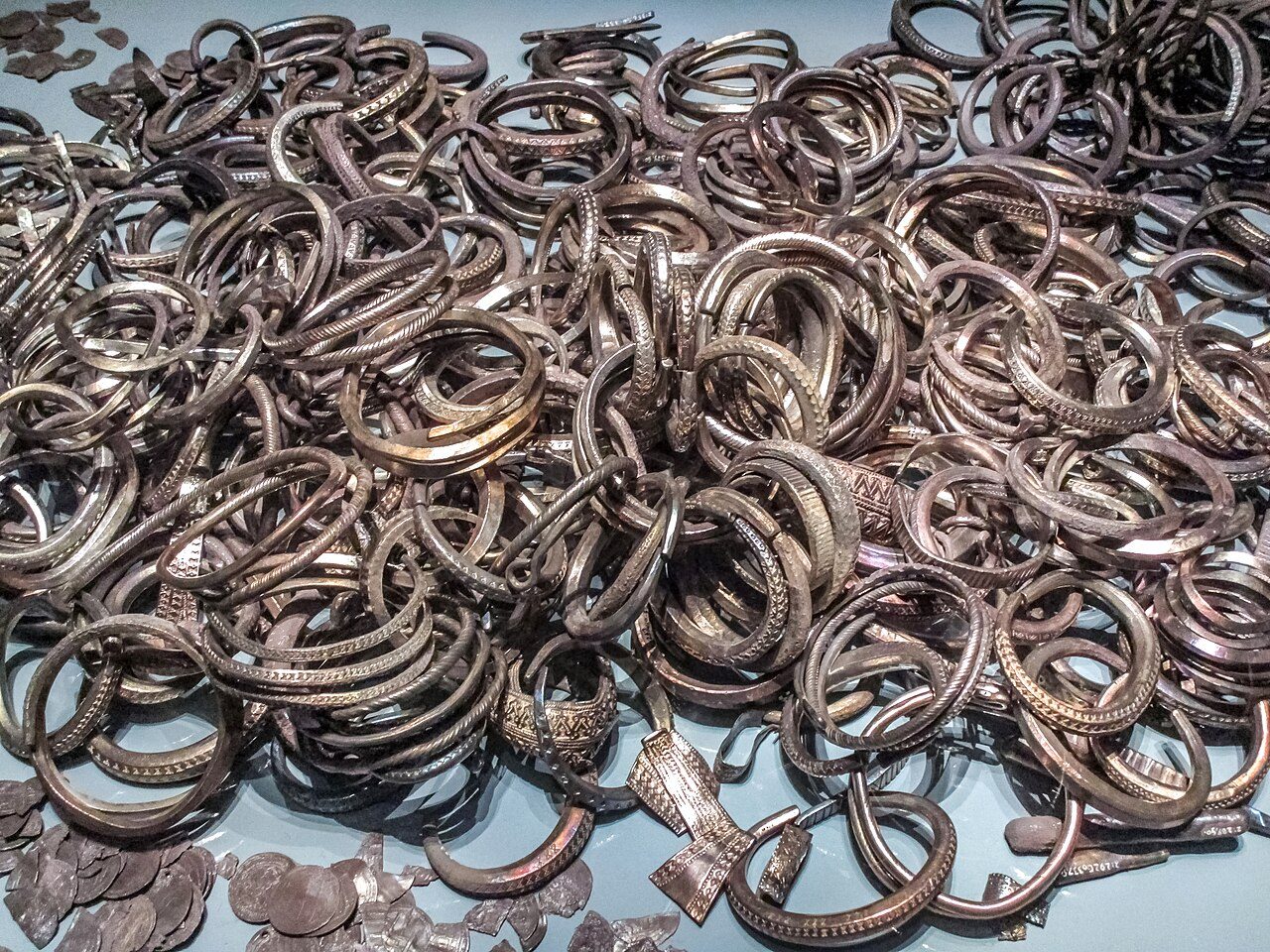
The numbers are hard to take in. Together the two silver deposits held 14,295 coins and close to 500 arm-rings, along with bars, coiled wire, finger-rings, neck-rings and chopped silver. For comparison, the Swedish History Museum notes that an ordinary Gotland silver hoard weighs 200 to 300 grams, and that the previous Swedish record, from Burge in Lummelunda, was about 10.4 kg. Many arm-rings are of the stamped Gotlandic type, weighing around 100 grams each, and were threaded together in bunches that seem to match Viking-age weight units. A few are of kinds more at home in Norway or the British Isles, and some plain rings resemble the 'ring money' of Finland and Britain.
Almost all the coins are dirhams from the Islamic world, struck at dozens of mints between Central Asia and North Africa. The oldest is a Sasanian Persian piece of 539; the youngest that has been identified dates to 870. Many coins and rings carry small nicks where someone tested the metal under the surface. Among the dirhams are contemporary imitations made of good silver, and one coin struck by the Khazars of the lower Volga that replaces the usual Muslim creed with 'Moses is the messenger of God'.
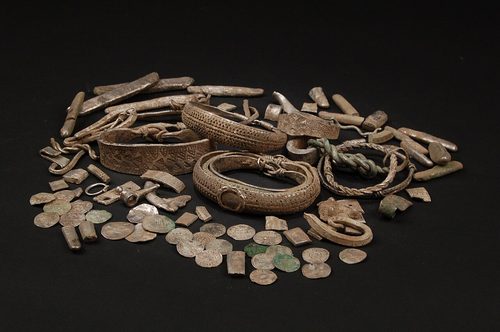
Excavations in 2000 and again in 2003 to 2006 showed that the three caches had lain beneath the floor of a wooden building with no hearth: a storehouse or outbuilding rather than a home. Traces of wood, iron fittings and a lock show the bronze, at least, had been kept in a chest. The bronze itself, broken neck-rings, bangles, pins and drinking-horn mounts, is mostly of East Baltic type and looks like stock gathered for recasting.
Who owned all this is unknown. The farm lay close to one of Gotland's best natural harbours, and Gotlanders sat on the routes that carried Arab silver from Russian rivers into the Baltic. The hoard is best read as the stored wealth of a household that did very well out of that traffic, buried and never recovered. Its scale has made it a reference collection for studying how silver moved and was valued in the ninth century.
Highlights
A silver coin struck in the Khazar realm in the 830s or 840s with the Arabic legend 'Moses is the messenger of God'. It is cited as rare physical evidence for the reported conversion of the Khazar elite to Judaism.
Hundreds of stamped Gotlandic arm-rings, many of about 100 grams, found threaded together. Their regular weights suggest they worked as a store of value as much as ornament.
Cast ingots from the larger deposit, raw material ready to be cut up, weighed and paid out.
A mass of bronze scrap about 40 cm across, partly fused by heat, from the third cache. Large deposits of bronze meant for melting are very rarely found.
What is in it
Two silver deposits of coins, arm-rings, bars, wire, finger-rings and cut silver, plus a separate chest of broken and part-melted bronze scrap.
Size: 14,295 coins, about 486 arm-rings, and hundreds of other pieces. Weight: about 67 kg of silver before conservation (two deposits of about 27 kg and 40 kg), plus over 20 kg of bronze.
| Item | Number | Notes |
|---|---|---|
| Silver deposit 1 | over 5,000 coins, 178 arm-rings | Also finger-rings, bars, rods and neck-rings; damaged by ploughing, so once larger |
| Silver deposit 2 | over 9,000 coins, about 340 arm-rings | Heavy objects at the bottom, cut coins strewn over the top |
| Coins (both deposits) | 14,295 | About 14,200 Islamic dirhams, 23 Sasanian Persian, 4 Scandinavian (Hedeby type), 1 Byzantine |
| Bronze deposit | over 20 kg | Broken and melted ornaments, mostly of East Baltic type, in a spruce chest with an iron lock |
Photographs
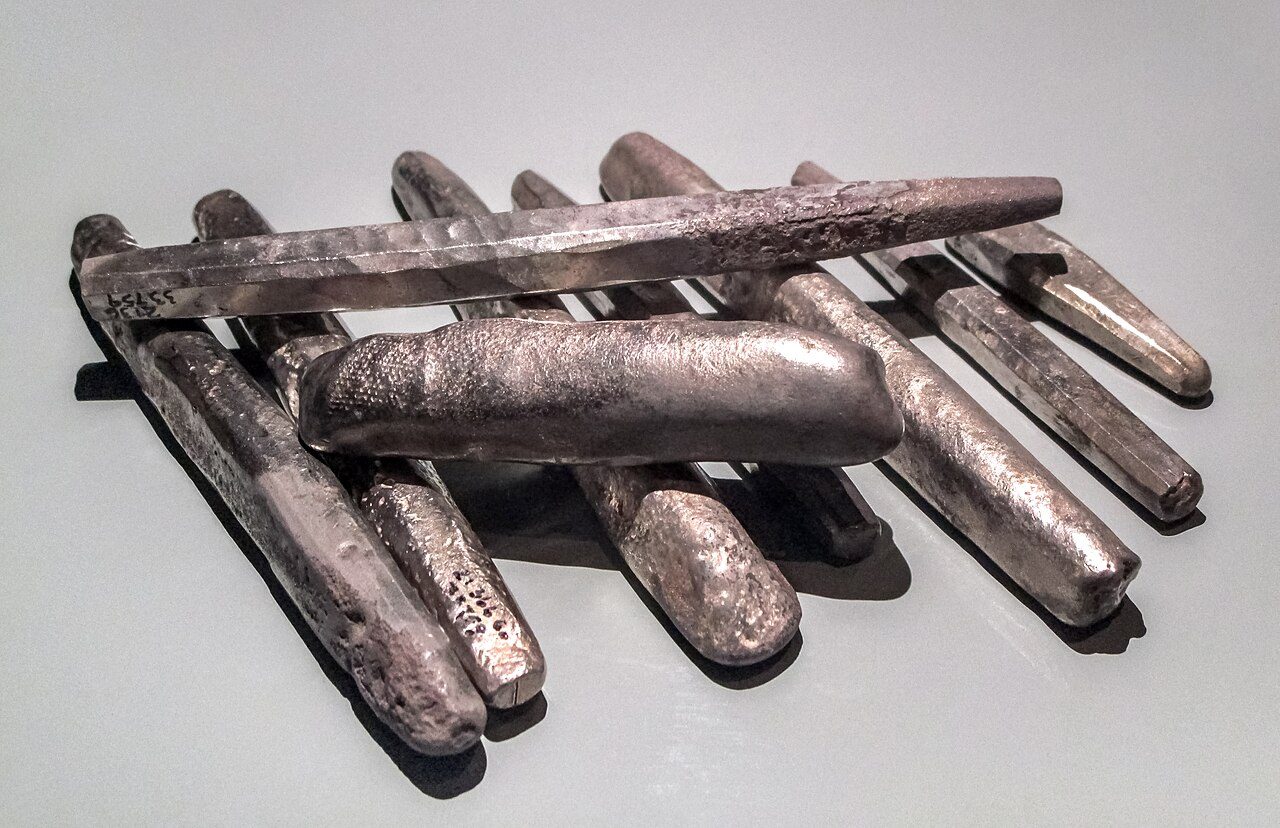
Photo: W.carter, CC BY-SA 4.0, via Wikimedia Commons
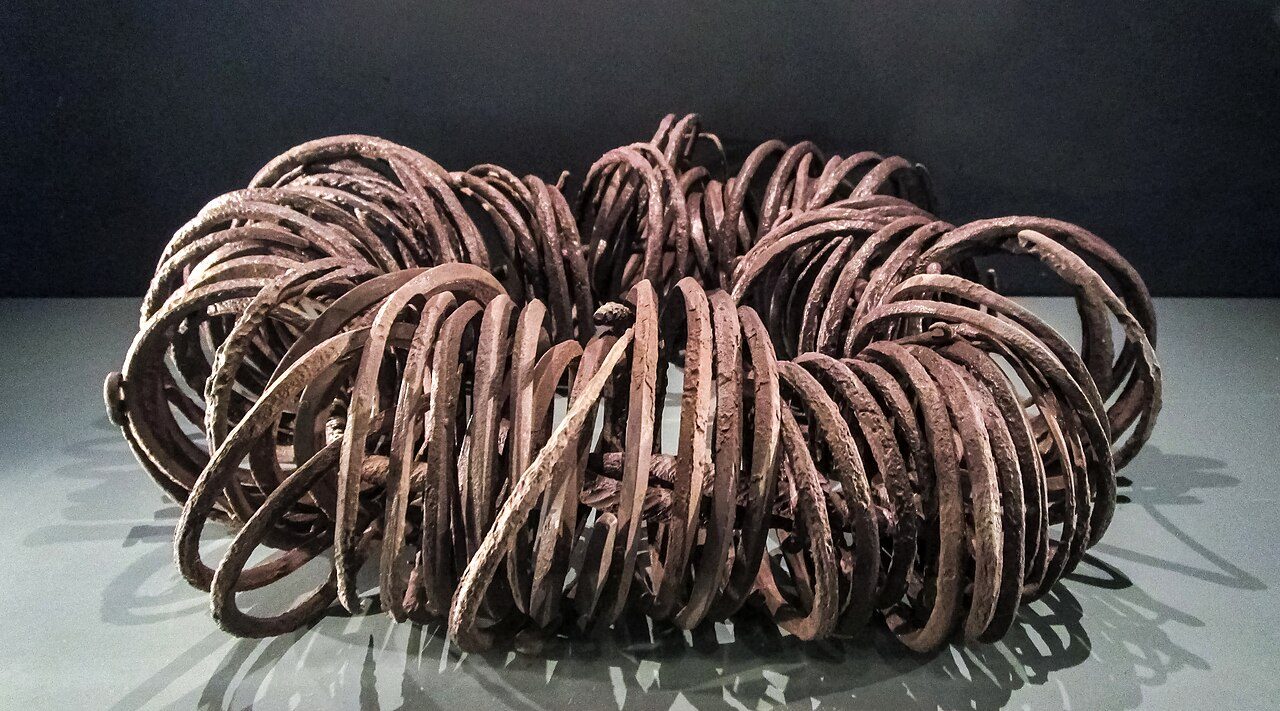
Photo: W.carter, CC BY-SA 4.0, via Wikimedia Commons
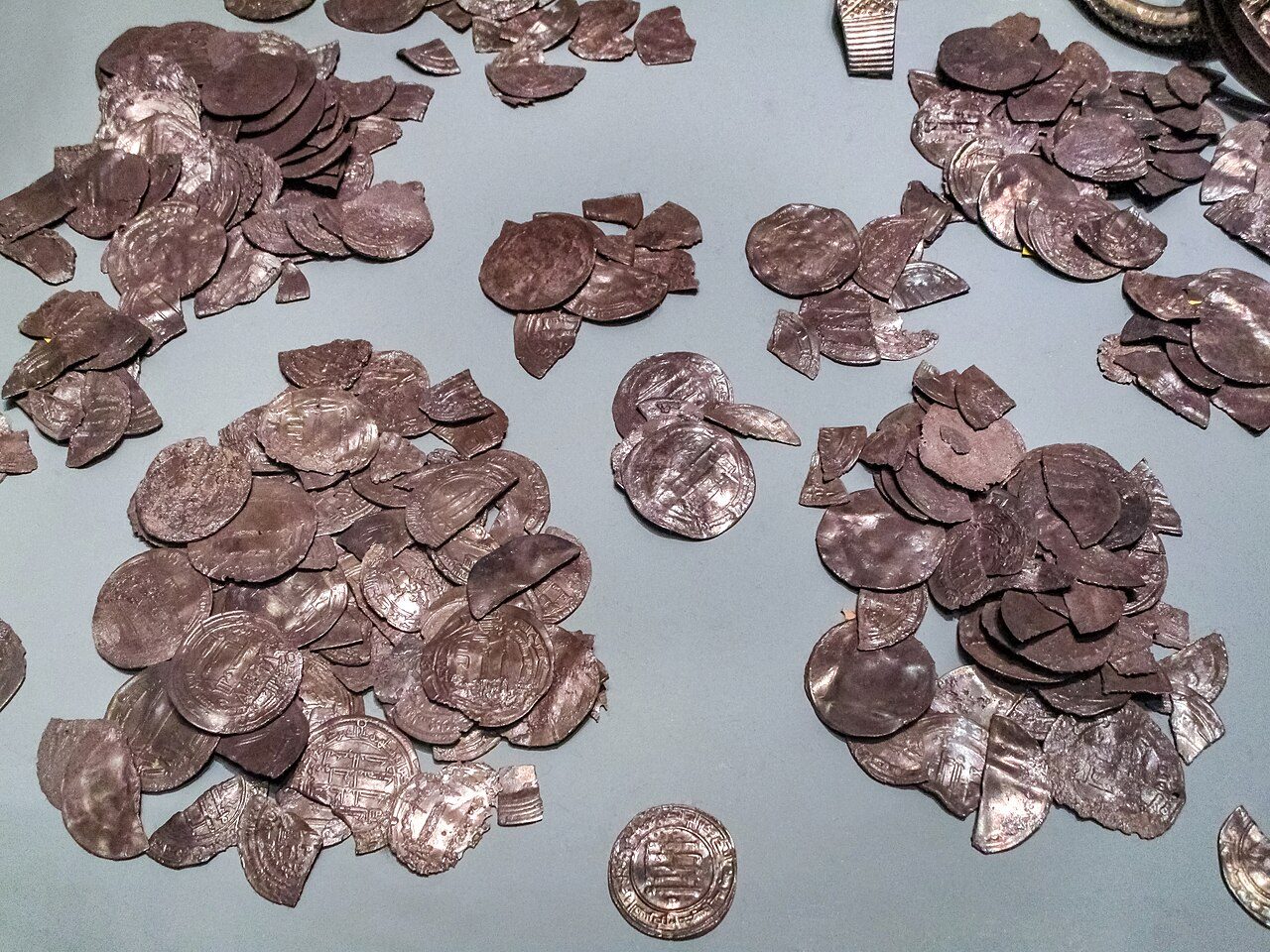
Photo: W.carter, CC BY-SA 4.0, via Wikimedia Commons
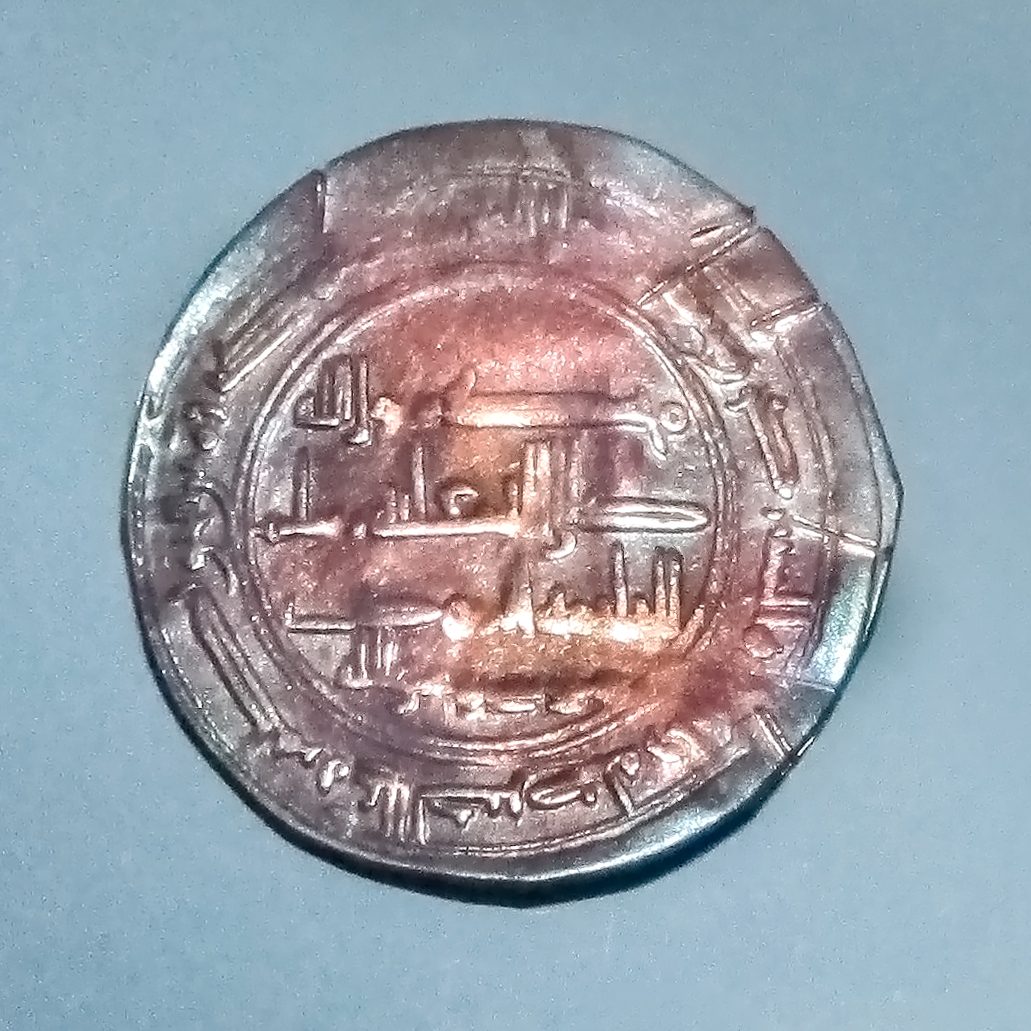
Photo: W.carter, CC BY-SA 4.0, via Wikimedia Commons
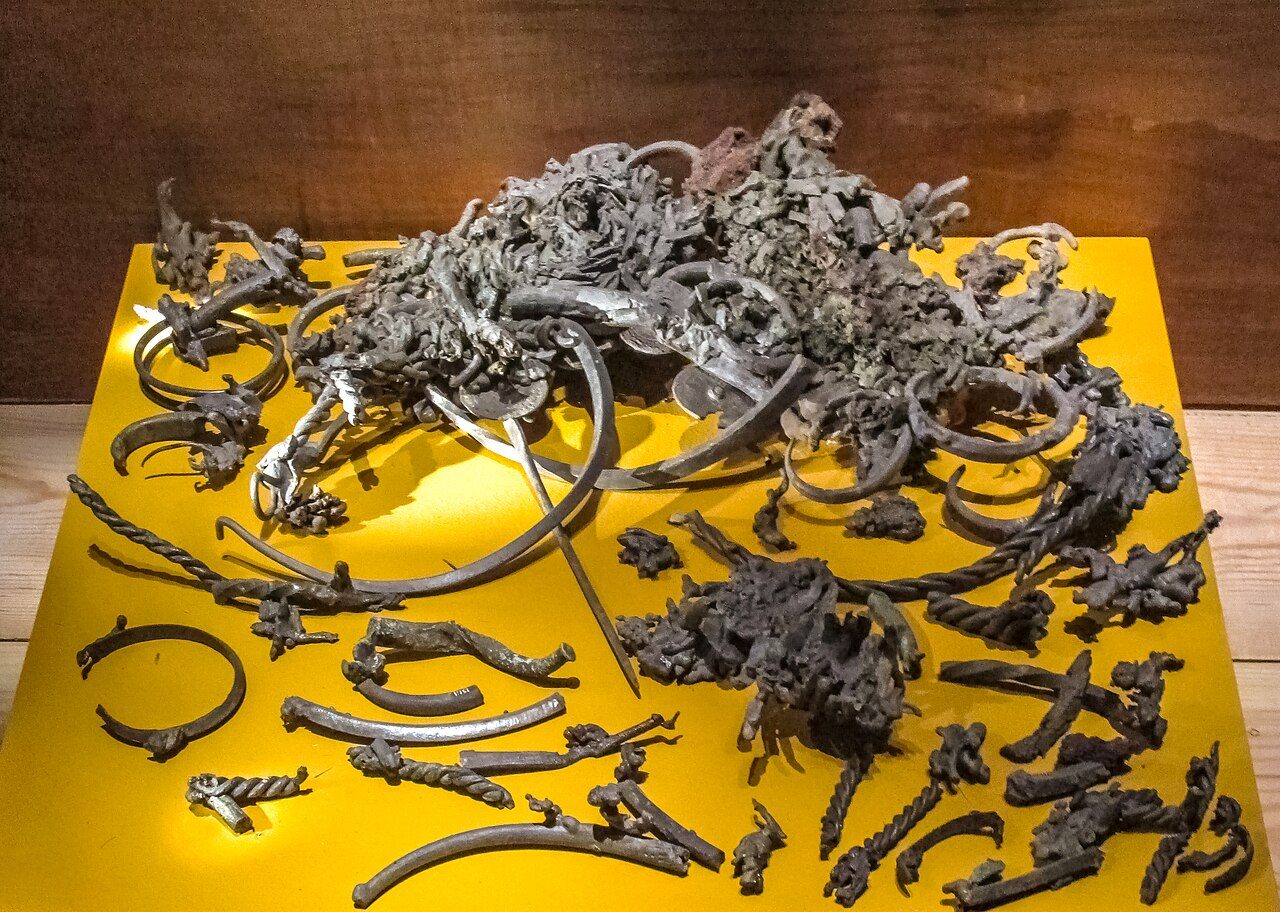
Photo: W.carter, CC BY-SA 4.0, via Wikimedia Commons
How it is dated
The youngest coin identified so far is a dirham of AD 870 (one Swedish summary gives 871), which sets the earliest possible date of burial. The building over the caches was radiocarbon-dated to a long span of use, so the coins give the tighter date. Not all coins have yet been fully studied, so a slightly later coin could still turn up.
What happened after the find
Under Swedish law the silver was claimed by the state and a finder's reward was paid to the landowner. Accounts of the amount differ; English sources cite about SEK 2.09 million, at the time the largest reward ever paid for a Swedish find.
Where sources differ
- Total weight: Wikipedia gives 67 kg of silver before conservation (27 + 40 kg); the Swedish History Museum gives just over 25 kg and around 41 kg for the silver and 'approximately 76 kilograms of silver and bronze' overall; a 2002 press report gives 85 kg for all material.
- Latest coin: 870 in English sources and the Swedish History Museum; 871 in Swedish Wikipedia.
- Finder's reward: SEK 2,091,672 (English Wikipedia) versus SEK 1,263,200 (Swedish Wikipedia).
- Date of the Moses coin: c. 800 (English Wikipedia), 830-840 (2002 press report), c. 837 (Swedish Wikipedia).
Questions
Where can I see the Spillings Hoard?
The hoard is on permanent display at Gotlands Museum (Fornsalen) in Visby, on the island of Gotland. It was shown in Stockholm in 2002 before returning to the island.
How big is the Spillings Hoard?
It is the largest Viking-age silver hoard known: about 67 kg of silver in two deposits, with 14,295 coins and nearly 500 arm-rings, plus a separate deposit of over 20 kg of bronze scrap.
Why is there so much Arab silver on Gotland?
In the ninth and tenth centuries silver dirhams flowed north from the Islamic world along the Russian rivers in exchange for furs, slaves and other goods. Gotland sat in the middle of the Baltic on those routes, and the island has produced hundreds of silver hoards.