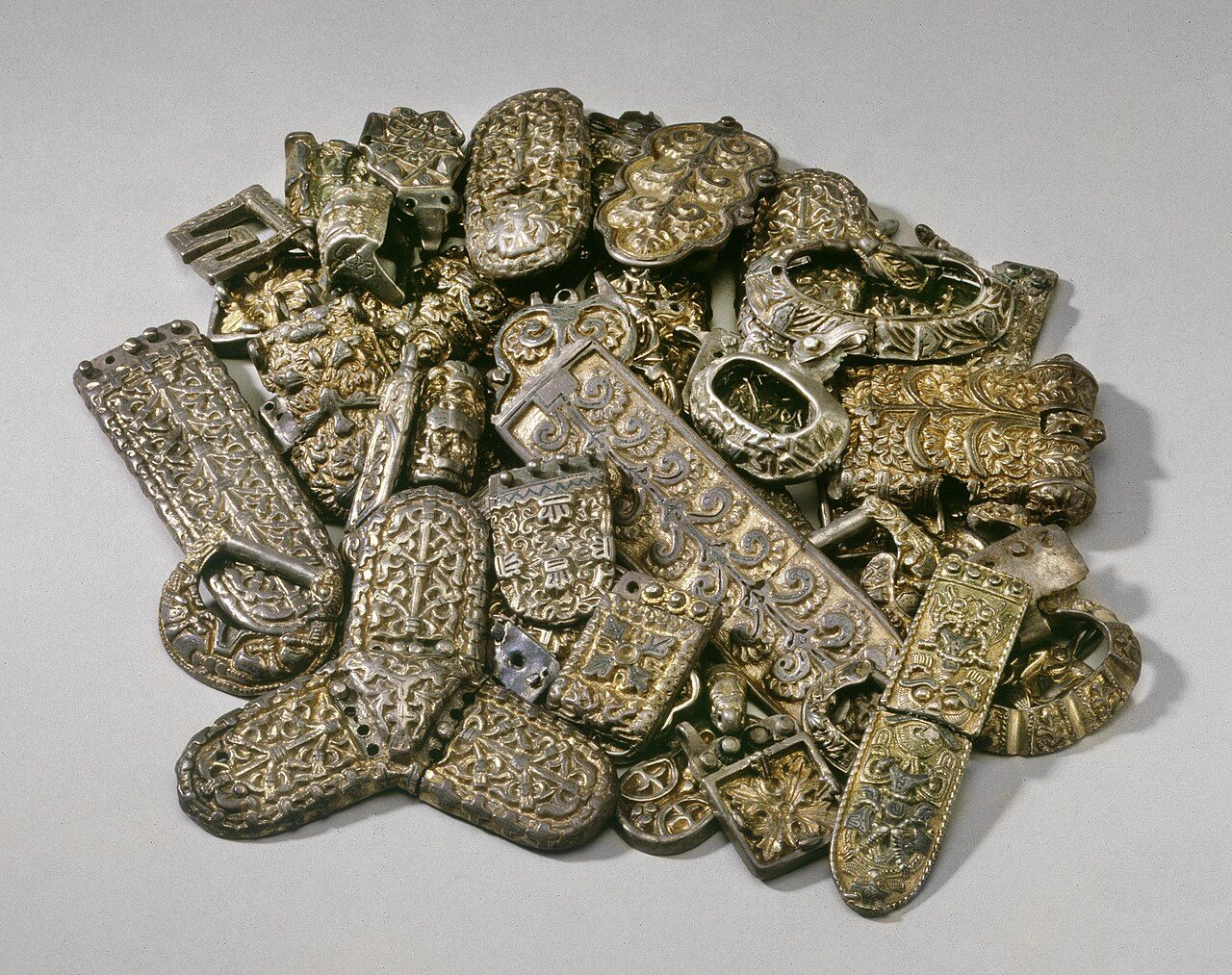
In 2002 an amateur archaeologist searching a field at Duesminde, south-west of Maribo on the Danish island of Lolland, began picking up pieces of ornate silver. The hoard had been struck by a plough at some point in recent times, and its parts lay spread over an area about ten by fifteen metres. Gathered together, they came to roughly fifty pieces weighing about 1.3 kg. The same field had already produced a different hoard forty years earlier: 23 spiral silver rings, probably from the Volga region, and a gold ring, found in 1962-65.
What came up in 2002 was not the usual Viking mix of coins and chopped silver. It was almost entirely Frankish metalwork: buckles, strap mounts and strap ends of silver, many of them gilded, from elaborate belts and at least one fine sword belt. The National Museum of Denmark notes that such fittings had never been found in such concentration anywhere in Europe. Most were made in the Carolingian empire between about 820 and 870, the generation of the great Viking raids on Frankia. Among them is a fragment of a key of a type used in church ceremonies.
That combination has led to the obvious suspicion that some of this silver was taken from a Frankish church or monastery, or formed part of the tribute and ransoms that Frankish rulers paid to Viking armies in the mid-ninth century. Nobody can prove how it reached Lolland. A war-band returning with booty is one explanation; the National Museum also allows that the hoard may have belonged to a rich man safeguarding his wealth, or to a silversmith or travelling trader keeping metal for reuse.
Not everything is Frankish. Some fittings and pendants carry animal ornament in Scandinavian style and were made between about 850 and 950. Their presence means the hoard was put together over time and buried no earlier than the middle of the tenth century, generations after most of the Frankish pieces were made. By then the belt fittings may have been treasured heirlooms, or simply silver waiting to be melted.
Duesminde is one of the clearest physical traces in Denmark of the Viking age's dealings with the Continent, whether by raid, ransom or trade. Because it was reported and recorded, its scattered pieces could be mapped and reunited, and the mixture of Frankish and Nordic work in one deposit shows how foreign treasure was absorbed into Scandinavian wealth over several generations.
Highlights
A set of gilt silver mounts for a sword scabbard and belt, made in the Carolingian empire in the mid-ninth century.
Part of a key of a kind used in church ritual, supporting the idea that some of the silver came from a church.
A smaller group of Scandinavian-made fittings and pendants with animal ornament, which date the burial to the mid-tenth century or later.
What is in it
Mostly Frankish silver and silver-gilt fittings from belts and a sword belt, with strap mounts, pendants and a fragment of a liturgical key, plus some Scandinavian-made pieces.
Size: about 50 pieces. Weight: about 1.3 kg of silver.
| Item | Number | Notes |
|---|---|---|
| Frankish belt and sword-belt fittings | most of the hoard | Buckles, strap mounts and strap ends, many gilded, made in the Frankish empire about 820-870 |
| Scandinavian pieces | some | Fittings and pendants with Nordic animal ornament, about 850-950 |
| Key fragment | 1 | Part of a key of a type used in church ritual |
How it is dated
The Frankish fittings were made between about 820 and 870, but some Scandinavian pieces in the hoard are dated by their animal ornament to about 850-950. The National Museum concludes that the hoard was buried in the middle of the tenth century or later. There are no coins to narrow the date.
What happened after the find
Declared danefæ (treasure belonging to the Crown) and acquired by the National Museum of Denmark; it was first shown at Stiftsmuseet Maribo.
Where sources differ
- Count: about 50 pieces (National Museum; Danish Wikipedia) versus 35 Frankish mounts (Danish Wikipedia article on prehistoric Lolland), which may count only the Frankish fittings.
- Date range of the Frankish pieces: 820-870 (National Museum) versus 825-875 (the museum's 2013 Flickr caption and another Danish Wikipedia article).
- The earlier rings were found 'forty years earlier' / 1962-65 (National Museum) or 'in the 1960s' (Danish Wikipedia).
- The 'danefæ' status is inferred from the hoard being in the National Museum, not stated outright in the sources.
Questions
What is the Duesminde Hoard?
A Viking-age silver hoard of about 50 pieces, mostly Frankish silver-gilt belt and sword-belt fittings, found with a metal detector on Lolland, Denmark, in 2002.
Is the Duesminde silver Viking loot?
Possibly. Most pieces were made in the Frankish empire in 820-870, the era of Viking raids, and one is a church key fragment, but the hoard could also have been a trader's or silversmith's stock.