On a Thursday in October 2015 a metal detectorist working a field near Watlington, at the foot of the Chilterns, found a cluster of silver close to the surface. He reported it, and archaeologists excavated the find. At the British Museum the muddy mass was described as looking like a greasy haggis with bits of treasure sticking out at the corners. Some arm-rings had to be carefully freed from the flints they were wedged against.
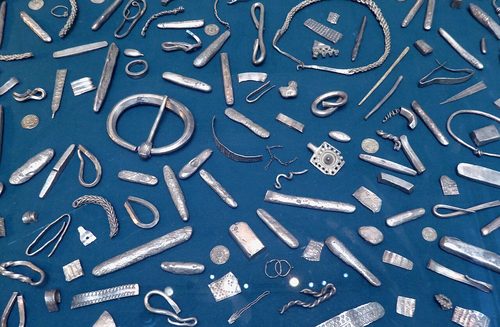
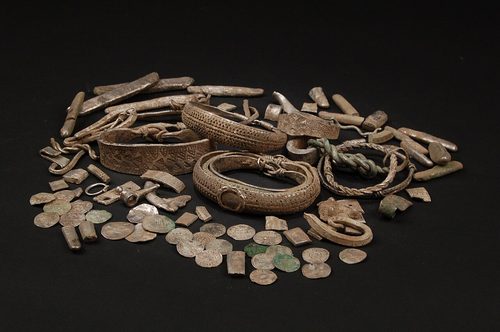
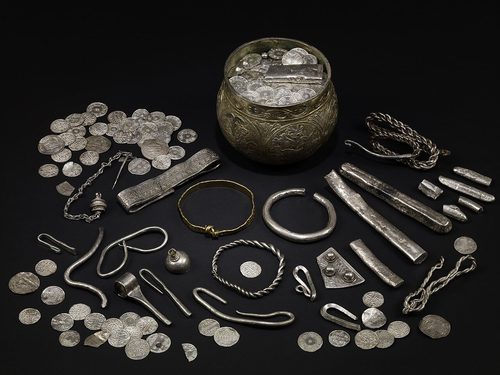
Cleaned, the block held some 200 silver pennies, 15 ingots, three arm-rings, two hacked-off ends of twisted neck-rings and a tiny piece of chopped gold rod, the first scrap of 'hack-gold' found in a Viking hoard in Britain. The ingots and jewellery are typical Viking bullion, the kind of silver weighed out in trade, and close parallels for the rings occur at Cuerdale and in Scandinavia.
The coins are what made the hoard famous. Most were struck in the late 870s for two kings: Alfred the Great of Wessex and Ceolwulf II of Mercia. Thirteen are of the 'Two Emperors' type, which shows two rulers seated side by side under a winged Victory, a design borrowed from late Roman coins. Before 2015 only a single example was known for each king. Many more are of the Cross-and-Lozenge type, which the two kings also struck jointly, sharing moneyers.
That matters because the Anglo-Saxon Chronicle, written at Alfred's court, dismisses Ceolwulf as 'an unwise king's thane' installed by the Vikings. The coins suggest instead a deliberate partnership between Wessex and Mercia, with Ceolwulf presented as Alfred's equal. Ceolwulf vanishes from the record soon afterwards, conventionally around 879, and Alfred's chroniclers had little reason to remember him kindly.
The burial date fits the war. In 878 Alfred defeated the Viking Great Army under Guthrum at Edington, forcing the Danes to retreat north. The coins stop around 879-80: the only coin of Alfred's next type, the Two-Line penny, is a single early example. A member of the retreating army may have hidden his share of silver and never returned, though that is an informed guess rather than a certainty.
The hoard was declared Treasure. In 2017 the Ashmolean Museum bought it for £1.35 million, with £1.05 million from the National Lottery Heritage Fund, £150,000 from the Art Fund and the rest from public donations, about 700 people among them.
Highlights
Thirteen pennies of Alfred and Ceolwulf II show two seated rulers under a winged Victory, a type known from just one coin of each king before 2015.
The bulk of the coins, struck c. 875-79 by both kings in a shared London style, often by the same moneyers.
A 14 mm piece cut from a twisted gold rod, probably an arm- or neck-ring, weighing 1.54 g.
A lozenge-sectioned silver arm-ring with ends twisted together and punched triangle decoration, a type also found at Cuerdale.
What is in it
About 200 silver pennies of Alfred the Great, Ceolwulf II of Mercia and the archbishop of Canterbury, two Carolingian deniers, 15 silver ingots, three arm-rings, two cut neck-ring ends and a scrap of gold.
Size: about 224 pieces (203 coins and 21 other items).
| Item | Number | Notes |
|---|---|---|
| Coins of Alfred the Great | 134 | including 10 Two Emperors pennies and one Two-Line penny |
| Coins of Ceolwulf II of Mercia | 56 | including 3 Two Emperors pennies |
| Other coins | 13 | 2 of Archbishop Æthelred of Canterbury, 8 uncertain, 2 Carolingian deniers from Pavia |
| Silver ingots | 15 | |
| Jewellery | 6 | 3 complete arm-rings, 2 cut neck-ring terminals, 1 scrap of twisted gold rod (1.5 g) |
How it is dated
The coin catalogue dates the coinage to c. 875-79/80 and the burial to c. 879-80. Almost all the English coins belong to the Two Emperors and Cross-and-Lozenge issues, and the single Two-Line penny of Alfred is the earliest of that new type, struck soon after the Battle of Edington.
What happened after the find
Declared Treasure under the Treasure Act 1996 (case 2015 T759). The Ashmolean Museum bought it for £1.35 million in 2017 with National Lottery and Art Fund grants and public donations; the reward went to the finder and the landowner.
Where sources differ
- Coin count: the Portable Antiquities Scheme record (following the 2022 publication) lists 203 coins including fragments; Wikipedia gives 186; the BBC said about 200; the Guardian in 2015 said at least 180. Early counts were made before the block was fully excavated.
- Jewellery count: Wikipedia says 7 pieces of jewellery; the PAS record lists 3 arm-rings, 2 neck-ring terminals and 1 gold fragment (6).
- The link between the burial and the Great Army's retreat after Edington is an interpretation, not proven.
- Ceolwulf's reign is conventionally 874-879 from a regnal list giving him five years; D. P. Kirby argued it ran into the early 880s.
Questions
Where is the Watlington Hoard?
It belongs to the Ashmolean Museum in Oxford, which bought it in 2017 so that it could stay in Oxfordshire.
Why is the Watlington Hoard important?
Its Two Emperors pennies show Alfred the Great and Ceolwulf II of Mercia as allies of equal standing, which contradicts the hostile picture of Ceolwulf in the Anglo-Saxon Chronicle.
How much was the Watlington Hoard worth?
The Ashmolean paid £1.35 million for it, raised mostly from the National Lottery Heritage Fund and the Art Fund, with about 700 public donations.
Sources
- Watlington Hoard (Wikipedia)
- Portable Antiquities Scheme record SUR-4A4231 (archived)
- Watlington hoard: relics purchased for £1.35m by Ashmolean Museum (BBC News, 2017)
- Watlington hoard of Viking silver casts light on Alfred the Great era (The Guardian, 2015)
- J. Naylor and E. Standley (eds), The Watlington Hoard (Archaeopress, 2022, open access)
- Wikidata Q24718384 (CC0)