Migration period hoards
c. 400-600 · 8 hoards on this site
On a hillfort in East Lothian, in 1919, excavators lifted just over 23 kg of late Roman silver from a pit. The Traprain Law Treasure is mostly tableware, platters, bowls, jugs and spoons, with basins and mirror fragments from the bath, but nearly all of it has been cut into pieces or crushed flat. Recent study shows that many pieces were cut carefully to standard Roman weights, so the silver was probably turned into bullion inside the Roman world and then handed north. Older accounts called it loot; more recent ones prefer diplomatic gifts or pay for military service. It was buried in the early fifth century, well beyond the frontier: the archetypal hoard of the period, imperial wealth broken up and carried away.
Much of what moved was gold. The Roman state paid allies, recruits and enemies in solidi, coins struck at 72 to the pound, and the Germanic and Hunnic world turned that gold into ornaments of rank. The Pietroasele Treasure, found in 1837 in Buzău county in Romania, was a late fourth-century Gothic hoard of some twenty-two gold objects, among them eagle-headed brooches set with stones and a dish with a seated goddess at its centre. Only twelve pieces survive, and those spent forty years in Moscow after being sent there for safety in 1916. In Scandinavia the same flow of gold produced bracteates, thin single-sided pendants of the fifth to seventh centuries whose designs borrowed from Roman coins and medallions and turned them into images of northern rulers and gods.
The safekeeping-or-offering question is especially sharp here. At Vindelev in Jutland, a metal detectorist found 23 gold objects in 2020, 794 g in all: sixteen bracteates, some almost 14 cm across, fittings from a sword scabbard, and four Roman solidi of Constantine I to Gratian reworked as pendants. One bracteate carries a runic line read as 'he is Odin's man', the earliest known mention of the god. The hoard lay inside a longhouse that may have been a chieftain's hall, which suggests hiding in wartime; yet several of the largest pieces had been folded symmetrically before burial, which looks like ritual. Wealth hidden in the house and gold given to the gods were not always separate ideas.
Coins in these hoards were rarely used as small change. The empire went on striking full-weight solidi of about 4.5 g, and in the sixth and seventh centuries also lighter ones, marked at 20 to 23 carats instead of 24, which may have been made for trade or tribute; many of them have been found in central Europe, Russia and Georgia. Migration-period hoards cluster at the edges of the old empire, in Scandinavia, along the lower Danube and in the north of Britain, where the examples on this page were found.
Migration period hoards
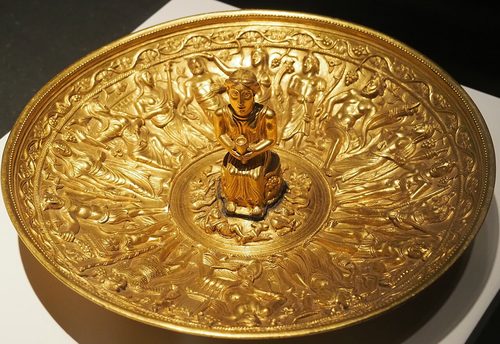
Pietroasele Treasure
A Gothic gold hoard of 22 pieces found by quarrymen in Romania in 1837; twelve survive, including eagle brooches and a runic neck-ring, in Bucharest.
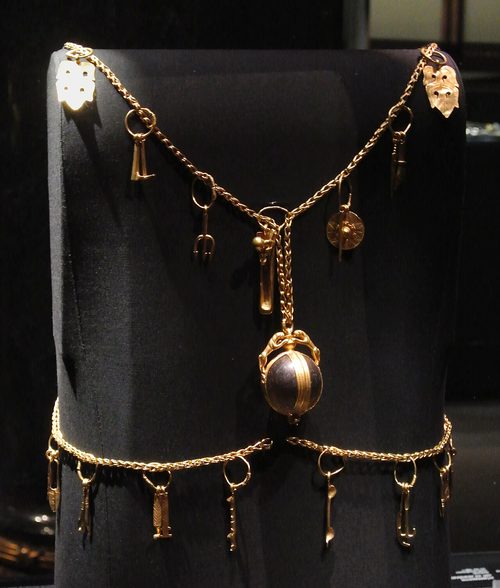
Szilágysomlyó Treasure
Found in two parts on one Transylvanian hill (1797, 1889): Roman gold medallions, a chain of 52 pendants and jewelled brooches of a Germanic royal house.
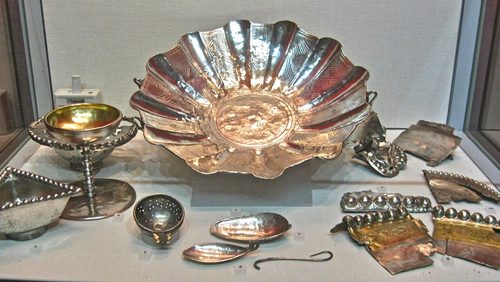
Traprain Law Treasure
About 23 kg of late Roman silver plate, mostly cut and crushed into hacksilver, dug up in 1919 on an East Lothian hillfort beyond Hadrian's Wall.
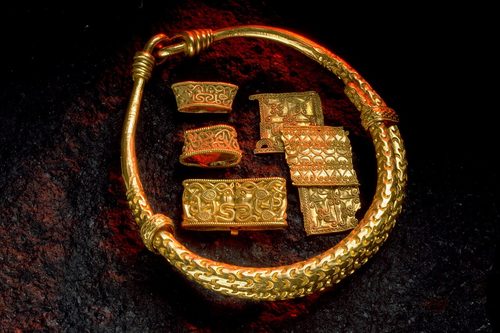
Tureholm Treasure
About 12 kg of Migration Period gold found at Tuna, Södermanland, in 1774. Most was melted down for coin; a neck-ring and sword fittings survive.
Patching Hoard
Gold solidi, silver coins, two gold rings and 54 scraps of hacksilver buried in Sussex after AD 461: the latest hoard of Roman coins ever found in Britain.
Gaulcross Hoard
Pictish silver found in a stone circle near Fordyce in 1838; only three pieces survived until a 2013 dig recovered 100 more, with Roman coins.
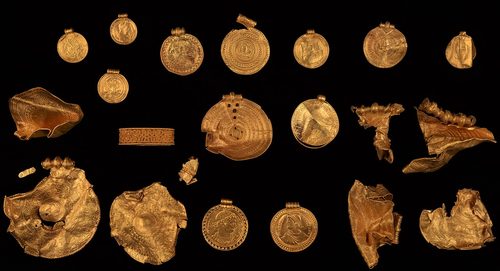
Vindelev Hoard
About 800 g of 5th-6th century gold found by detectorists near Jelling, Denmark, in 2020: the largest known bracteate and the earliest naming of Odin.
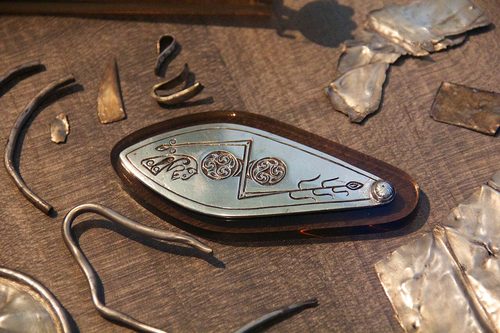
Norrie's Law Hoard
Pictish and late Roman silver dug from a Fife cairn around 1819: perhaps 12 kg found, most melted down; about 170 pieces (750 g) survive in Edinburgh.