In 1838 the new tenant of Ley farm near Fordyce, in what was then Banffshire, set about improving his fields. They held two stone circles, and his men removed them ruthlessly, blowing some of the stones apart with explosives. Among the boulders of a ring-cairn on the south side of the northern circle they found a small group of silver objects. Contemporary accounts mention pins, brooches and buckles, but only three pieces are known to have survived: a hand-pin, a spiral bracelet and a length of silver chain. The landowner, Sir Robert Abercromby, gave them to the museum in Banff, from where they were later lent to the national museum in Edinburgh.
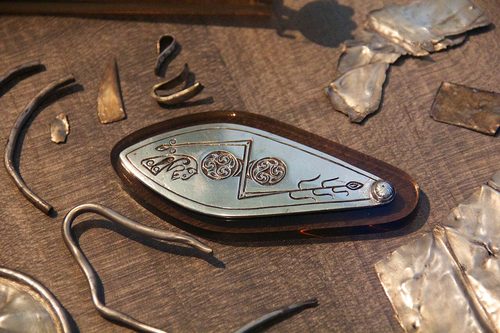
Those three objects were the Gaulcross hoard for 175 years. The hand-pin is among the finest of its kind, a long silver pin with a half-moon head and three projecting fingers, its palm filled with hair-fine spirals ending in tiny bird heads, and the remains of a small cross or star on the central finger.
In spring 2013 a team from the University of Aberdeen's Northern Picts project and National Museums Scotland went back to the field to see whether anything of the find-spot survived. Nothing of the stone circles was left above ground, but on the second day a metal detectorist working with the project found three late Roman silver coins, folded hacksilver, a strap-end and part of a bracelet. With the field about to be ploughed and sown, the team stripped the topsoil in stages, detecting each layer and plotting every find by GPS. Over the following eighteen months the field was searched again and again.
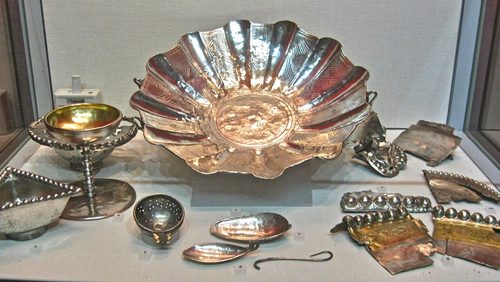
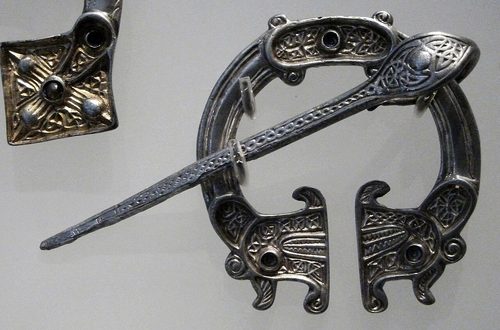
The result was 100 new silver items, all from the disturbed plough-soil. They change the hoard completely. Gaulcross was not a small group of ornaments but a hacksilver hoard: fragments of late Roman dishes and spoon handles, clipped Roman coins, ingots of two different shapes, bracelets chopped up and bundled into packets, sometimes with a coin pinched inside the fold. There are also intact ornaments, among them a crescent-shaped pendant and a rare small zoomorphic penannular brooch in silver. Many of these pieces have close matches in the Norrie's Law hoard from Fife.
The find makes Gaulcross the most northerly pre-Viking hacksilver hoard known in Europe, and one of only two comparable hoards from Scotland. It shows late Roman silver being cut, weighed and recirculated far beyond the frontier, and then remade into the status objects of an emerging Pictish elite. The coin-filled parcels hint at standard weights of silver used as payment, whether for service in the late Roman army, as subsidies to native leaders, or in exchange among the Picts themselves.
The project also made a point about protection. Like most 19th-century hoard sites in Scotland, Gaulcross had no legal protection, and its survival depended on careful, permitted excavation by a research team before the next ploughing.
Highlights
A silver pin with a half-moon head and three fingers, its palm filled with fine spirals ending in bird heads. It has been described as probably the finest known pin of its type.
Bracelet fragments folded into packets, two of them with late Roman silver coins squeezed into the fold, perhaps measured units of silver.
Ingots of two shapes, D-sectioned and rectangular. Before Gaulcross, only one silver ingot was known from Pictland.
What is in it
Three objects survive from 1838, a silver hand-pin, a spiral bracelet and a length of chain. In 2013 archaeologists recovered 100 more silver items from the plough-soil: hacksilver parcels, ingots, clipped Roman coins, brooch and bracelet fragments and small ornaments.
Size: 3 surviving 1838 objects plus 100 items recovered in 2013.
| Item | Number | Notes |
|---|---|---|
| 1838 survivors | 3 | Silver hand-pin, spiral bracelet, chain |
| Hacksilver | most of the 2013 finds | Cut sheet and fragments of dishes, spoon handles and bracelets, some folded into packages |
| Ingots | several | Two forms, D-sectioned and rectangular-sectioned |
| Roman coins | several | Late Roman silver siliquae, some clipped, two pinched inside folded bracelet fragments |
| Ornaments | a few | Brooch fragments including a small silver zoomorphic penannular, a crescent-shaped pendant, two silver hemispheres |
How it is dated
Stevenson and Emery, writing in the 1960s, dated the hand-pin to the 6th or early 7th century. The 2013 finds add clipped late Roman siliquae, coins trimmed in the 5th century to stretch scarce silver, and more Roman objects than Norrie's Law, so the excavators argue tentatively for burial in the 5th or 6th century.
What happened after the find
The 1838 finders were not subject to modern reporting rules and most of the original hoard was lost. The 2013 work was a planned research excavation with the landowners' permission; the outcome of Scottish Treasure Trove allocation for the new finds was not found in the sources consulted.
Where sources differ
- Find year: Noble et al. (2016) say 1838; Stevenson and Emery (1964) say 'shortly before 1840'.
- Deposit date: 6th-7th century in older literature; Noble et al. (2016) tentatively 5th-6th century.
- Where the 2013 finds were allocated under Scottish Treasure Trove, and whether they are on display, could not be confirmed.
- Exact numbers of coins and ingots among the 100 new items are not given in the article text I read.
- No Wikipedia article or Wikidata item for the hoard was found.
Questions
What is the Gaulcross hoard?
A Pictish silver hoard found in 1838 in a stone circle near Fordyce in Aberdeenshire. Only three pieces survived until a 2013 excavation recovered 100 more items, showing it was a large hacksilver hoard with late Roman coins and ingots.
Where can I see the Gaulcross hoard?
The three original 1838 objects, a hand-pin, a bracelet and a chain, are displayed at the National Museum of Scotland in Edinburgh on loan from Banff.
How old is the Gaulcross hoard?
It was probably buried in the 5th or 6th century AD, though older studies placed it in the 6th or 7th century.