Around 1819 someone digging sand at the base of Norrie's Law, a prehistoric stone cairn on the Largo estate in Fife, turned up a mass of silver. The find was not reported. Most of the metal went to a pedlar, who sold it as scrap to be melted down for its bullion value; some pieces were simply given away. When the landowner, General Philip Durham, heard of it he recovered what was left at the site, but kept the find quiet for some twenty years. The first proper account came only in 1839, when a local antiquary, George Buist, collected the stories and published them.
How much was lost is staggering. Estimates put the original find at about 12 kilograms of silver. What survives, about 170 pieces, weighs roughly 750 grams. It is the largest surviving early Pictish silver hoard, and still only a sliver of what came out of the ground.
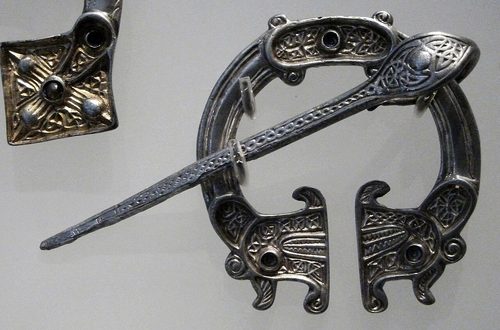
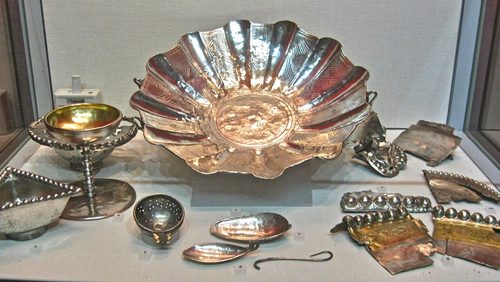
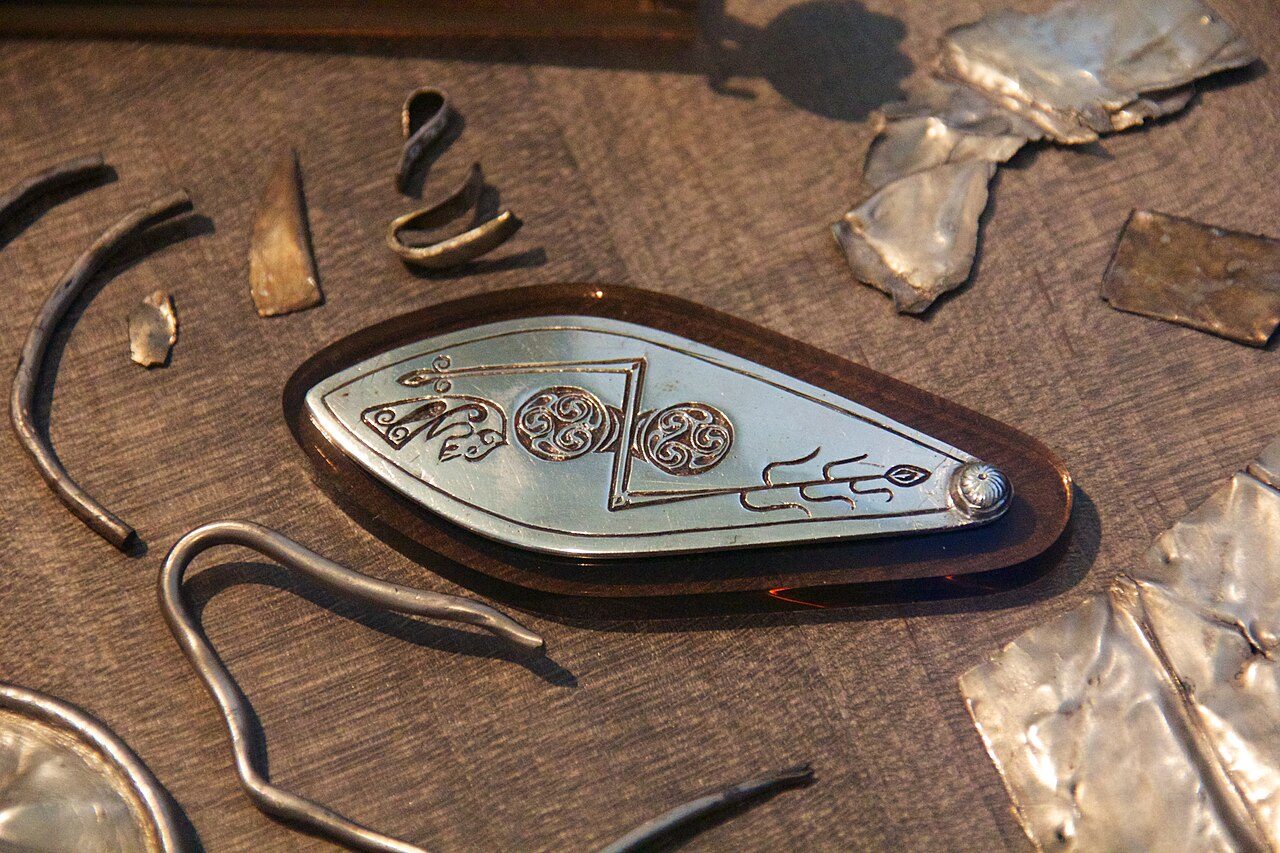
Most of the survivors are hacksilver: bracelets, sheet from vessels, chains and fittings chopped up and folded into parcels, valued by weight rather than as objects. Among them is part of a late Roman silver spoon with an inscription, a reminder that much of this silver began as Roman tableware. Two late Roman coins were in the find too; they were melted almost at once, and only a drawing records them. Alongside the scrap are a few complete ornaments: a leaf-shaped plaque engraved with Pictish symbols, a large silver hand-pin with a spiral-decorated head, penannular brooches with twisted hoops and a spiral finger-ring.
The plaque and the hand-pin come with a twist. For more than a century each was thought to have an identical twin in the hoard. Research by National Museums Scotland has shown that one plaque and one pin are 19th-century silver copies, probably made around 1839, when Buist also had pewter casts taken. One of the copies even carries a Pictish symbol added by the copyist. That matters, because the copy's decoration had been used to date the whole hoard to the 7th or 8th century.
With the copies set aside, opinion has moved earlier. The beast on the genuine plaque is closely matched on a symbol stone from Rhynie in Aberdeenshire, where the associated high-status settlement is radiocarbon-dated to the 5th and 6th centuries, and the newly recovered Gaulcross hoard shows a similar mix of Roman and Pictish silver. National Museums Scotland now places the hoard in the 6th century AD.
Like Gaulcross, the silver was buried in an already ancient monument. Whether that was for safety, as an offering, or as a way of tying a new elite to the ancestors is open to debate. The Durham family's heirs gave most of the surviving pieces to the Society of Antiquaries of Scotland in 1864 and the rest in 1883.
Highlights
A leaf-shaped silver plaque engraved with a double disc and Z-rod and a beast's head, with traces of red enamel. Pictish symbols are normally found carved on stone.
A large silver pin whose head resembles a hand with raised fingers, decorated with fine spirals. Its twin in the collection is now known to be a 19th-century copy.
Penannular brooches with twisted hoops, a type otherwise known only from the Gaulcross hoard.
What is in it
Mostly hacksilver, cut and folded pieces of bracelets, vessels and fittings, with a few complete ornaments: a plaque engraved with Pictish symbols, a large hand-pin, penannular brooches with twisted hoops and a spiral finger-ring.
Size: about 170 surviving pieces. Weight: about 750 g surviving, of perhaps 12 kg found.
| Item | Number | Notes |
|---|---|---|
| Hacksilver | most of the surviving pieces | Cut and folded bracelets, sheet from vessels, chain and fittings, including part of an inscribed late Roman spoon |
| Symbol plaque | 1 original (plus a 19th-century copy) | Leaf-shaped plaque with a double disc and Z-rod and a beast's head |
| Hand-pins | 1 original (plus a 19th-century copy) | Large silver pin with a hand-shaped head and spiral ornament |
| Brooches and ring | a few | Penannular brooches with twisted hoops, a spiral finger-ring |
| Roman coins | now lost | Late 4th-century silver siliquae, known only from an early drawing; melted or sold soon after discovery |
Photographs
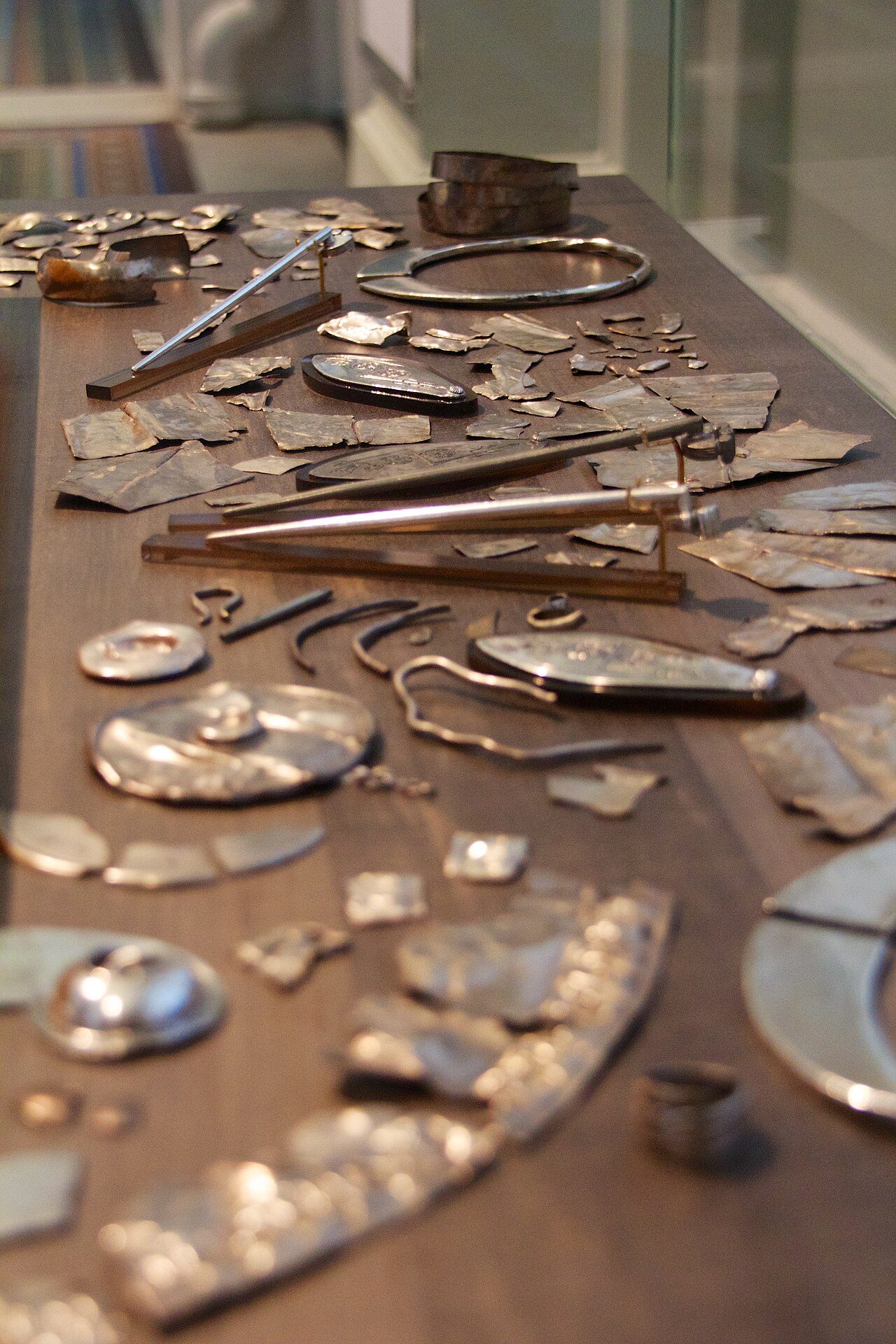
Photo: Mike Peel ( www.mikepeel.net )., CC BY-SA 4.0, via Wikimedia Commons
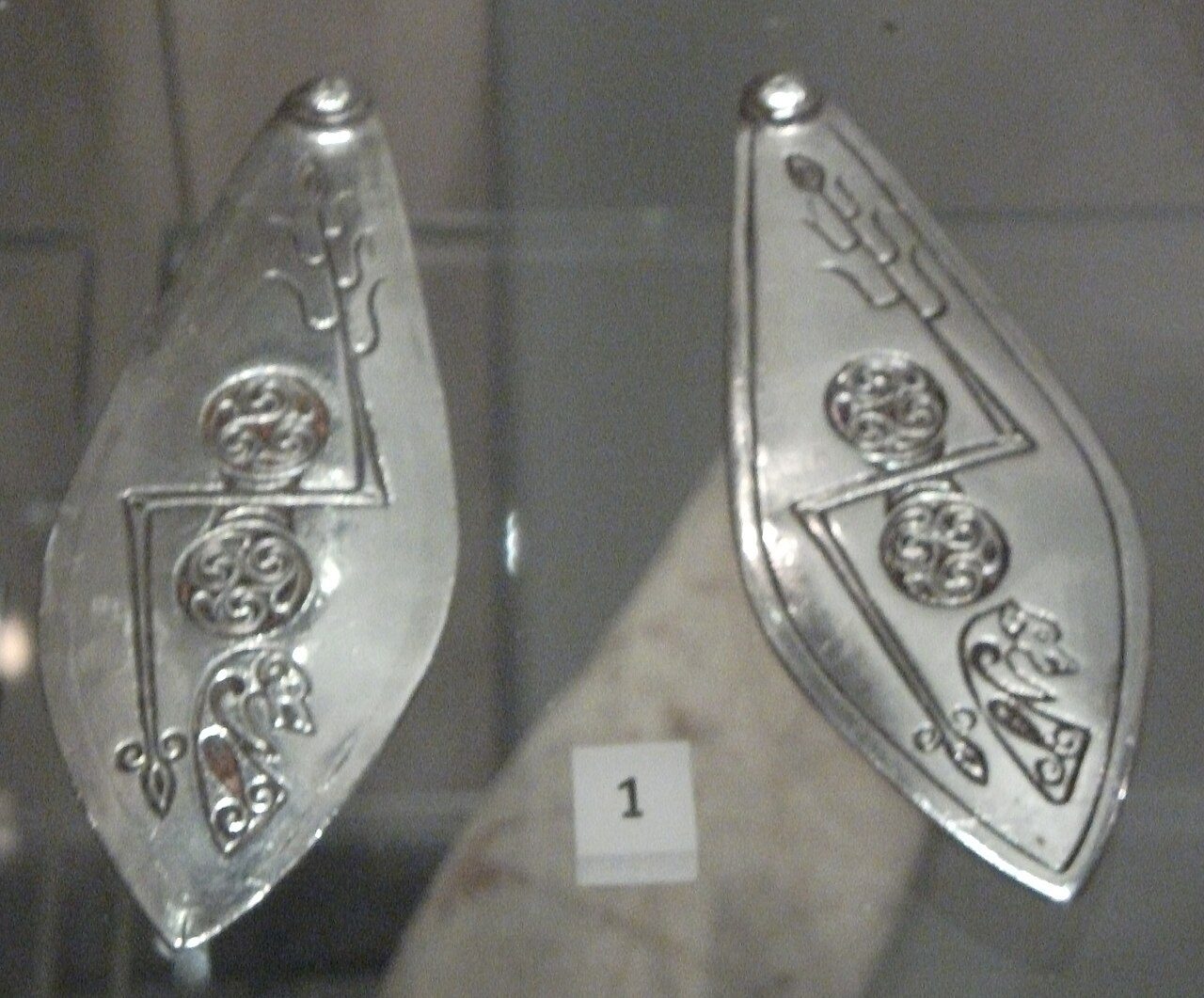
Photo: Johnbod, CC BY-SA 3.0, via Wikimedia Commons
How it is dated
The Roman coins and spoon show that the hoard cannot have been buried before the 5th century. Older studies dated it to the 7th or 8th century from the art of the plaque and a hand-pin, but that pin turned out to be a 19th-century copy. Current research by National Museums Scotland, supported by comparisons with Rhynie and Gaulcross, places the burial in the 6th century.
What happened after the find
The find was never reported at the time and most of it was sold and melted. The surviving pieces were donated by the landowner's heirs to the Society of Antiquaries of Scotland museum (now the National Museum of Scotland) in 1864 and 1883.
Where sources differ
- Original weight: 12.5 kg on Wikipedia; 'the 12kg of silver estimated to have been found originally' in Noble et al. (Antiquity 2016). Both are estimates from antiquarian accounts.
- Surviving weight: 'less than 1 kg' (Wikipedia) and '750g' (Antiquity 2016).
- Date: 6th century (NMS research, per Wikipedia); Antiquity 2016 suggests 5th to 6th century tentatively; older literature 7th to 8th century.
- Number of Roman coins: Wikipedia says two late Roman coins; Antiquity 2016 says three late 4th-century siliquae have been identified from an early drawing.
- Finder(s): Wikipedia says unknown discoverer or discoverers; Antiquity 2016 says a labourer digging for sand.
Questions
Where is the Norrie's Law Hoard?
The surviving pieces are in the National Museum of Scotland in Edinburgh, given by the landowner's heirs in 1864 and 1883.
How much of the Norrie's Law Hoard survives?
Only about 750 g, in some 170 pieces, out of an estimated 12 kg of silver. The rest was sold and melted down soon after it was found around 1819.
Are the Norrie's Law plaques genuine?
One is. Research by National Museums Scotland has shown that the second plaque and one of the two large hand-pins are silver copies made in the 19th century.