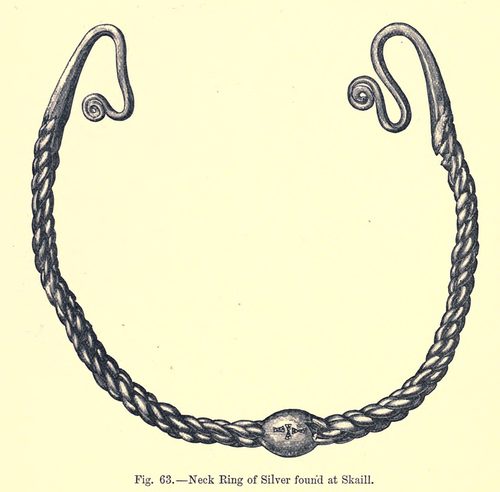
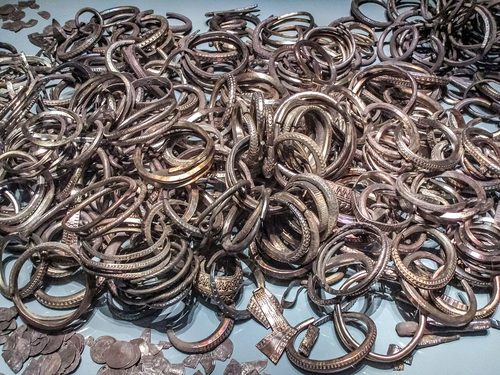
The pocket scales and standard weights Viking-age traders used to pay in silver: cubo-octahedral and oblate-spheroid weights, units and key finds.
A merchant's kit
If silver is paid by weight, the scale is the bank. Viking-age traders carried small balances: a bronze beam hinged so its arms could fold, two shallow pans on cords or chains, and a set of weights, often kept together in a round metal case or a leather pouch. Boat grave 12 at Valsgärde in Uppland, dated to the 10th century, held exactly that combination of collapsible scale, weights and pouch.
One case has kept its owner's voice. In August 1911 a box of copper alloy about 10 cm across was dug up in a garden in Sigtuna, north of Stockholm. It once held a folding balance and weights; its contents, a heavy mass of small metal pieces, were thrown away before anyone examined them. Two runic inscriptions run round it. One says that Djarfr got the scales from a man from Samland or Semgallia, on the far side of the Baltic. The other is a couplet in skaldic metre in which a bird tears apart a pale thief, a curse aimed at anyone who might steal the box.
Balances survive best in graves. Swedish scholarship counts more than a hundred from Birka alone, Sigtuna's predecessor on Lake Mälaren. One of the best-known Birka burials, grave Bj 581, held a set of weights wrapped in a bag with dice and gaming pieces; a quarter of a dirham of the Samanid emir Nasr ibn Ahmad dates the burial to after 913-933, probably to the 940s.
Two new weights, one standard
The decisive change came in the second half of the 9th century, when standardised weights spread across most of Scandinavia in the 860s and 870s. Two types dominate. Cubo-octahedral weights are small solid bronze pieces with fourteen faces, the corners of a cube sliced off, and punched dots marking how many units they represent. Oblate-spheroid weights are heavier balls flattened at top and bottom, made of iron with a brass or bronze skin. Jane Kershaw dates the first to about 860/870 and the second to about 870/880.
In Sweden, where nearly a thousand Viking-age weights have been found, cubo-octahedra usually weigh between 0.5 and 5 g and the cased spheres between 5 and 150 g. The small ones suited fragments of cut dirhams; the big ones suited ingots and arm-rings. According to Kershaw, the two types share a weight standard of around 4 g, and their form and standard point to Islamic origins, though some were certainly made in Scandinavia.
Lead weights in the west
Around the Irish Sea and in England traders also made weights of lead, cheap to cast and easy to adjust. Many are set with a piece of decorated metalwork, a scrap of Insular jewellery or an old coin, pressed into the top. Kaupang in southern Norway has produced at least 410 lead weights, only seven of them inset. Woodstown in Ireland has given 217, six decorated with Insular metalwork. At Hedeby two inset lead weights have recently been found by metal-detecting; at Ribe and Birka the type is absent.
The Great Army's winter camp at Torksey in Lincolnshire (872-3) is the richest English site. Hadley and Richards record more than 350 weights: nearly a hundred copper-alloy cubo-octahedra, six spheroids and nearly 250 of lead, 37 of them inset. They found no consistent weight standard among them and suggest that an army gathered from many places brought many habits. No balance has been reported from Torksey; Kershaw's national survey of single finds counts 34 oblate-spheroid and 26 cubo-octahedral weights from England, and two oblate-spheroid weights from excavations in York come from layers dated between the mid to late 9th and early 10th centuries.
What the units were
Written sources for Viking-age units are late, and the objects are worn, corroded or deliberately adjusted, so any unit is a statistical reconstruction. Two are often discussed. Kershaw's base unit of around 4 g fits the small cubo-octahedra. A larger unit near 24 g, the Scandinavian 'ounce' (eyrir in Old Norse), appears in a study of plain penannular arm-rings from Scotland and the Isle of Man, the so-called ring-money of the Norse north: Richard Warner found preferred weights clustering round 24.0 g, plus or minus 0.8 g, across 72 complete rings. James Graham-Campbell, reporting the result in 1976, warned that the spread of weights was disturbingly wide.
Even without a single agreed standard, the system worked because both parties could see the beam. The scale did not care who you were. That is the quiet revolution of the folding balance: it let strangers from different peoples and faiths agree a price without trusting each other's word.
Modern parallel (an analogy)
A set of standard weights works a little like an open technical standard. Anyone holding compatible equipment can run the same check and get the same answer, and the dots on a cubo-octahedral weight are a published specification you can read with your eyes. In the language of digital systems, verification is local: you do not need to ask a central authority, you run the test yourself.
The Sigtuna box adds a second idea that will be familiar to anyone who protects digital keys: the tools of verification are themselves valuable, and worth guarding.
Where the analogy breaks: Weights could be shaved, filed or simply faked, and nobody audited a trader's set, so 'standard' meant shared habit rather than enforced rule. Torksey's weights show no single standard at all, and a balance only checks mass, not what the metal is.
Objects
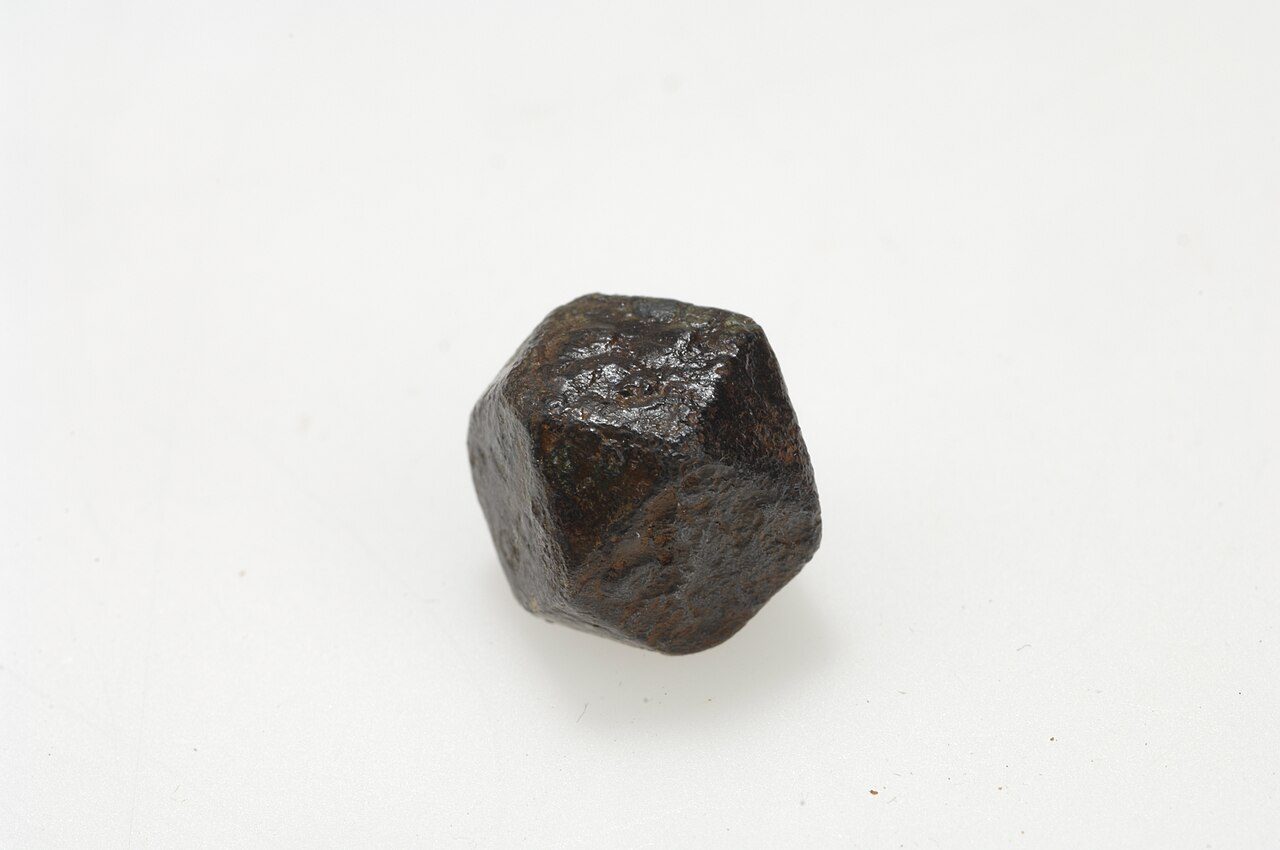
Photo: The Swedish History Museum, Stockholm from Sweden, CC BY 2.0, via Wikimedia Commons
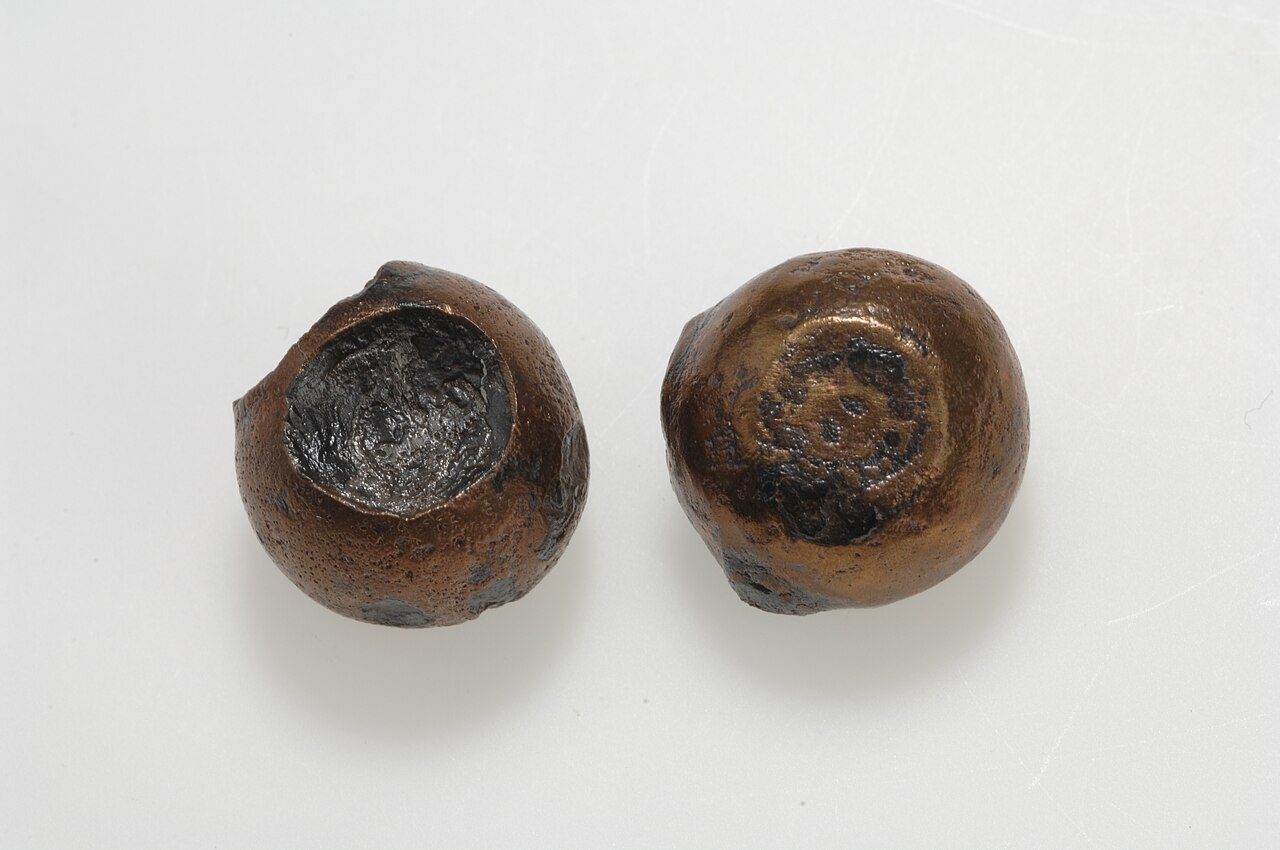
Photo: The Swedish History Museum, Stockholm from Sweden, CC BY 2.0, via Wikimedia Commons
Sources
- Kershaw, 'An early medieval dual-currency economy: bullion and coin in the Danelaw', Antiquity (2017)
- Hadley and Richards, 'The winter camp of the Viking Great Army, AD 872-3, Torksey', Antiquaries Journal (2016)
- Heen-Pettersen, 'Evidence of Viking trade and Danelaw connections? Inset lead weights from Norway and the western Viking World', Internet Archaeology 56 (2021)
- Sperber, 'Bronze coated cubo-octahedral weights with an iron core from Viking Age Sweden', JONAS (1999)
- Graham-Campbell, 'The Viking-age silver and gold hoards of Scandinavian character from Scotland', PSAS 107 (1976)
- Sigtuna box (Wikipedia)
Analogies on this page are comparisons, not claims about the past. Nothing here is financial or investment advice.