How archaeologists trace where Viking-age silver came from: mint names, die studies, XRF and lead isotopes, with Cuerdale, Vale of York and Galloway.
Three different questions
Provenance in a Viking hoard covers at least three separate questions: where and by whom a coin was struck, where an object was made, and where its metal was mined. The answers can differ for the same piece. A dirham struck in Samarkand might be cut up in Gotland, melted in Dublin and re-cast as an ingot buried in Lancashire. Archaeologists use different tools for each layer of that history: inscriptions and die studies for the coin, style and workshop traces for the object, chemistry for the metal. The tools do not always agree, and the most convincing results come where two or three of them point the same way.
Reading the inscriptions
The simplest evidence is written on the coin. Islamic dirhams give their mint and year; the latest one in the Vale of York hoard names al-Shash, modern Tashkent, and the year AH 303, AD 914-15. English pennies from the 10th century on name both moneyer and mint. The Vale of York hoard includes coins of King Athelstan with the York mint signature, struck soon after he took the city in 927. Viking York's own coins use the name EBRAICE.
Inscriptions can also mislead or puzzle. Some 3,000 pennies in the Cuerdale hoard, struck for a king named Cnut, carry the word CUNNETTI, which has been read as a mint name and placed variously in northern England and northern France; no suggestion has won general agreement. A mint name tells you where a coin was struck, not where its silver came from or where it went next.
Die studies and die links
Medieval coins were struck by hand between two engraved iron dies, one for each face. Dies cracked and wore out and were replaced, and each was cut individually, so careful comparison can show which coins came from the same die. When two coins share one die but differ on the other, they are die-linked. Chains of such links let numismatists estimate how many dies a mint used, put undated issues in order, and show that coins with different inscriptions were made in the same workshop.
The method has practical results for this period. Olof Skötkonung's pennies are tied to Sigtuna by die links as well as by their design, even where their inscriptions are garbled. In York, excavators at Coppergate identified a workshop where dies were made and tested. The Watlington hoard (c. 879) showed Alfred of Wessex and Ceolwulf II of Mercia striking matching coins with shared moneyers, evidence of an alliance the Anglo-Saxon Chronicle plays down.
Metal analysis: XRF and lead isotopes
Science reads the metal itself. X-ray fluorescence (XRF) measures the elements on and near the surface, giving the proportions of silver, copper, lead, gold and trace metals. Lead isotope analysis goes further. The lead that occurs naturally in silver ores carries a ratio of isotopes that varies from one ore body to another, so the ratio in an object can be matched, or ruled out, against known mines.
The Galloway hoard, buried about 900 in south-west Scotland, shows what the combination can do. National Museums Scotland, working with Jane Kershaw of the University of Oxford, used XRF, laser ablation and lead isotope analysis on the hoard's lidded silver vessel. Its silver proved to be alloyed with almost pure copper, a recipe typical of Sasanian Persian silver and not of contemporary European work, and the black niello inlay could be traced to the silver mine of Nakhlak in central Iran. The same project found that most of the hoard's hacksilver was made from melted-down Anglo-Saxon and Anglo-Scandinavian coins.
There are limits. Silver was melted and mixed again and again, so an ingot's signature may average several sources. Earlier attempts to use silver composition for dating, such as a National Museum of Antiquities of Scotland programme reported in 1976, offered only tentative results.
Two hoards, many origins
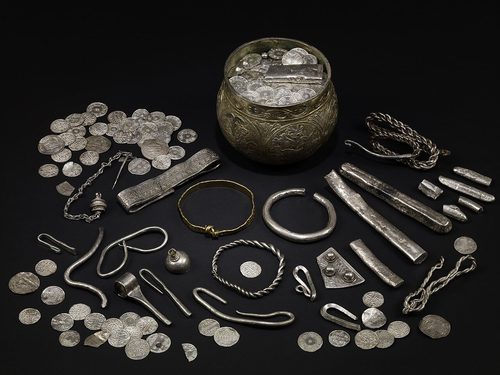
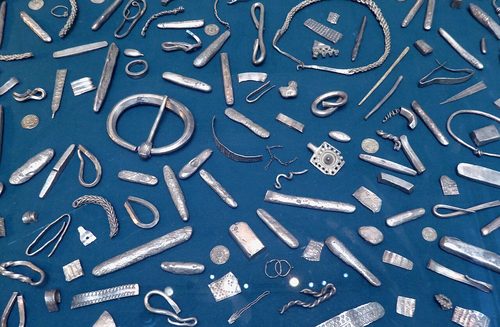
Put together, these methods turn a hoard into a map. Cuerdale's coins point to the Danelaw, Wessex and Francia, while the British Museum's curators think its handful of Scandinavian, Byzantine and Islamic coins came to Britain by way of Scandinavia, along the Russian rivers. Its bullion is largely Irish-Norse in style. The Vale of York hoard's gilded cup came from a Carolingian workshop of the mid-9th century, matched by the Halton Moor cup, and its contents range from Samarkand and Afghanistan to Ireland and Scandinavia.
Modern parallel (an analogy)
Die links work rather like matching cryptographic fingerprints: an identical mark on two objects proves a shared origin without any written record. Lead isotopes are closer to the provenance data that digital tools now attach to images or files, a signature of origin carried inside the thing itself. Projects that record the provenance of digital works on public ledgers share the archaeologist's goal of an unbroken chain from maker to holder.
The Galloway vessel shows the value of that chain: an object with almost no written history acquired one through its chemistry.
Where the analogy breaks: Archaeological provenance is inferred and probabilistic, and recycling can scramble it, whereas a cryptographic hash either matches or it does not. A digital provenance record only proves what was entered into it; it cannot show that the real-world object it points to is genuine or that the first entry was honest.
Objects
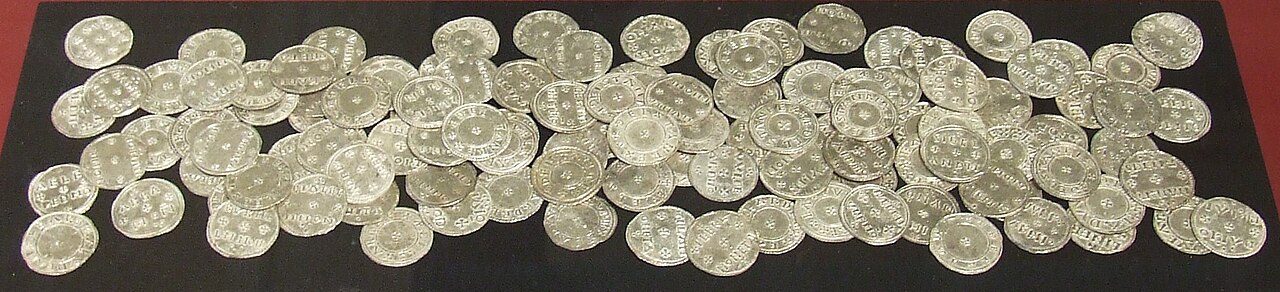
Photo: Unknown, CC BY-SA 3.0, via Wikimedia Commons
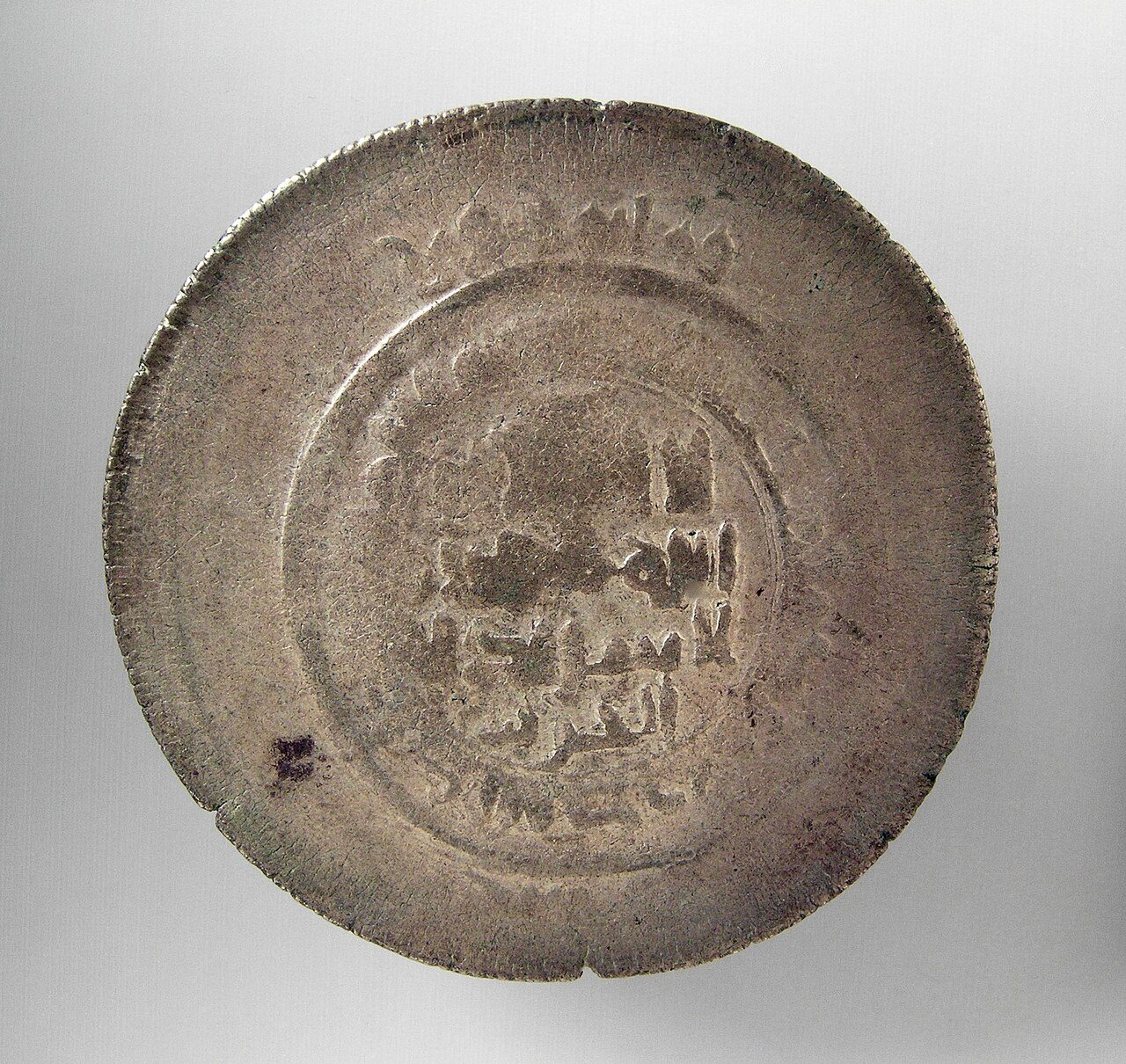
Photo: Unknown, Public domain, via Wikimedia Commons
Sources
- National Museums Scotland, 'Conserving the Galloway Hoard vessel'
- The Observer, ''Amazing' Viking-age treasure travelled half the world to Scotland, analysis finds' (2024)
- Vale of York hoard, PAS record SWYOR-AECB53 (archived)
- BBC History, 'The Cuerdale Hoard' (Williams and Webster)
- Cuerdale Hoard (Wikipedia)
- Graham-Campbell, 'The Viking-age silver and gold hoards of Scandinavian character from Scotland', PSAS 107 (1976)
Analogies on this page are comparisons, not claims about the past. Nothing here is financial or investment advice.