How Viking-age people checked silver for plated fakes and base alloys with knife nicks and pecks, and what modern metal analysis says about its purity.
The forger's opportunity
Paying by weight solves one problem and opens another. A balance tells you how heavy a piece of silver is, not what it is made of. A bar with a copper core and a silver skin weighs less than solid silver of the same size, but cut to the right weight it will balance perfectly. Silver alloyed with copper or lead looks much the same as fine silver once it has tarnished. With no mint standing behind the metal, every recipient had to check it personally.
Fakes did circulate. Excavations in York found a counterfeit dirham beside two regulated weights, and at the Great Army's camp at Torksey one dirham with a green patina may be a contemporary forgery. Coinage was not safe either: Jane Kershaw notes that a severe debasement in southern England in the third quarter of the 9th century pushed the silver in local coins as low as 18 per cent.
Nicks: a knife as a test kit
The commonest test leaves a small crescent-shaped cut, a nick, on the edge of an ingot or ornament. Kershaw explains how it worked: a nick exposed any plating, and the feel of the knife going in was itself a test of fineness. If the blade met too much resistance the silver was likely heavy with copper; if it slid in too easily there was probably too much lead.
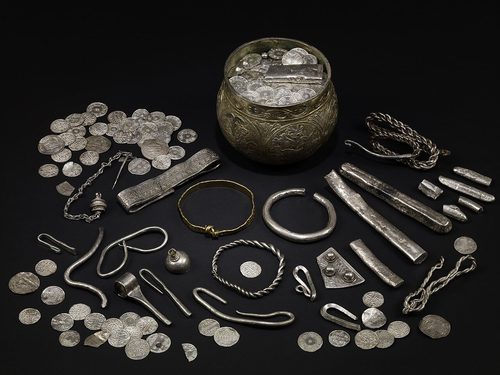
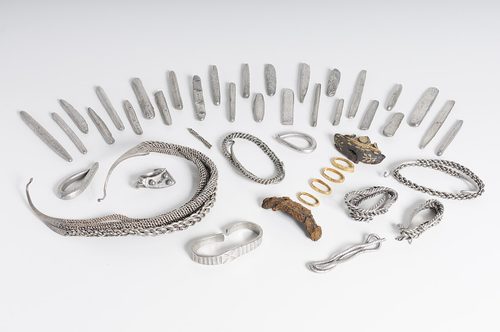
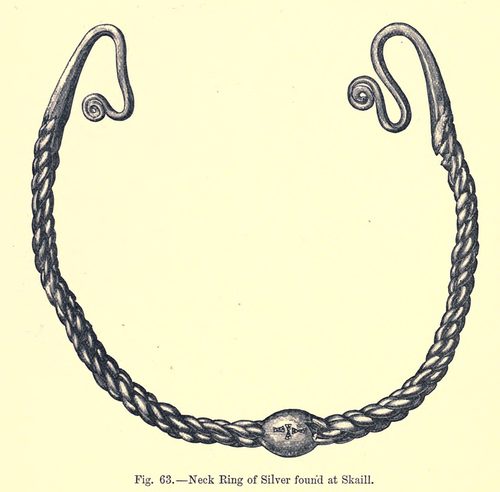
The marks are everywhere once you look. The Treasure report on the Vale of York hoard (c. 928) describes ingot after ingot with 'testing nicks on edges', some with several. The Yorkshire Museum notes tiny cuts on the silver of the Bedale hoard that show its purity being tested. The Skaill hoard from Orkney carries the same marks.
Kershaw adds a neat inference. A smith who had just cast an ingot had no reason to test it, so a nicked ingot is one that has passed from hand to hand. Each nick is the trace of a transaction, or at least of someone weighing up whether to accept one.
Pecks: testing coins
Coins were tested too, by pecking: jabbing the point of a knife into the face of the coin to see what lay beneath. In England this practice has been studied by Marion Archibald, who linked its arrival to the coinage reform of the mid-870s; Hadley and Richards note that pecking is first demonstrated in hoards buried after about 890. None of the English silver pennies from Torksey (872-3) shows it.
Testing was selective. In the Danelaw, Kershaw finds that local coins were only occasionally tested and never deliberately cut, while dirhams were routinely chopped up and treated as raw metal. Some pieces were tiny: the dirham fragments in her English data set average just 0.57 g, a fifth or so of a whole coin of about 3 g. People were readier to trust a coin they recognised from their own region than a foreign one valued only for its silver. Bent and folded coins are common in hoards too. Bending may sometimes have been another test, but folding also made coins easier to pack, so not every bend is a verdict on quality.
What metal analysis shows
Modern analysis suggests that the tests mostly worked. Of 13 ingots from England that Kershaw had analysed by surface X-ray fluorescence (XRF), 11, or 85 per cent, contained more than 90 per cent silver. Lower values, around 60 to 80 per cent, turn up only occasionally. The British Museum's report on the Vale of York hoard did not analyse its 617 coins at all, because enough coins of the period had already been tested to show that their silver content was high.
At the Galloway hoard (c. 900), National Museums Scotland report that the broad-band arm-rings and ingots were made from recycled good-quality silver, mainly melted-down coins. The bullion economy ran largely on coin silver that had changed its shape. That recycling also limits what analysis can say: a melted and re-cast ingot records the mixture in the crucible, not the mine where the silver began (see tracing provenance).
Royal coinage, when it came, could match or beat that standard. Edgar's reformed English penny of the 970s contained about 96 per cent silver, high by the standards of contemporary Europe (see from weight to coin). When a coin's fineness could be relied upon, the knife could stay in its sheath.
Modern parallel (an analogy)
'Don't trust, verify' is a slogan of the cryptocurrency world, and a nicked ingot is that slogan carved in metal. Each recipient checked the asset personally instead of relying on a central issuer, much as a node on a public network checks every transaction against the rules rather than taking another computer's word for it.
The Danelaw pattern, where familiar local coins were rarely tested and foreign dirhams always cut, also has a modern echo: people verify hardest where reputation is weakest.
Where the analogy breaks: A knife test is partial and destructive: it samples one spot, depends on skill and feel, and leaves damage. Cryptographic verification is exact, repeatable by anyone and leaves the asset untouched. A nick also proved nothing about who owned the silver or where it came from.
Objects
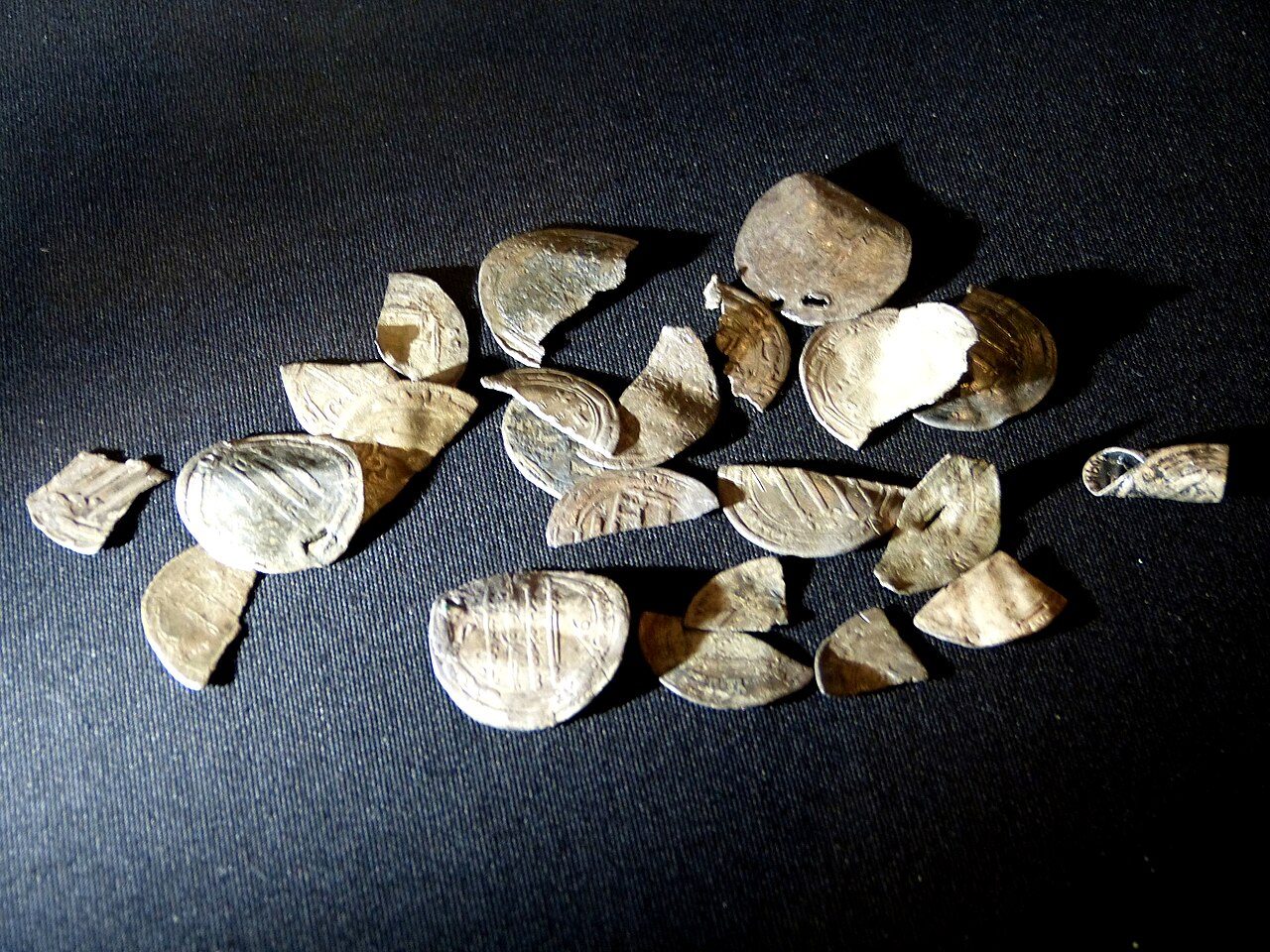
Photo: Wolfgang Sauber, CC BY-SA 4.0, via Wikimedia Commons
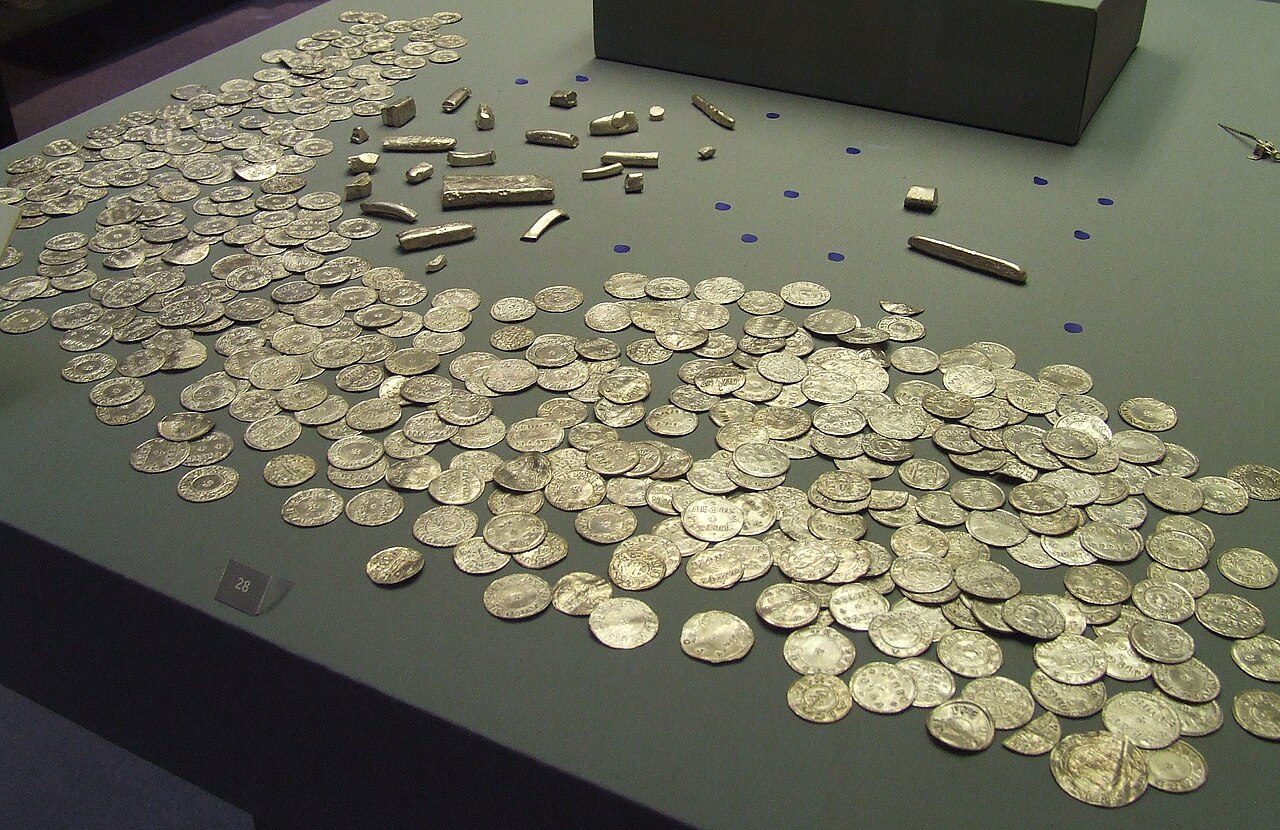
Photo: JMiall, CC BY-SA 3.0, via Wikimedia Commons
Sources
- Kershaw, 'An early medieval dual-currency economy: bullion and coin in the Danelaw', Antiquity (2017)
- Hadley and Richards, 'The winter camp of the Viking Great Army, AD 872-3, Torksey', Antiquaries Journal (2016)
- Vale of York hoard, PAS record SWYOR-AECB53 (archived)
- Yorkshire Museum, The Bedale Hoard
- National Museums Scotland, 'How Viking is the Galloway Hoard?'
- Edgar, King of England (Wikipedia), section on coinage
Analogies on this page are comparisons, not claims about the past. Nothing here is financial or investment advice.