How Viking-age people paid with cut and weighed silver, why coins and bullion ran side by side in the Danelaw for decades, and what hacksilver is.
Paying by the gram
For most of the Viking age an arm-ring was savings you could wear. In Scandinavia, and in the parts of Britain and Ireland where Scandinavians settled, silver changed hands by weight. A price was agreed in silver, the payer cut off roughly the right amount, and both parties watched it settle on a small balance. The National Museum of Denmark sums up the system in two lines: goods were paid for in silver by weight, and the amount needed was simply cut off.
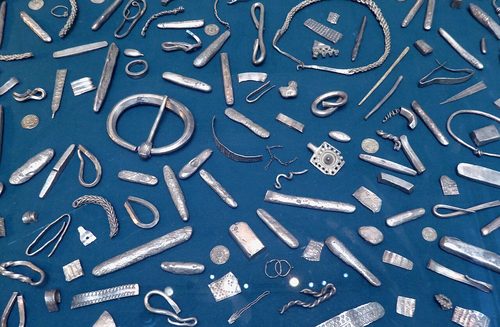
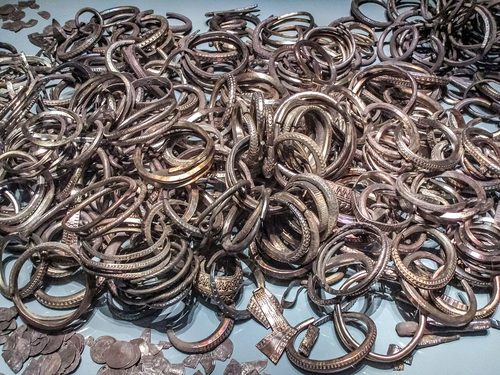
Hacksilver is the archaeologists' word for what that habit left in the ground (see hacksilver). Brooches snipped into wedges, arm-rings chopped into short lengths, ingots with one end sliced away, coins cut into halves and quarters. Gotlands Museum points out that the island's hoards are full of silver objects twisted together, a sign that the weight of the metal mattered and the shape did not. In the Spillings hoard many arm-rings were found hooked into bunches, which reads more like a stack of value than a jewellery box.
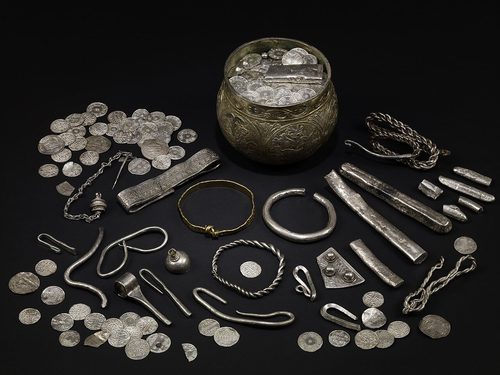
The Cuerdale hoard, buried beside the River Ribble in Lancashire about 905-910, shows the balance between the two kinds of money. It held over 7,000 coins, yet most of its roughly 40 kg was bullion: more than 36 kg of ingots, rings and chopped jewellery, much of it from the Irish Sea world.
Coin and bullion side by side in the Danelaw
England already had a working coinage when the Viking Great Army arrived in 865: the silver penny, struck under royal control. The newcomers did not give up weighed silver. Jane Kershaw's study of finds recorded by the Portable Antiquities Scheme argues that Scandinavian bullion was used as currency across the Danelaw from about 865 until at least 930-940, so that bullion and coin circulated together for some 70 or 80 years. Her data set holds more than 180 single finds of Viking-age bullion and weights from England, among them 44 ingots and 65 newly recorded dirhams; of the 64 dirhams whose condition was noted, 29 had been cut.
The sharpest snapshot comes from Torksey in Lincolnshire, where the Great Army spent the winter of 872-3. The camp has produced 124 dirham fragments, every one cut, about 60 pieces of hacksilver and a number of silver ingots, alongside some 40 English silver pennies and more than 170 Northumbrian copper-alloy stycas. Dawn Hadley and Julian Richards, who published the site, see a hybrid in which coins, bullion and even base metal were all in use: in their words, 'not so much of a dual economy as of multiple metal economies'.
The settlers soon struck coins of their own. From the mid-890s the Viking rulers of York and of East Anglia issued pennies, the East Anglian ones in memory of St Edmund, the king the Vikings had killed. Even so, Cuerdale and the Vale of York hoard, buried about 928, keep coins and hacksilver in the same parcel. Their owners saw no contradiction in holding both.
Scandinavia: plenty of silver, almost no local coin
In the Scandinavian homelands there was very little local coinage before the 990s (see from weight to coin). Silver arrived as foreign coin, above all Islamic dirhams, and as plunder and tribute from the west, and it was melted, cut or worn. The excavators of Kaupang in southern Norway found that in the early 9th century silver reached the town mainly from the Carolingian world. After the middle of the century it became more plentiful, and the spread of standardised weights across most of Scandinavia in the 860s and 870s made paying in silver easier and more common (see folding balances).
Gotland shows the scale of it. The island accounts for about two-thirds of all Viking-age silver coins found in Sweden, roughly 168,000 by Gotlands Museum's count. Most of that came in small parcels: the Swedish History Museum gives 200 to 300 grams as the weight of a typical Gotland silver hoard. Spillings, at about 67 kg of silver, is the outlier that makes the habit visible.
Weighed silver could also be displayed. Ahmad ibn Fadlan, an envoy from Baghdad who met Rus traders on the Volga in 922, wrote that their women wore neck-rings, one for every 10,000 dirhams a husband held, in the translation most often quoted. A ring on the neck was a balance sheet everyone could read.
The Irish Sea and the far north
Kershaw ties much of the bullion in northern England to an Irish-Scandinavian metal-weight economy centred on Dublin. Cuerdale's silver, with its Irish-style arm-rings, has been read as a war chest gathered by Norse exiles after their expulsion from Dublin in 902. Dublin's Norse rulers began striking their own coins in 997, and Irish hoards soon held little else. James Graham-Campbell noted in 1976 that the last Irish coin hoard with any non-coin silver, buried about 1030, contained a single ingot.
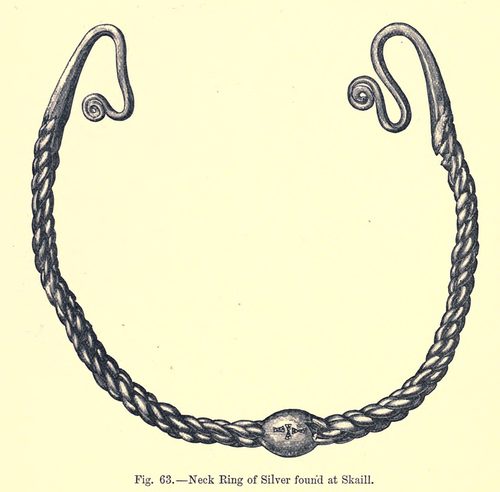
The Norse of Scotland held on to weighed silver far longer. In the Burray hoard from Orkney, buried about 998, coins make up no more than half of one per cent of the silver by weight. The latest hoard of purely Scandinavian character in Britain or Ireland to contain hacksilver, from Dunrossness in Shetland, seems to date from the 1060s. The Skaill hoard, roughly eight kilograms of brooches, neck-rings and ingots with only 21 coins, belongs to the same world.
Modern parallel (an analogy)
Hacksilver is money with no issuer. Its value sits in the metal, and anyone with a balance and a sharp knife can check it. People who follow digital assets will recognise two ideas here: a bearer asset whose worth does not rest on a bank's promise, and settlement that is final the moment the thing itself changes hands. Once the cut silver was on your side of the scale, the deal was done.
The Danelaw is also a reminder that new forms of payment rarely replace old ones overnight. For two generations coins and bullion ran side by side, and people chose between them deal by deal.
Where the analogy breaks: Silver was a physical metal with uses outside exchange, as jewellery and raw material, and nothing about a payment was recorded anywhere. Weighed silver was not free of trust either: payers and payees still had to trust their scales, their weights and their own skill at spotting a plated fake.
Objects
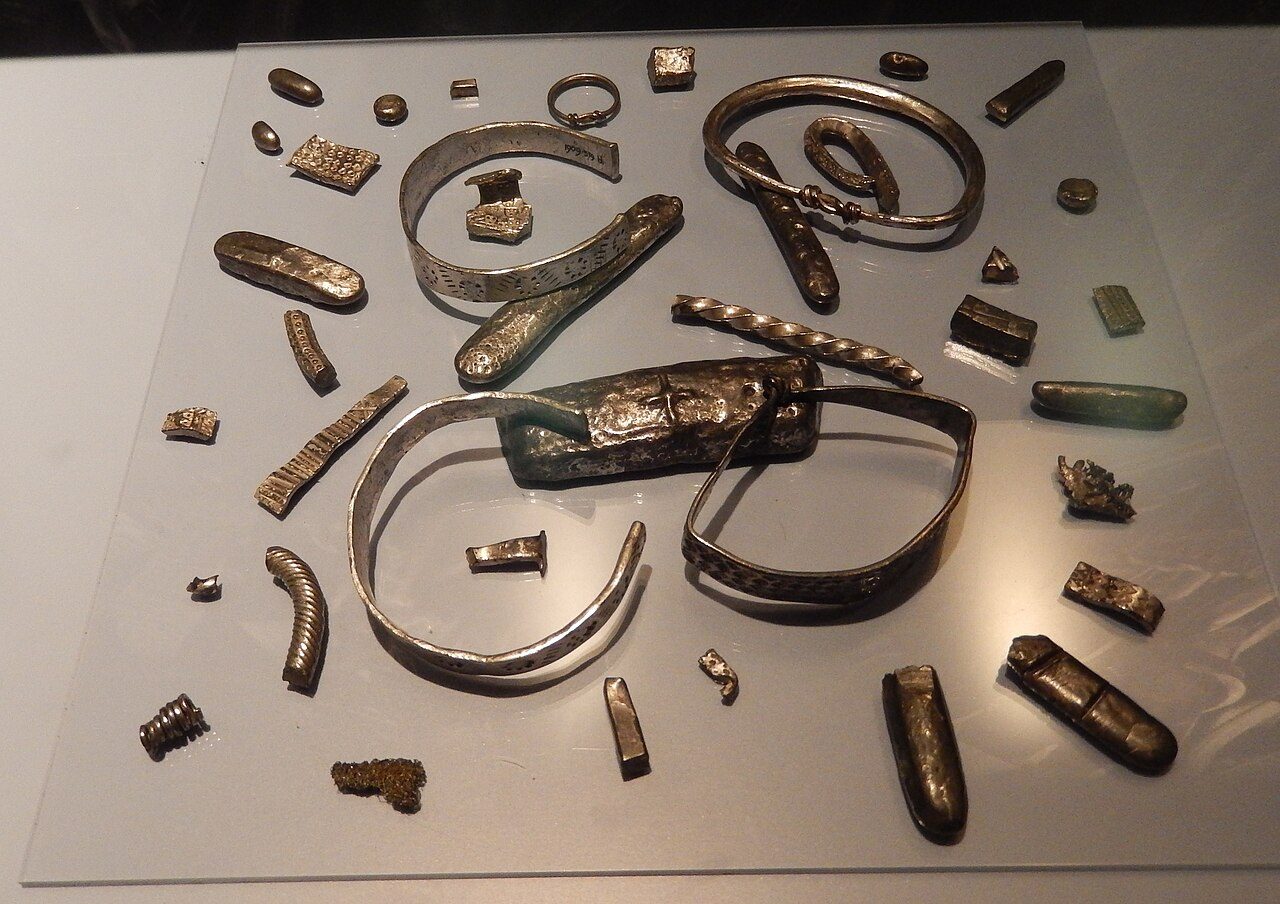
Photo: BabelStone, CC BY-SA 3.0, via Wikimedia Commons
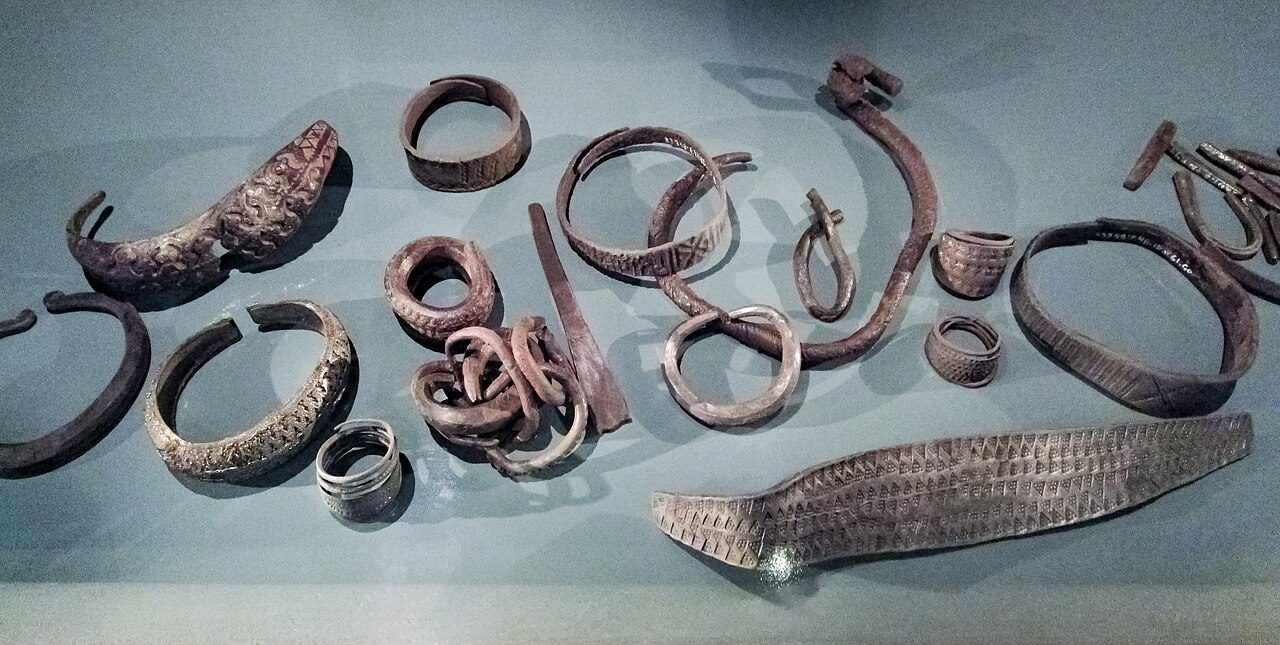
Photo: W.carter, CC BY-SA 4.0, via Wikimedia Commons
Sources
- Kershaw, 'An early medieval dual-currency economy: bullion and coin in the Danelaw', Antiquity (2017)
- Hadley and Richards, 'The winter camp of the Viking Great Army, AD 872-3, Torksey, Lincolnshire', Antiquaries Journal (2016)
- National Museum of Denmark, 'The silver hoards of the Vikings' (archived)
- Gotlands Museum, Skattkammaren
- Skre (ed.), Means of Exchange: Dealing with Silver in the Viking Age (Aarhus University Press, 2008)
- Graham-Campbell, 'The Viking-age silver and gold hoards of Scandinavian character from Scotland', PSAS 107 (1976)
Analogies on this page are comparisons, not claims about the past. Nothing here is financial or investment advice.