Medieval hoards
c. 1100-1500 · 8 hoards on this site
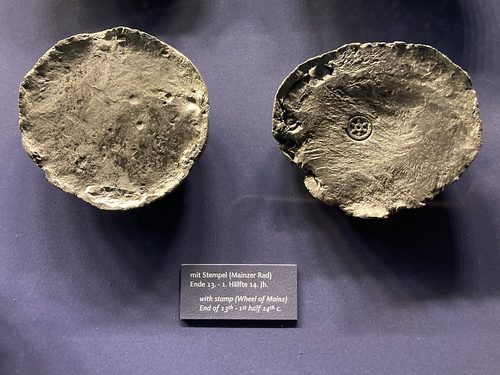
In 1998 archaeologists working in the old Jewish quarter of Erfurt found a cache under the wall of a cellar entrance: about 24 kg of silver coins and ingots, including 3,141 silver tournois groats, with more than 700 pieces of goldsmiths' work, eight finger-rings among them. One is a gold Jewish wedding ring crowned by a tiny Gothic building with mazal tov engraved on its roof. Its owner is thought to have been a moneychanger who hid his stock before the massacre of Erfurt's Jews in March 1349, during the Black Death. The Erfurt Treasure is now shown in the town's restored Old Synagogue. Smaller treasures hidden in the same terror have come from Colmar, Weißenfels, Lingenfeld, Münster and Środa Śląska; at Colmar the cache was found in 1863 inside the wall of a house in the rue des Juifs.
In this period the safekeeping reading is usually the right one, and the law said so. Under the English common law of treasure trove, buried gold or silver belonged to the Crown only if it had been hidden with the intention of recovering it, the animus revocandi; objects simply lost or deliberately abandoned went to the finder or the landowner. Medieval lawyers assumed, in other words, that people hid money in order to come back for it. The great medieval hoards fit: they turn up in walls, cellars and under floors, and they date to wars, plagues and persecutions that killed or scattered their owners.
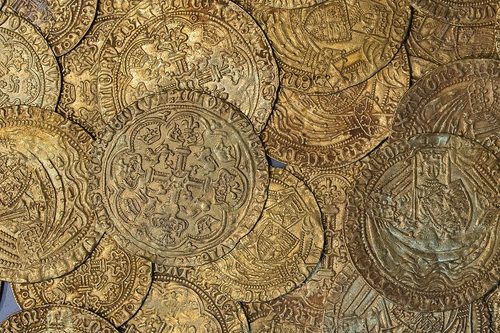
Coin had replaced bullion almost everywhere. In England the silver penny was struck by weight from the Tower pound of about 350 g, 240 pence to the pound at first and 243 by 1279, so a penny of around 1300 weighed roughly 1.44 g. Edward III cut it to 18 grains (about 1.17 g) in 1351, when the Statute of Labourers set a master carpenter's wage at 3d a day. Gold returned to Western coinage in the thirteenth century: Florence struck its florin of about 3.5 g from 1252, and Edward III's gold nobles, struck to a new standard in 1351, were the first English gold coins made in quantity. The Fishpool Hoard, found by building workers in Nottinghamshire in 1966, holds 1,237 fifteenth-century gold coins with rings, jewels and chain, a face value of about £400 when it was buried in 1463-64, perhaps by someone fleeing after the Battle of Hexham. It is the largest hoard of medieval coins found in Britain.
Medieval hoards therefore cluster in time as much as in space: around 1348-50 in the Jewish communities of the Rhineland, Alsace, Thuringia and Silesia, and around England's civil wars of the fifteenth century. The weight explorer sets their silver against what a labourer earned or a cow cost in England around 1300.
Medieval hoards
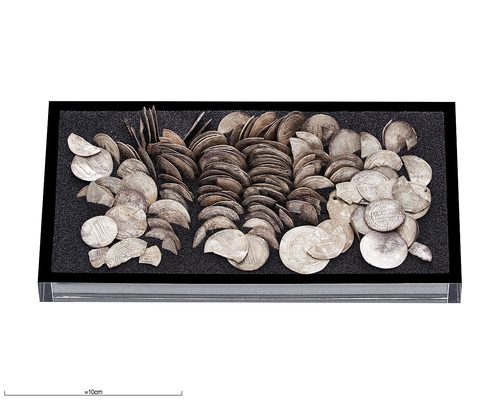
Burge Hoard
Over 10 kg of silver ploughed up at Burge on Gotland in 1967: about 3,000 coins, Russian grivna ingots and cut silver, buried soon after 1143.
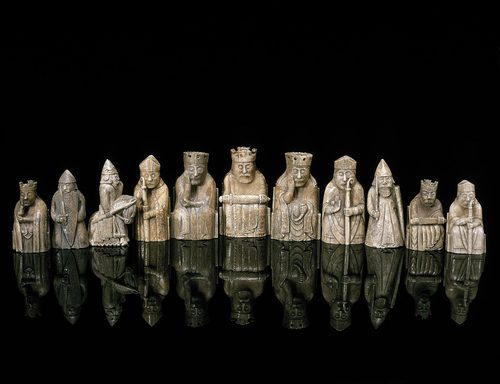
Lewis chessmen
93 walrus-ivory gaming pieces, mostly 12th-century chessmen probably carved in Norway, that came to light on the Isle of Lewis in 1831.
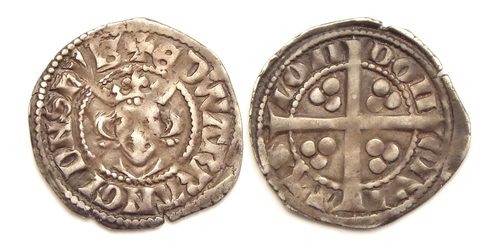
Tutbury Hoard
Perhaps 200,000 or more silver pennies dug from the River Dove in 1831, probably the war chest Thomas of Lancaster lost in his flight of March 1322.
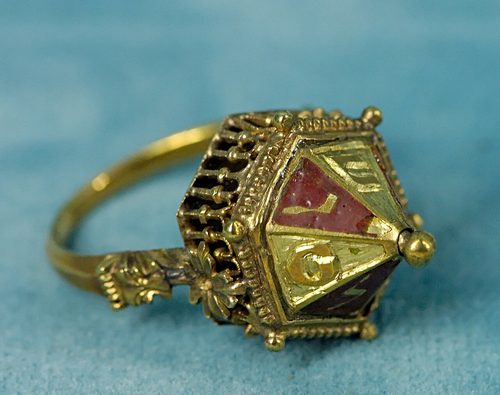
Colmar Treasure
Rings, brooches and some 300 coins hidden in a wall on Colmar's Jewish street in 1348-49, when the town's Jews were killed in the Black Death persecutions.
Erfurt Treasure
Nearly 28 kg of silver coins, ingots, tableware and jewellery hidden by a Jewish household before the Erfurt massacre of March 1349, found in 1998.
Środa Treasure
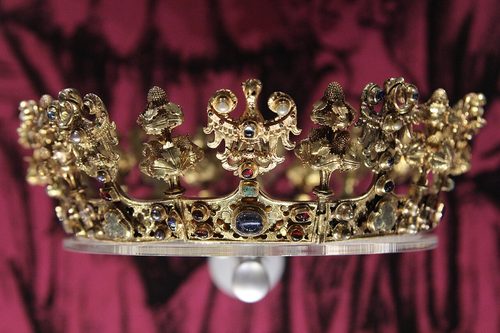
A royal crown, a Staufer cameo brooch and nearly 8,000 coins, pledged to a Jewish banker in 1348 and found in Środa Śląska in 1985 and 1988.
Dune Treasure
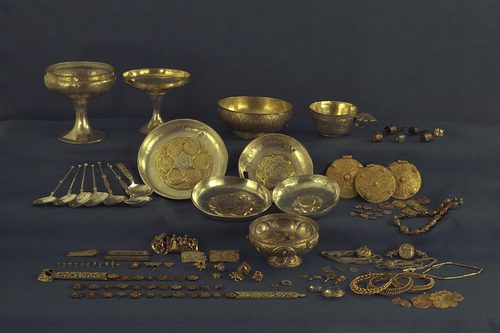
122 gold and silver bowls, spoons, chains and belt fittings hidden on a Gotland farm in the 1360s or 1370s, perhaps in 1361; found in 1881.
Fishpool Hoard
1,237 gold coins, rings, love jewels and chains hidden in Sherwood Forest in 1463-64: the largest medieval coin hoard found in Britain.